Families
BeginnerThe Family Fika: A Simple Ritual for Slowing Down Together
A family fika is a few minutes when people stop what they are doing and make room for conversation, listening, or simply being together. What it can look like, and why it doesn't need to be elaborate.
- Reading time
- 5 min
- Words
- ~1,100
- Sections
- 8
- Published
- September 27, 2026
- Updated
- September 27, 2026
Key Takeaways
- A family fika can be as short as five minutes and needs no special food, drink, or setting.
- The ritual matters more than what is served — including nothing at all.
- Nobody has to talk. Listening, drawing, sitting nearby, or passing all count.
- Connection is an invitation, never an obligation.
Series
Families1 of 3 · ~13 min total
- The Family Fika: A Simple Ritual for Slowing Down Together
- Beyond “How Was Your Day?”: Conversation Starters for Family Fika
- Small Family Rituals: Making Room for Everyday Connection
A Few Minutes, Together
Most households are busy in a particular way. People are home at the same time, but not quite together — one person is cooking, another is finishing homework, someone is on a phone, someone else is already thinking about tomorrow. Nobody has done anything wrong. It is simply how days go.
A family fika is one small way to interrupt that pattern now and then. It is a few minutes when people stop what they are doing, gather if they want to, and make room for conversation, listening, quiet company, or simply being in the same place at the same time. That is all it needs to be.
It does not need a set table, a baked good, a plan, or a purpose. It does not need to be daily. It does not need to go well. It only needs to happen, occasionally, in a way that feels natural for the people involved.
Fika as Inspiration, Not a Rulebook
Fika is a Swedish word for a pause, usually with coffee and often with something small to eat, taken with other people or alone. It is an ordinary part of Swedish life at work and at home. If you would like the fuller picture, the guide to fika at home covers how the practice fits into household life.
The Family Fika described here borrows from that spirit. It is not a traditional Swedish parenting practice, and it is not a framework Swedish families follow. It is a contemporary idea inspired by fika: the notion that a short, deliberate pause, shared with people you care about, is worth making room for.
What Goes on the Table
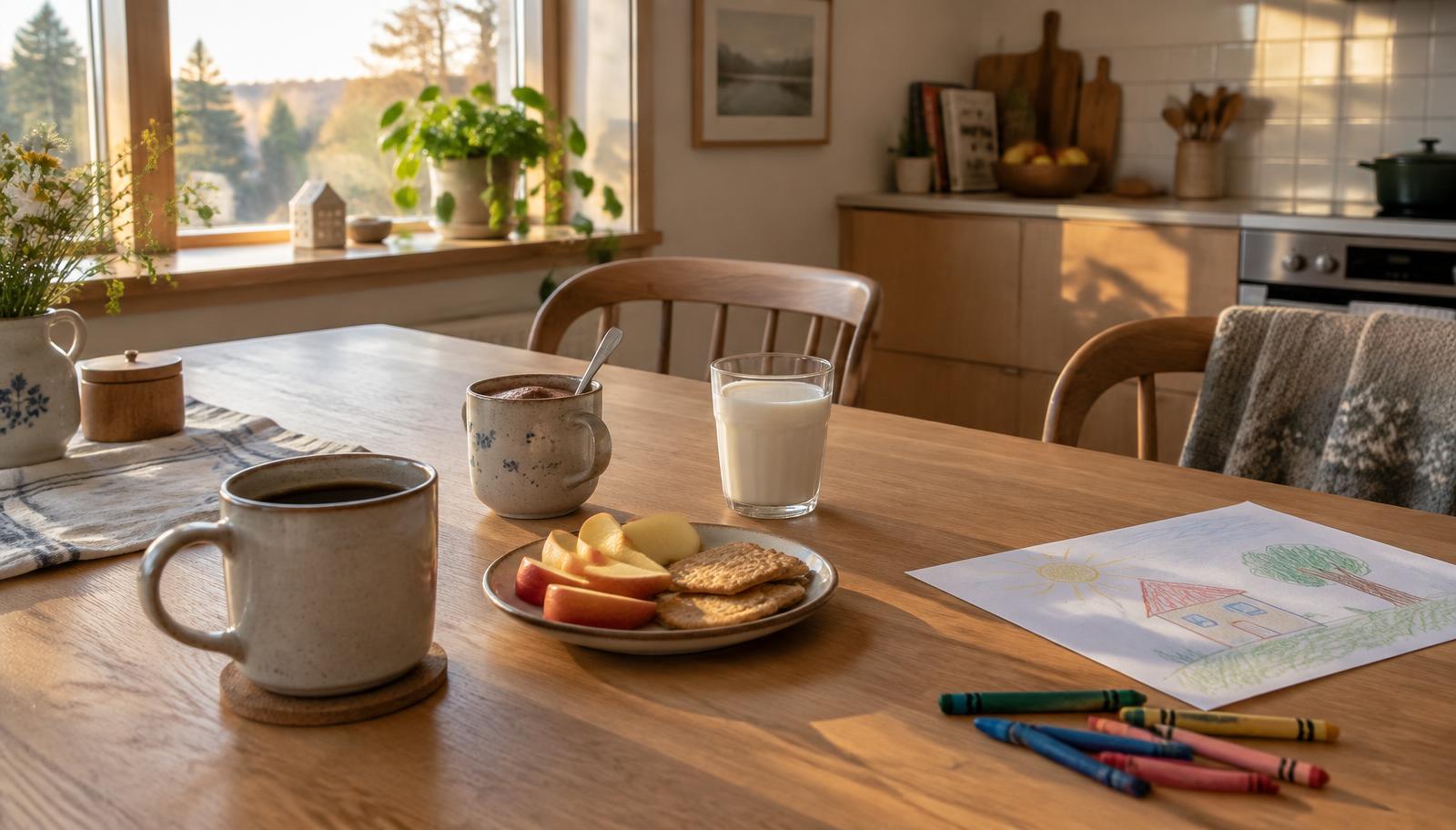
In Sweden, fika is closely associated with coffee. At a family fika, coffee might be what an adult drinks, but children have plenty of other options. Some families reach for cocoa, milk, water, or tea. Others put out fruit, crackers, or a small treat. Some serve nothing at all.
Any of these is fine. What is on the table is only there to give people a reason to sit down for a moment. The ritual matters more than what is served, and a pause with a glass of water is every bit as much a family fika as one with warm cinnamon buns.
A Simple Structure
Structure can help a new habit feel less awkward, as long as it stays loose. If it is useful, a family fika can follow a gentle shape:
Pause → Settle in → Something to sip or snack on, if desired → One invitation to conversation → Listen → Continue with the day
Pause. Someone suggests stopping for a few minutes. Screens go down if that's easy; tasks can wait.
Settle in. People find a spot — at the table, on the couch, on the back step. Nobody needs to sit in a particular place.
Something to sip or snack on, if desired. A drink or a bite, or nothing.
One invitation to conversation. A single, easy question or observation. One, not a list. If you want ideas, see conversation starters for family fika.
Listen. Whatever comes back — a long story, one word, a shrug — is received without pressure for more.
Continue with the day. The pause ends. Nothing needs to be concluded or summarized.
Everyone Can Join Their Own Way
A family fika does not require everyone to talk. That is worth saying plainly, because the idea of a "family conversation" can quietly turn into an expectation that each person has something to share.
People join in different ways. Someone may talk. Someone may listen. A child may draw while others chat. A teenager may sit nearby without joining in. Someone may help prepare something, answer briefly, or simply enjoy the quiet company. Anyone may pass. All of these are part of the fika.
“Connection is an invitation, never an obligation.”
Nobody has to share private thoughts, make eye contact, perform enthusiasm, or become more talkative than they are. A family fika offers a setting for connection; it does not ask anyone to prove it.
Practical Versions
There is no single correct form. A few versions that tend to fit ordinary family life:
5-Minute Family Fika
The smallest version. A glass of milk and a piece of fruit after school, or a cup of tea while dinner finishes cooking. Five minutes is enough to count.
15-Minute Family Fika
A little more room — perhaps on a slower weekday evening. Time for a snack, one question, and whatever conversation follows, or doesn't.
Weekend Fika
Weekends sometimes allow for a longer, unhurried pause: a late breakfast, a walk to a bakery, an afternoon cocoa after being outside. Still no agenda.
Parent + Child Fika
One adult and one child, sharing a few minutes. In busy households, a pause with just two people can feel quite different from a whole-family gathering, and can be easier to fit in.
Grandparent + Grandchild Fika
Fika-inspired pauses can suit time across generations particularly well: a snack at a grandparent's kitchen table, a cup of tea together, a card game on the side. Nothing needs to be asked or explained.
Whole-Family Fika
Everyone in the household, gathered in the same place for a few minutes. Lovely when it happens, and not the only version that counts.
Keeping It Light
The easiest way to spoil a family fika is to make it into a project. If it becomes mandatory, scheduled to the minute, or treated as a test of how close a family is, it will start to feel like one more thing to get right.
Some fikas will be chatty and warm. Some will be quiet. Some will be interrupted by a spilled drink or a phone call. Some weeks it won't happen at all. None of this is failure. Ideas for keeping small rituals flexible are gathered in small family rituals.
A family fika is also not a tool for solving problems. It is not the moment to raise a difficult subject, review a report card, or discuss behavior. Those conversations have their place — this pause is simply for being together. And, as always, adults keep their ordinary responsibility for children's safety and wellbeing at every moment, fika or not.
Try This
Sometime in the coming week, choose one ordinary moment — after school, before dinner, a Saturday morning — and turn it into a small family fika. Put out something to sip or snack on if you like, offer one easy question, and see what happens.
There's no challenge here, no streak, and no pressure. If it feels good, you might do it again. If it doesn't happen, that's fine too.
Continue Your Fika Journey
Learning about fika is only the beginning. The real transformation happens when you practice it. Explore daily reflections, conversation prompts, kindness challenges, and meaningful connection activities inside Fika Pause.
Keep going
Continue Learning
Recommended Series
You May Also Like
Families
Beyond “How Was Your Day?”: Conversation Starters for Family Fika
Specific, playful, and choice-based questions that give children and adults an easier place to begin — without interrogating anyone or asking for personal disclosure.
Families
Small Family Rituals: Making Room for Everyday Connection
Meaningful shared routines don't need to be elaborate, expensive, or picture-perfect. How to notice, shape, and keep small family rituals flexible — including fika with grandparents.
Understanding Fika
Fika at Home: How Fika Fits Into Everyday Household Life
What fika can look like inside an ordinary home — coffee or tea, simple food or none, company or quiet, planned or spontaneous — without hosting, baking, or a beautiful kitchen.
Newest Guides
Families
Small Family Rituals: Making Room for Everyday Connection
Meaningful shared routines don't need to be elaborate, expensive, or picture-perfect. How to notice, shape, and keep small family rituals flexible — including fika with grandparents.
Families
Beyond “How Was Your Day?”: Conversation Starters for Family Fika
Specific, playful, and choice-based questions that give children and adults an easier place to begin — without interrogating anyone or asking for personal disclosure.
Popular Guides
Understanding Fika
What Is Fika? The Swedish Tradition That Can Improve Your Relationships
Discover the meaning of fika, the Swedish tradition of slowing down to connect over coffee, conversation, and community—and how to practice it every day.
Understanding Fika
The Meaning of Fika: More Than Coffee, More Than a Break
Discover the true meaning of fika and why this Swedish tradition is about slowing down, building relationships, and creating meaningful moments together.
Understanding Fika
How to Practice Fika Every Day: A Simple Guide
Learn how to practice fika every day with simple ideas for home, work, school, and community. Discover how small daily pauses create stronger relationships.