Understanding Fika
BeginnerFika at Home: How Fika Fits Into Everyday Household Life
What fika can look like inside an ordinary home — coffee or tea, simple food or none, company or quiet, planned or spontaneous — without hosting, baking, or a beautiful kitchen.
- Reading time
- 17 min
- Words
- ~4,180
- Sections
- 25
- Published
- September 2, 2026
- Updated
- September 2, 2026
Learning Goals
After reading this article you will:
- Describe what fika can look like inside ordinary household life, distinct from hosting and from general daily practice.
- Separate what Swedish cultural sources document about fika from contemporary adaptations Fika Pause suggests.
- State accurately how coffee, tea, and other drinks relate to fika without overclaiming in either direction.
- Distinguish everyday fika from the more formal kafferep tradition, including the seven-kinds-of-cookies custom.
- Handle the question of solitary fika with the nuance the evidence actually supports.
- Recognise that participation inside a household is voluntary, that silence is not failure, and that a pause does not need to become a project.
Key Takeaways
- Fika at home is a pause in ordinary household life, not a performance of fika. It requires no hosting, no baking, and no particular kind of kitchen.
- Swedish sources describe fika as a break, usually shared, usually with coffee — or another drink — and often with something small to eat. The home has long been one of its ordinary settings.
- Coffee is culturally central to fika, but Swedish dictionary definitions also cover tea and other drinks, so the practice is not closed to people who do not drink coffee.
- Something to eat is common but not a requirement every time, and the food does not have to be homemade or specially prepared.
- The seven-kinds-of-cookies custom belongs to the more formal kafferep tradition, not to ordinary everyday fika. Treating it as the standard makes home fika look far more elaborate than it is.
- A shared pause does not require continuous conversation. Sitting quietly together is not a failed fika.
- Home is a first place, not a third place. Fika happens in cafés, at work, outdoors, and at home — the setting does not define it.
- Nobody in a household is obliged to join. Joining, leaving, staying quiet, and declining all have to remain available.
- If preparing for the pause becomes more work than the pause itself, it can be simplified. That is Fika Pause guidance, not a Swedish rule.
Fika Doesn't Need a Café
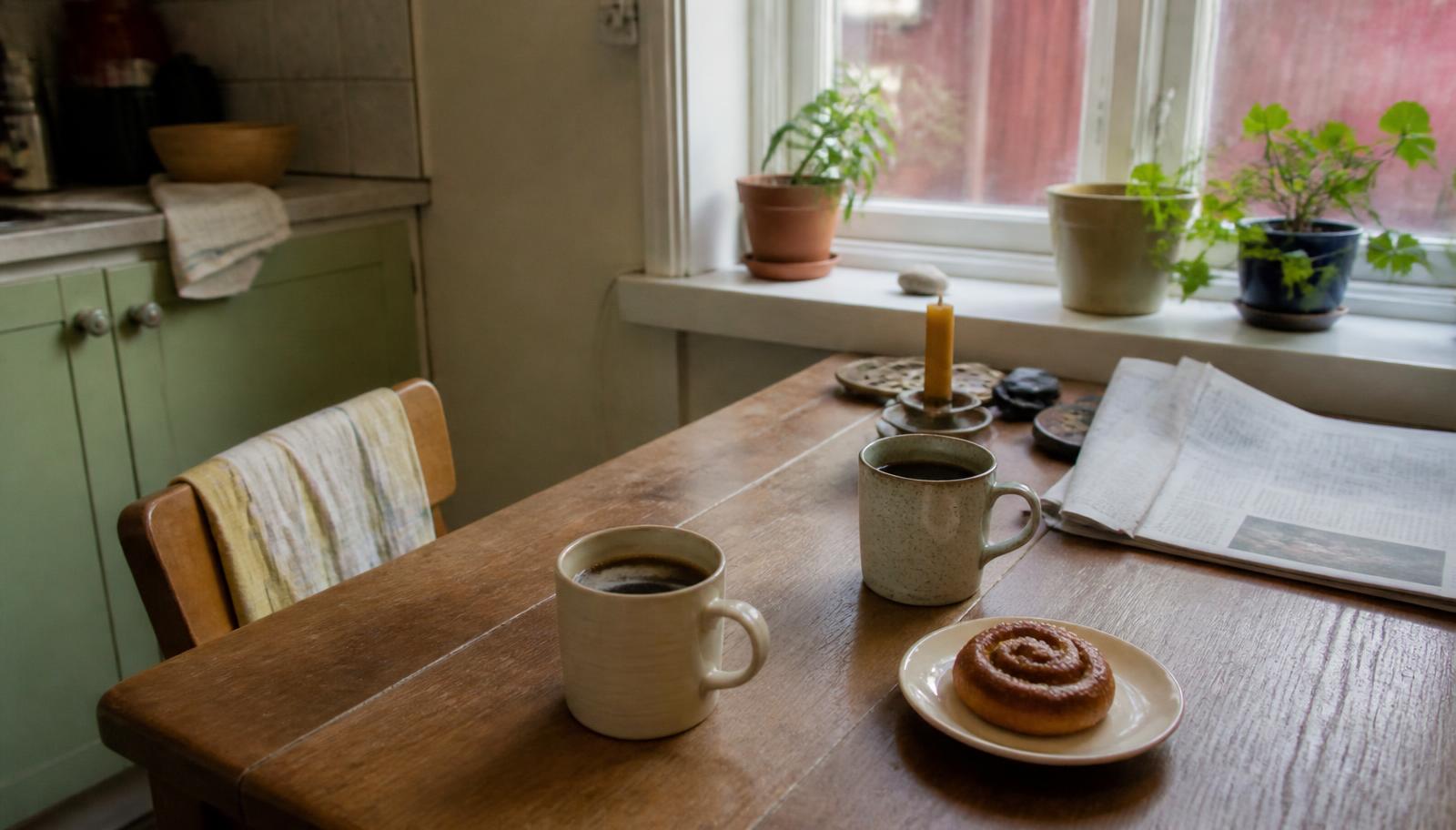
Most images of fika are set somewhere public. A café table, a tray of buns, a workplace break room, a paper cup on a bench. Those settings are real, and they are photogenic, which is largely why they became the images. But a great deal of fika happens in the least photographed place of all: someone's kitchen, on an ordinary day, with whatever is in the cupboard.
This article is about that setting. Not the café version, not the workplace version, and not the version where guests are coming. Home fika — what the practice can look like inside ordinary household life, on a weekday morning or a slow Sunday, alone or with the people you live with.
There is one idea running underneath everything below, and it is worth stating plainly before the details start.
“Fika at home is not a performance of fika. It is a pause in ordinary life.”
Everything in this article follows from that. The home does not need to become a hosting space, a photo set, or a project for fika to belong there.
What Is Fika at Home?
Sweden's national inventory of living heritage, maintained by the Institute for Language and Folklore, describes fika as most often associated with taking a break — from work, for instance — together with one or more others, in order to spend time together, talk, drink coffee or another drink, and eat something alongside it. It also notes how much weight Swedish fika culture puts on the accompaniments: cinnamon buns, sponge cake, prinsesstårta, punsch-rolls, chocolate balls, various biscuits.
Read that description carefully and notice what is missing. There is no venue. There is no host. There is no menu requirement, no minimum duration, and no aesthetic. The elements are a break, usually some company, a drink, and often something to eat. All four of those are available in an ordinary home without anyone doing anything special.
So home fika is not a variant that needs its own permission. It is one of the settings the practice already lives in. If you want the fuller definition and history of the practice itself, that belongs to what is fika and the history of fika in Sweden. This article assumes them and moves into the house.
Fika Has Always Had a Home Life
Coffee drinking in Swedish homes long predates the word fika, which Swedish dictionaries date to around 1910 and describe as a playful reversal of the syllables in kaffi. Domestic coffee hospitality is older than the term. Swedish popular history traces recurring home coffee gatherings — the kafferep — from eighteenth-century upper-class women meeting in each other's homes over coffee and baked goods, through a later spread across social classes, into a fixture of household social life whose real function was the gathering rather than the refreshments.
Two things follow, and they pull in different directions, which is why both are worth saying. First, the home is not a modern afterthought in Swedish coffee culture; it is one of its original settings. Second, the specific historical form — the arranged gathering with its own etiquette and its tray of baking — is not the same thing as somebody having coffee at their own kitchen table on a Tuesday.
Throughout this article you will see that distinction kept visible: what Swedish cultural sources document, and how Fika Pause suggests someone might adapt the practice. They are not the same kind of statement and should not be blurred together.
What Do You Actually Need?
The short answer is a drink and a moment when you are not doing the previous thing.
The slightly longer answer, as a list of elements rather than requirements:
- Something to drink — most often coffee, frequently tea, sometimes something else.
- A stop. Some separation from whatever came before and whatever comes after. This is the part that does the most work.
- Perhaps something small to eat.
- Perhaps another person.
- Somewhere to be while it happens, which can be almost anywhere.
What you do not need: special cups, Swedish coffee, pastries, candles, a tablecloth, matching dishes, Scandinavian décor, cinnamon buns, or seven kinds of cookies.
There is a limit to how far this can be loosened, and it is worth being honest about it. Framing fika around the pause does not mean that every sip of water, every snack eaten standing up, or every idle minute becomes fika. The practice has a recognisable shape — a break, a drink, usually company, often something to eat — and it carries cultural meaning that a generic pause does not. Keeping that shape is what stops the word from dissolving into nothing.
Coffee, Tea, and the Drink Question
Coffee is central to fika in a way that is not really debatable. The word derives from kaffe. Swedish descriptions of the practice put coffee first. Sweden's coffee consumption is part of how the country describes itself.
And yet the standard Swedish dictionary entry for fika is broader than coffee alone: the noun refers to coffee, sometimes with something to eat, and is also used of tea, chocolate, or squash, and of a coffee break generally; the verb is glossed as drinking coffee or tea, possibly with something alongside. That is a lexicographic record of ordinary usage, not a modern liberalisation.
So the accurate formulation is something like this: coffee is historically and culturally central to fika, and the practice is not limited to people who drink coffee. A household where one person has coffee, another has tea, and a child has something else is not producing a compromised fika. It is producing a normal one.
This article stops there. It is not a beverage history.
From the makers of Fika Spice™
An easy addition to a home fika
Fika Spice™ is The Spice for Coffee™ — nine real spices in one blend, made for the cup you're already pouring. The Fika Discovery Set™ includes one full-size bottle each of Original and Maple Sugar Fika Spice™.
Try the Fika Discovery Set™Does Fika Need Food?
Something to eat is a genuine feature of fika rather than a decoration. The living-heritage description of fika culture explicitly emphasises the accompaniments, and the named examples — kanelbullar, sponge cake, prinsesstårta, punsch-rolls, chokladbollar, assorted biscuits — are specific enough to show that this is a real part of the practice and not an optional garnish someone invented for tourists.
But a feature of a practice is not a test that each instance must pass. Nothing in these sources suggests that a coffee taken without a bun has failed to be a fika, and nothing in them prescribes what the food should be on a given afternoon. Everyday household fika sits at the plain end of the range: bread, fruit, a biscuit, whatever is around, or nothing.
Fika Pause is not going to turn this into a recipe roundup. The traditions and expectations around fika food are covered in fika etiquette and traditions, which is the owner page for cultural norms of that kind.
Everyday Fika vs. the Seven-Kinds-of-Cookies Tradition
The most persistent misreading of fika in English-language writing is the assumption that it is inherently elaborate — and the seven-kinds-of-cookies custom is usually the reason.
Sju sorters kakor is a documented Swedish tradition attached to the kafferep: the host sets out seven different sorts of small baked goods, with a social convention that fewer would look inadequate and more would look like showing off. Swedish ethnological work on the custom situates it in the early twentieth century, bound up with the domestic ideals expected of a housewife of that period, and treats it as a ritual of the arranged gathering.
That is exactly why it is useful here — as a contrast rather than a model. The seven-cookie tray belongs to formal domestic coffee hospitality with its own expectations and its own historical moment. Ordinary everyday fika is a different thing at a different scale. Reading the first as the standard for the second is what makes home fika look unnecessarily demanding to people encountering it from outside Sweden.
If you want to bake seven kinds of anything, that is a pleasure in its own right. It is not the price of admission to a Wednesday afternoon coffee.
Can You Fika Alone?
This question deserves care, because it is where a company with a philosophy about pauses could easily rewrite someone else's culture to suit itself. So here is the evidence, and then the wording Fika Pause has settled on.
On one hand, Swedish cultural descriptions present fika primarily as a social institution. The living-heritage entry describes it as taking a break together with one or more others. Cultural analyses of fika likewise emphasise company — friends, family, acquaintances, colleagues. The social dimension is not incidental to how the practice is described.
On the other hand, ordinary Swedish usage plainly includes taking a fika on your own. Standard dictionary definitions of both the noun and the verb turn on the drink and the break, with company mentioned as a possibility rather than built into the definition. People say they are going to ta en fika without implying anyone else is coming.
The honest reading holds both. Fika is strongly associated with shared pauses, and a solitary pause with coffee is also an ordinary use of the word. What Fika Pause will not do is claim that every solitary cup of coffee, anywhere, automatically constitutes traditional Swedish fika. Stopping to have a coffee on your own at home is a real and unremarkable thing; whether you call it fika is a matter of usage, not a test you can fail.
If the broader question behind this one is whether a person needs more social contact than they currently have, that belongs to connection without more socializing, not here.
Fika With a Partner or Spouse
Among people who live together, this is probably the most common home fika there is, and it is almost always unremarkable: coffee before the day begins, ten minutes at the kitchen table, sitting down together after dinner, a weekend afternoon that slows for a while, coffee taken outside because the weather allowed it.
Sometimes there is a real conversation. Sometimes there is a practical one about the week. Sometimes almost nothing is said and that is fine.
Fika Pause makes no claims about what this does for a relationship. It does not strengthen marriages, improve communication, create intimacy, or reduce conflict — or at least, nothing in the cultural or research literature supports saying so, and this is not relationship advice. The setting provides an occasion. What happens in it belongs to the people involved.
Fika With Family
A household fika with several people in it usually looks less coordinated than the phrase suggests. Different drinks. Something simple to eat, or nothing. People arriving at different points and leaving at different points. Someone standing at the counter rather than sitting.
That is not a degraded version of a proper fika. Cultural descriptions of fika include family among the ordinary company it happens in, and family life is not tidy. A pause that accommodates who is actually in the house is more durable than one that requires everyone to assemble.
Fika With Children
Children are frequently part of household fika, and the practical version is simple: a child-appropriate drink, whatever simple food is around — fruit, bread, a biscuit, a small treat — and sitting together for a while.
Several things Fika Pause deliberately will not say about this. It will not make claims about child development, family bonding, emotional regulation, nutrition, or health. It will not prescribe what children should eat or drink. It certainly will not suggest children need coffee. And it will not suggest requiring a child to sit still, to talk, or to stay for a set length of time.
Participation stays optional and age-appropriate. A child who joins for two minutes and leaves has participated.
Across Generations
A fika can be shared by grandparents and grandchildren, parents and adult children, siblings, and relatives who see each other occasionally. Part of what makes it workable across ages is how little it asks: a familiar drink, somewhere to sit, no entertainment to arrange, no activity anyone has to be good at.
That is the whole claim. A shared pause does not resolve generational differences, repair family history, or substitute for conversations people are not having. It is a form that several ages can occupy at once without much effort.
When Someone Stops By
Putting coffee on when someone arrives is one of the most recognisable forms of ordinary home hospitality there is, and it is a genuinely small gesture: a drink, whatever is in the cupboard, a place to sit.
This section owns unceremonious welcome, and only that. Deliberate hosting — inviting people, planning what to put out, thinking about how a gathering will go — belongs to how to host a fika. The boundary matters because collapsing the two turns every visitor into an event.
Nor does Fika Pause suggest that a household should be perpetually ready to serve anyone who arrives. Having nothing in the house is not a failure of hospitality, and unexpected visitors do not create an obligation. If the wider question is why welcome matters at all, hospitality and human connection is the owner page for it.
Quiet Fika
A shared fika does not require continuous conversation. People sit quietly, read, look out of the window, eat, drink, exchange a few sentences, or talk steadily for half an hour. All of these happen; this article is not claiming they are equally traditional, only that silence is not a malfunction.
That is the editorial boundary worth stating outright: silence does not make a shared pause a failure. The full case for quiet company, and for the fact that connection is not measured in social volume, is made in connection without more socializing, which owns that ground.
Home Is Not a Third Place — And Fika Doesn't Need One
In Ray Oldenburg's terms, home is the first place and work is the second. A café may, under some conditions, function as a third place — an informal setting apart from both.
Fika happens in all of them. At home, at work, in cafés, outdoors. Which means fika is not defined by the third place, and someone whose life includes no café-like setting at all is not thereby excluded from the practice. The concept itself, with the conditions Oldenburg actually specified, belongs to what is a third place.
Fika Does Not Require a Perfect Home
This next point is a Fika Pause observation about contemporary lifestyle presentation, not a claim about Swedish culture. Swedish homes are not culturally opposed to candles, ceramics, or a tidy table — several of those are genuinely enjoyed. The problem is what happens when images of fika travel and start functioning as a standard.
A fika at home does not require a clean kitchen, expensive furniture, Nordic design, neutral colours, candles, curated ceramics, baked-from-scratch food, flowers, matching cups, an uncluttered table, or anything worth photographing. It can happen at a crowded kitchen table, in a small apartment, in a shared house or dorm, on a couch, on a porch, in a backyard, at a kitchen counter with the dishes still in the sink, or in a place someone is living temporarily.
The home does not have to perform an aesthetic in order to be a place where people pause. Whether the misconceptions that grow out of these images are worth unpicking further is handled in common misconceptions about fika.
Store-Bought, Leftovers, and Keeping It Simple
Nothing in the practice requires baking. Bought buns, biscuits, bread, or fruit accompany a fika without qualification, and Fika Pause takes no position on homemade versus shop-bought, healthy versus indulgent, or traditional versus modern. Preparation effort is not what determines whether a pause was worth taking.
The same goes for food that was not prepared for this particular occasion. Yesterday's cake, a packet already open in the cupboard, bread, fruit — whatever is ordinarily available may be enough. To be clear about the status of that statement: it is Fika Pause guidance for keeping home practice simple, not a documented Swedish rule about what may be served.
How Long Does Fika Take?
There is no documented standard length, and no minimum. Swedish descriptions of fika turn on the break and the company, not on a stopwatch. In practice a home fika may run a few minutes or a long afternoon depending on the day.
Fika Pause is not going to invent a five-minute fika, a ten-minute fika, and a twenty-minute fika as though they were cultural categories. Short pauses are a reasonable contemporary adaptation for busy households, and that is exactly how they should be labelled — an adaptation, not a tradition.
Planned or Spontaneous?
Both occur. Some households have a habitual pause at roughly the same point in the day, most commonly in the afternoon, and some fikas start when someone asks whether anyone wants coffee. A weekend fika may be looser and longer than a weekday one. A visitor arriving produces one on the spot.
None of these is the correct version, and this article is not about habit formation. For guidance on fitting the practice into daily life across settings — not just at home — how to practice fika every day is the owner page.
Fika Is Not Another Task
A practice meant to be a pause can quietly become another item on a list. It usually happens through good intentions: buying the right things, remembering to do it daily, getting everyone to the table, establishing a tradition, making the moment meaningful, photographing it.
A useful Fika Pause principle — again, editorial guidance rather than a historical Swedish rule:
“If preparing for the pause creates more work than the pause itself requires, simplify it.”
There is nothing to do correctly here. No streak to maintain, no baking to schedule, no family member to recruit, and no need to make the occasion mean something. A pause that needs managing is not doing its job.
When Someone Doesn't Want to Join
Nobody in a household is required to participate in anything, and this matters more at home than anywhere else, because home is where the pressure to participate is hardest to escape.
So: no convincing, no persuading, no household rule, no requiring children to sit, no getting a partner to talk, and no using a shared pause as a device for prompting a conversation someone has not agreed to have.
A household pause stays voluntary only if all of the following remain true:
- Joining is optional.
- Leaving early is acceptable.
- Sitting there in silence is acceptable.
- Declining outright is acceptable, without needing a reason.
Connection is an invitation, never an obligation — including, and especially, among the people you live with.
A Few Ordinary Examples
Not a checklist. Just recognisable shapes a home fika can take, with no outcomes attached and no recommended frequency.
- A weekday morning. Coffee or tea at the kitchen table before the day moves on.
- A quiet afternoon. A drink and something already in the cupboard.
- Two people. Ten or twenty minutes together without needing an agenda.
- A family pause. Different drinks, a simple snack, whoever wants to join.
- A weekend. A longer pause with something baked or bought.
- A visitor. Coffee or tea and whatever is available.
- Outside at home. A porch, a balcony, a step, a yard, a garden.
- On your own. A stop with a drink and no company — an ordinary pause, with the usage caveat above.
What Home Fika Is Not
It can overlap with plenty of things without being defined by any of them. Home fika is not necessarily a dinner party, entertaining, a formal coffee service, a recipe project, a family meeting, a relationship exercise, a wellness intervention, a productivity break, a mindfulness exercise, a digital detox, an exercise in Scandinavian interior design, or content for social media.
On screens specifically: Fika Pause has no rule about phones. There is no credible cultural basis for declaring devices forbidden during fika, and turning a pause into a digital-detox regime would be inventing a tradition. A household can decide for itself what it wants the pause to be like. That is not a decision this article gets to make.
And one boundary worth keeping clear: fika is not simply the presence of coffee. Drinking coffee while working through email is drinking coffee. The distinction between the two, with its history and its nuances, belongs to fika vs. coffee break. Similarly, how the practice travels and changes outside Sweden is covered in fika around the world.
Knowledge Check
Frequently Asked Questions
- What is fika at home?
- Fika at home is simply a fika that happens in a household rather than in a café or at work: a pause, usually with coffee or another drink, often with something small to eat, sometimes with other people in the house and sometimes not. Sweden's living-heritage inventory describes fika as a break taken with one or more others, with a drink and something to eat alongside it — nothing in that description requires a venue, a guest list, or preparation.
- How do you have fika at home?
- Make or pour something to drink, stop what you were doing, sit down somewhere you can sit — the kitchen table, the couch, a step outside — and let the pause be the point. If someone else in the house wants to join, they join. Anything beyond that is optional.
- What do you need for fika?
- Something to drink and a moment when you are not doing the previous thing. Everything else — food, company, a table, a particular time, matching cups — is common but not required. If you find yourself preparing for a pause more than pausing, that is a sign to simplify.
- Does fika have to include coffee?
- Coffee is culturally central to fika, and the word itself comes from a syllable-swapped form of the Swedish word for coffee. But Swedish dictionary definitions of fika also cover tea, chocolate, and squash, so non-coffee drinks are inside the recorded meaning rather than a workaround. The practice is not closed to people who do not drink coffee.
- Can you drink tea during fika?
- Yes. Tea appears in standard Swedish definitions of the word alongside coffee, and a household where one person drinks coffee and another drinks tea is not doing anything unusual.
- Does fika require food?
- Something to eat is a strong and well-documented feature of fika culture — Swedish sources put real weight on the accompaniments — but it is a characteristic of the practice rather than a test any individual pause has to pass. A cup of coffee at the kitchen table with nothing beside it is still a pause.
- What foods are traditionally served at fika?
- Swedish sources commonly name cinnamon buns, sponge cake, prinsesstårta, punsch-rolls, chocolate balls, and assorted biscuits, along with simple sandwiches in some settings. The deeper customs around them belong to the article on fika etiquette and traditions.
- Do you need cinnamon buns for fika?
- No. Kanelbullar are the most recognisable fika baking there is, and they are one option rather than an entry requirement. Plenty of home fika involves whatever is already in the cupboard.
- What are seven kinds of cookies?
- Sju sorters kakor — seven kinds of cookies — is a Swedish custom associated with the kafferep, a more formal home coffee gathering, in which the host puts out seven different sorts of small baked goods. It is a tradition of domestic coffee hospitality with its own expectations, not a description of ordinary weekday fika.
- Can fika be simple?
- Yes, and most of it is. The elaborate versions are the memorable ones, which is why they dominate photographs, but an ordinary fika is closer to a mug and ten minutes than to a laid table.
- Can fika food be store-bought?
- Nothing in the practice requires baking. Bought buns, biscuits, bread, or fruit accompany fika perfectly well, and Fika Pause takes no position on homemade versus shop-bought — effort of preparation is not what makes a pause worth taking.
- Can you fika alone?
- The honest answer has two halves. Swedish sources describe fika primarily as a shared break, so a solitary coffee is not the same social institution as a fika with other people. At the same time, ordinary Swedish usage covers taking a fika on your own, and standard dictionary definitions of the word do not require company. So: yes, people do fika alone — while it is worth not assuming that every solitary cup of coffee anywhere is automatically traditional Swedish fika.
- Can children participate in fika?
- Children are often present at household fika, usually with a child-appropriate drink and whatever simple food is around. Fika Pause makes no claims about what this does for children and suggests nothing about requiring them to sit, stay, or talk — participation should be as optional for them as for anyone else.
- How long does fika last?
- There is no documented standard length. It can be a few minutes or a long afternoon depending on the day and the setting. Short pauses are a reasonable adaptation, but they are not established cultural categories, and Fika Pause does not recommend a minimum.
- Does fika have to happen at a certain time of day?
- No. Morning, mid-morning, afternoon, and evening pauses all occur, and afternoon fika is especially common in many households. Whether a household has a usual time is up to that household.
- Does fika have to be planned?
- It can be either. Some households have a habitual pause at roughly the same point in the day; other fikas begin with someone asking whether anyone wants coffee. Neither version is more correct.
- Can fika be quiet?
- Yes. Two people can share a pause largely in silence without anything having gone wrong. The broader case for quiet company is made in the article on connection without more socializing.
- Is fika at home different from hosting a fika?
- Yes, and the difference matters. Hosting means deliberately inviting and welcoming people, with all the preparation and attention that implies. Home fika is what happens in a household whether or not anyone is being hosted — your spouse sitting down does not turn you into a host. If you do want to invite people, the article on how to host a fika owns that.
- Is every coffee break at home fika?
- Not automatically. Fika carries social and cultural meaning that goes beyond drinking coffee, which is why the comparison has its own article on fika versus the coffee break. Drinking coffee while answering email at your desk is a coffee; stopping to have it is closer to a fika.
Sources & Further Reading
Organization
Fika — Levande kulturarv (Sweden's inventory of living heritage)
Institutet för språk och folkminnen (Isof), the Swedish Institute for Language and Folklore
The primary cultural source for this article's definition. The national living-heritage inventory describes fika as most often associated with taking a break — for example from work — together with one or more others, socialising, talking, drinking coffee or another drink, and eating something alongside it, and notes the weight Swedish fika culture places on the accompaniments (cinnamon buns, sponge cake, prinsesstårta, punsch-rolls, chokladbollar, assorted biscuits). Used for: fika as a shared break, coffee's centrality with other drinks admitted, and food as a characteristic rather than a rule.
Research
Svensk ordbok (Swedish Dictionary), 2009 edition, entry for 'fika'
Svenska Akademien; consulted via Språkbanken Text, University of Gothenburg
Used for the lexical facts stated here: the noun refers to coffee, sometimes with something to eat, and is also used of tea, chocolate, or squash, and of a coffee break; the verb is glossed as drinking coffee or tea, possibly with something to eat; and the word is attested from 1910 as a syllable-reversal of 'kaffi'. This is the basis for saying that non-coffee drinks are inside the recorded meaning rather than a modern exception, and that the word's ordinary sense is broader than any single ritual.
Research
Sju sorters kakor: Vardagsritual och husmodersideal i kafferep, tidigt 1900-tal
Elin Johansson, bachelor's thesis in ethnology, Department of Ethnology, History of Religions and Gender Studies, Stockholm University, 2024
An ethnology thesis on the kafferep and the seven-kinds-of-cookies custom as an early-twentieth-century domestic ritual bound up with ideals of the housewife. Cited for one point only: that the seven-cookie convention belongs to a formalised home coffee gathering with its own social expectations, which is precisely why it should not be read as the standard for everyday fika. A student thesis is a secondary source and is presented as such.
Research
Kaffi–Fika: En vardagsföreteelse med kulturarvsstatus?
Student thesis, cultural analysis of Swedish fika culture, 2016 (DiVA)
Used only for its framing of fika as an everyday social institution — a pause taken from an activity or simply in the day, with a drink and often something sweet, in the company of friends, family, acquaintances, or colleagues. Referenced for the range of company involved, including family at home. A student thesis, weighted accordingly.
Article
Kafferepet – hånat nätverk för hemmafruar
Sara Griberg, Populär Historia, 10 March 2017
A Swedish popular-history magazine article on the kafferep as a recurring home coffee gathering with a real social function, describing its beginnings among upper-class women meeting in homes over coffee and baked goods in the eighteenth century and its later spread across social classes. Used for background on domestic coffee hospitality, not for any claim about present-day practice. Popular history rather than scholarship; treated as supporting context.
On Fika Pause
The owner page for the definition of fika itself. This article assumes it rather than repeating it.
On Fika Pause
How to Practice Fika Every Day
The owner page for fitting the practice into daily life across settings. This article covers one setting in detail: the home.
On Fika Pause
The owner page for deliberately inviting and welcoming people for fika. Home fika does not require hosting, which is why the two are separate.
On Fika Pause
The owner page for cultural norms, customs, and expectations around fika. Referenced here rather than duplicated.
On Fika Pause
Connection Without More Socializing
The owner page for quiet company, privacy, declining, and the absence of any social quota — all of which apply inside a household.
Continue Your Fika Journey
Learning about fika is only the beginning. The real transformation happens when you practice it. Explore daily reflections, conversation prompts, kindness challenges, and meaningful connection activities inside Fika Pause.
Keep going
Continue Learning
You May Also Like
Understanding Fika
How to Practice Fika Every Day: A Simple Guide
Learn how to practice fika every day with simple ideas for home, work, school, and community. Discover how small daily pauses create stronger relationships.
Understanding Fika
How to Host a Fika: A Simple Guide to Bringing People Together
Learn how to host a simple, meaningful fika with practical ideas for invitations, food, conversation, setting, and making guests feel welcome.
Understanding Fika
Fika Etiquette and Traditions: How to Show Up Well for a Swedish Pause
A gentle, evidence-informed guide to fika etiquette and traditions — how to accept an invitation, host respectfully, share the table, and honor the Swedish practice.
Newest Guides
Families
Small Family Rituals: Making Room for Everyday Connection
Meaningful shared routines don't need to be elaborate, expensive, or picture-perfect. How to notice, shape, and keep small family rituals flexible — including fika with grandparents.
Families
Beyond “How Was Your Day?”: Conversation Starters for Family Fika
Specific, playful, and choice-based questions that give children and adults an easier place to begin — without interrogating anyone or asking for personal disclosure.
Families
The Family Fika: A Simple Ritual for Slowing Down Together
A family fika is a few minutes when people stop what they are doing and make room for conversation, listening, or simply being together. What it can look like, and why it doesn't need to be elaborate.
Popular Guides
Understanding Fika
What Is Fika? The Swedish Tradition That Can Improve Your Relationships
Discover the meaning of fika, the Swedish tradition of slowing down to connect over coffee, conversation, and community—and how to practice it every day.
Understanding Fika
The Meaning of Fika: More Than Coffee, More Than a Break
Discover the true meaning of fika and why this Swedish tradition is about slowing down, building relationships, and creating meaningful moments together.
Understanding Fika
How to Practice Fika Every Day: A Simple Guide
Learn how to practice fika every day with simple ideas for home, work, school, and community. Discover how small daily pauses create stronger relationships.