Human Connection
BeginnerWhat Is a Third Place? Why the Places Between Home and Work Matter
A clear explanation of the third place: where the idea came from, what makes one, examples and non-examples, how access differs from person to person, and why familiarity in a place never has to become friendship.
- Reading time
- 17 min
- Words
- ~4,150
- Sections
- 20
- Published
- August 30, 2026
- Updated
- August 30, 2026
Learning Goals
After reading this article you will:
- Define a third place accurately: a recurring, informal setting outside home and work where people can spend time with relatively little obligation.
- Trace the idea to Ray Oldenburg's sociological framework — and understand it as a framework rather than a fixed scientific classification.
- Tell the difference between a building type and a social setting: why a café, library, or park is not automatically a third place.
- Separate the concept of a third place from the phrase “third space,” which carries other meanings in other fields.
- See why access to informal gathering places is uneven, and why that is a condition to notice rather than a personal failing.
- Understand that familiarity in a place does not require friendship, conversation, or becoming more social.
Key Takeaways
- A third place is a recurring, informal setting outside home and work where people can spend time with relatively little obligation.
- The term comes from sociologist Ray Oldenburg. It is a useful framework and cultural concept, not a scientific classification with fixed criteria.
- The building type does not decide it. A café where everyone is moved along quickly can function less like a third place than a plain counter where the same people linger.
- What matters most is whether people can return, stay, recognise one another, and take part at whatever depth suits them.
- Familiarity is not friendship. Being recognised, nodded to, or simply known by sight is a real form of social life on its own terms.
- Access to informal gathering places is uneven — cost, hours, transport, mobility, caregiving, and expectation all shape who can linger.
- Fika and third places are different concepts. A café can host a fika, but fika happens at home and at work too, and third places exist far from any coffee.
- Nobody needs a third place to have a meaningful life. It is one form of social infrastructure, not a prescription.
The Places Between Home and Work
Most descriptions of a life account for two settings. There is home, and there is work or school. Between them sits a third category that is harder to name and easy to overlook: the café where the same four people are always there before nine, the library reading room, the bench at the edge of the market, the barbershop where the conversation continues whether or not you join it, the community centre corridor where people stop to talk on their way somewhere else.
These places rarely feel significant while you are in them. Nothing is decided there. No one takes attendance. You can go for a year and never learn anybody's surname. And yet when one closes, people talk about it for a long time afterwards — not because they lost a service, but because they lost a setting where a certain kind of ordinary social life had been possible without anyone arranging it.
Sociology has a name for that category. This article is about what the name means, where it came from, what it does and does not explain, and why the value of such a place has very little to do with whether anyone there becomes your friend.
What Is a Third Place?
A third place is a recurring, informal social setting outside home and work where people can spend time with relatively little obligation.
Each part of that sentence is doing work. Recurring, because a place visited once is an outing, not a third place; the concept depends on return. Informal, because the interaction there is unscheduled and optional rather than programmed. Outside home and work, because the point is a setting where neither household roles nor professional ones fully apply. And relatively little obligation, because you can arrive without announcing yourself, stay as long as suits you, and leave without explaining — which is what makes returning easy.
“The value of a third place is not that everyone there becomes friends. It is that repeated presence makes ordinary recognition, familiarity, and conversation possible.”
That distinction matters more than any other in this article. A third place does not produce closeness, and it makes no promises about how a person will feel. What it can do is supply the one thing that most ordinary social life quietly depends on and that adult life rarely arranges on purpose: the same people, in the same place, more than once.
Where the Idea Came From
The term was popularised by the American urban sociologist Ray Oldenburg in his 1989 book The Great Good Place, subtitled with a list of the places he had in mind — cafés, coffee shops, bookstores, bars, hair salons, and other hangouts. Oldenburg's argument was that informal public gathering places do something distinct in social life, that American development patterns of the post-war decades had made them scarcer, and that their scarcity was worth taking seriously.
It is important to be accurate about what kind of claim this is. Oldenburg was writing sociology and cultural argument, drawing on observation, history, and comparison across countries. He was not reporting an experiment, and the third place is not a scientific classification with agreed thresholds. It is a framework — a way of noticing a category of setting that everyday language had no good word for.
Frameworks get extended and argued with, and this one has been. Urbanists, community researchers, and later scholars have applied it to settings Oldenburg did not discuss, questioned how universal his account of the ideal third place really is, pointed out that his examples reflect particular times and cultures, and asked whether places that felt wonderfully open to some regulars felt open to everyone else. Treating the concept as useful and contested at the same time is the honest position.
First Place, Second Place, Third Place
The numbering is simple. The first place is home: the domestic setting, with its household roles and its particular obligations. The second place is work — or school, for those whose days are organised that way — where a role, a schedule, and usually some form of evaluation apply. The third place is the informal public or semi-public setting outside both, where people may return and encounter one another without the structure that governs the first two.
The ordering is descriptive rather than hierarchical. It does not say home matters most or that anyone needs all three. It also fits some lives better than others: people who work from home collapse the first two settings into one; people without stable housing or conventional employment do not have the tidy pair the framework assumes; and some households function as gathering places for a whole extended network, doing much of what the third place is described as doing.
Keeping the categories loose is part of using them well. The value of the framework is that it makes a familiar but unnamed kind of place visible, not that every life can be sorted into three neat boxes.
What Makes a Third Place?
Oldenburg described a set of characteristics that his examples tended to share. Summarised plainly, and attributed to him rather than to research:
- Neutral ground. Nobody is host and nobody is guest. People can come and go as they please, and nobody bears the duties of hosting or the obligations of being hosted.
- A leveling quality. Status from outside carries less weight inside. Whatever people do for a living, the place treats them roughly alike, and membership is not by invitation.
- Conversation as a main activity. Talk is a characteristic activity of the place rather than a byproduct of some other purpose. That describes what typically happens there — not a requirement on anyone who walks in.
- Accessibility. Open at the hours people are actually free, close enough to reach, easy to enter without a plan.
- Regulars. A group of people who show up often enough to set the tone, and whose presence is part of what newcomers encounter.
- A plain character. Unpretentious, ordinary, sometimes shabby. Nothing about the place asks people to perform, dress up, or measure up.
- A light mood. Playful more than earnest. Wit and ease rather than intensity.
- A home away from home. A quality of ease and familiarity that resembles being at home without any of the domestic work.
The temptation is to turn that list into a scoring sheet. It works better as a description of what such places often have in common. Real places are mixed. A neighbourhood library is rarely playful and is often quiet by design; it may still be the most important informal gathering place for miles. A market stall has no seating at all and a conversation there lasts ninety seconds; over two years those ninety-second exchanges accumulate into something. A place does not need to score well on a checklist to matter socially.
The list also invites a question it does not answer on its own: accessible to whom? Neutral ground for whom? Levelling for whom? Those questions get their own section further down, because they are the point at which a romantic reading of third places usually breaks down.
Examples — And Why the Building Type Isn't Enough
The usual examples are easy to list: cafés and coffee shops, libraries, parks and public squares, community centres, markets, barbershops and hair salons, bookstores, diners, recreation centres, community gardens, allotments, launderettes, the common rooms of faith communities for the people who belong to them, and — where the culture supports it — pubs and taverns.
But the building type does not settle it. A café is not automatically a third place. A library is not automatically a third place. A park is not automatically a third place. What decides the matter is what recurring social life is actually possible in the space.
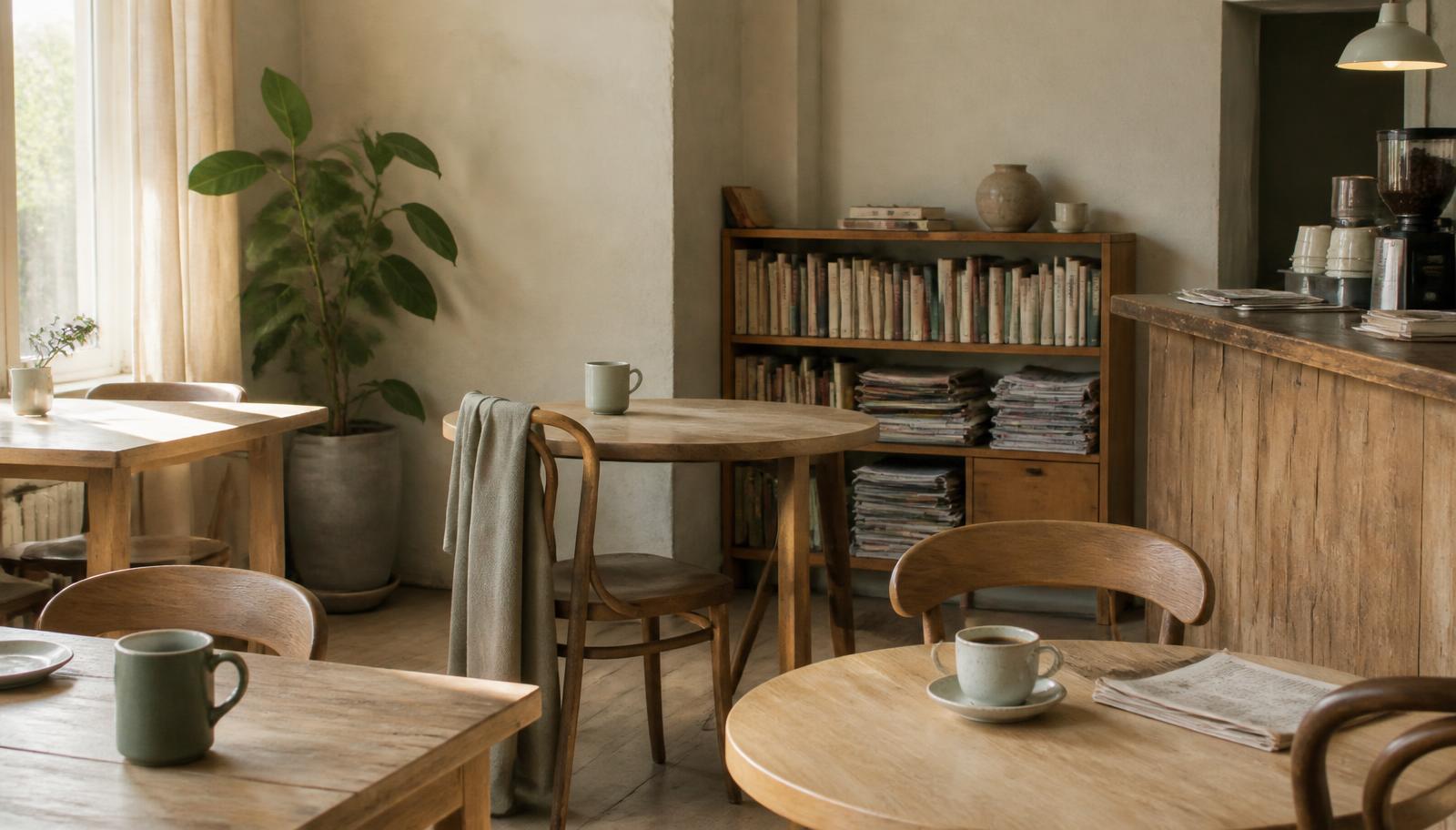
Consider two cafés on the same street. The first is beautifully designed, with a queue system, a twenty-minute table limit at busy hours, music loud enough to make talk effortful, and staff who rotate so often that nobody is recognised twice. The second is a plain counter with six stools, indifferent lighting, and the same handful of people every Tuesday morning, one of whom always sits at the end and rarely says more than good morning. The second is doing more third-place work than the first, whatever the first one's reviews say.
This is why the concept is about settings rather than architecture. Seating, shelter, hours, and permission to stay all matter — William Whyte's observational studies of small urban spaces found that where and how people could sit shaped whether they stayed at all, and Jan Gehl's public-life work makes the related point that necessary activities happen in any conditions while optional and social ones depend on the quality of the setting. But underneath the design question is a social one: can the same people return, and is anything allowed to develop between them if they do?
What a Third Place Is Not
Boundaries make the concept useful. A third place is not automatically:
- Any place outside home and work. A petrol station, a bank, and a dentist's waiting room are none of the three, but no recurring informal social life is possible in them.
- A destination you visit once. A famous café in another city can be a lovely afternoon and still be an outing. Return is structural, not incidental.
- A networking event. Purpose-built social occasions with an agenda, however friendly, are the opposite of the low-obligation, unscheduled quality being described.
- A mandatory social activity. If attendance is expected by an employer, an institution, or a group, the essential freedom to not show up is gone.
- A coworking office because it has coffee. Members are usually there to work, with all the role and obligation that entails. It may be a pleasant second place.
- A place where everyone knows everyone. Total familiarity can be its own barrier. A place a newcomer cannot enter unnoticed is not more of a third place; it is often less of one.
- A place where everyone becomes friends. Most people in most such places never become close, and the concept does not require it.
Regulars, Familiar Strangers, and Weak Ties
The people in a third place are usually not friends and not strangers either. They occupy the large middle category that everyday language handles badly: the man who reads the paper at the far table, the woman who arrives with a dog at four, the person behind the counter whose name you know and nothing else. Familiar faces attached to no relationship.
Sociology calls the looser end of this range weak ties. Mark Granovetter's 1973 paper The Strength of Weak Ties argued that low-intensity, infrequent connections are structurally different from close ones — they reach into circles your close ties do not, which is why they carried information, including news about jobs, in the group he studied. His evidence concerned information flow among professional and technical workers, and it is worth keeping the claim that size.
Researchers have since looked at the everyday experience of such interactions. In studies by Gillian Sandstrom and Elizabeth Dunn, participants reported greater happiness and feelings of belonging on days when they had more interactions with weak ties. Those were self-reported measures in particular samples, and they do not establish that acquiring acquaintances makes anyone healthier, happier, or less lonely over time. What the research supports is narrower and still interesting: interactions with people we barely know are not socially empty.
That is as far as this article goes on the subject. Weak ties deserve their own treatment, which they now have in why acquaintances matter. The point that belongs here is the simple one: a socially meaningful place does not require intimate relationships.
Recognition Without Friendship
Being a regular somewhere sounds like a social achievement. It usually is not. In practice it can mean any of these, and nothing more:
- recognising a face
- being recognised
- a nod, or a good morning
- sitting quietly among people you know by sight
- occasionally talking, when there is something to say
- joining in sometimes
- declining other times
- simply knowing the place is there
None of these require you to be sociable, and none of them are a lesser version of friendship. They are a different thing: the experience of being a known quantity somewhere, without any of the maintenance that closeness asks for. Fika Pause takes this seriously because the alternative — the idea that only close relationships count — quietly writes off most of the social life an ordinary week contains. The difference between being around people and feeling connected is real, and it cuts both ways: proximity is not connection, but familiarity is not nothing.
Third Places and Belonging
A third place can make recognition and repeated encounter possible. It does not manufacture belonging.
That sentence is the whole boundary. Belonging is an experience a person has — a sense that there is a place for you here, that your absence would register. It is not a property a building can dispense. Why Belonging Matters is the Fika Pause guide to the concept itself, and this article deliberately does not re-teach it.
What a place can supply is the raw material: enough repetition for people to become familiar, enough ease that arriving is not an event, enough room that participation can be partial. Whether anything grows in that material depends on the people involved, on time, and on a good deal of chance. Some regulars of some places feel deeply at home there. Others go for years, enjoy it, and feel nothing they would call belonging. Both are ordinary outcomes.
Third Places and Hospitality
There is a related question about how a place makes people feel welcome, and Fika Pause treats it separately on purpose. Hospitality and Human Connection covers hospitality as a human practice — what it means to receive someone well. Creating Spaces Where People Feel Welcome covers the conditions a host or space-maker can create.
This article stands in a different position: that of the person who walks in. Not the owner deciding on the seating plan, but the visitor working out whether they can stay. From that vantage point, hospitality is something you read off a place in the first minute — whether anyone looks up, whether there is somewhere to sit, whether staying without buying a second coffee will attract attention, whether the regulars' conversation closes when a stranger enters or simply continues.
Deliberately outside this article: how to build a third place, how a café can increase loyalty or dwell time, how a business can turn customers into regulars. Those are commercial questions. They may be interesting; they are not what the concept is for, and treating third places primarily as a marketing opportunity is one of the ways the idea gets hollowed out.
Do You Have to Talk?
No. Conversation appears in Oldenburg's description as a characteristic activity of these places. That is a statement about what tends to happen in the room, not an entry requirement.
A person can go to the same place for a year, read, watch the street, exchange a nod with the same two people, and never have a conversation longer than a sentence. Nothing about that is a failure to use the place properly. Quiet participation is participation. Watching is participation. Leaving early is fine. Declining an invitation to join a table is fine, and doing so does not close the door on any future visit.
For readers who do want to talk in such settings, Fika Pause has guides that own that ground — How to Talk to Strangers and Small Talk That Leads Somewhere. They are there if they are useful. Nothing in this article suggests anyone should be reaching for them.
Third Places in a Digital World
Oldenburg's concept was grounded in physical places, and the book predates most of what online community life has since become. The question of whether digital spaces can be third places is therefore a genuine extension of the idea rather than something the original answers.
The case in favour is not silly. Long-running forums, group chats, and gaming and hobby communities are informal, recurring, and conversational; they have regulars, in-jokes, newcomers, and a tone; people return to them daily for years and speak about them the way others speak about a local bar. The case against points to what does not carry over: shared physical presence, the unplanned encounter with people unlike you, the accident of who happens to walk in, and the fact that a privately owned platform can change or vanish in a way a public square usually cannot.
A categorical ruling either way would be overreach. Some online spaces plainly perform some third-place functions and plainly not others. This article stays mostly with ordinary physical settings, because that is where the concept was developed and where its implications are best understood — not because online community life is trivial.
Access Isn't Equal
It is easy to write about third places as though everyone could simply go and find a café. Access to informal social space is uneven, and the unevenness is structural rather than personal.
Cost is the most obvious constraint. In many places, sitting somewhere for two hours implies buying something, sometimes more than once, and that expectation is enforced quietly rather than posted on a sign. Transport decides whether a place twenty minutes away is nearby or out of reach. Opening hours often assume a standard working day, which excludes shift workers and night staff from most of what exists. Caregiving removes both time and the possibility of lingering. Mobility and physical accessibility determine whether a building can be entered, whether the seating is usable, and whether a visit costs more energy than it returns.
There are subtler filters too. Who is allowed to linger without being asked whether they need help? Who is watched? Who is read as a customer and who as a problem? Language shapes whether the room's ongoing conversation is available to you. Age restrictions rule out some settings entirely. Weather and daylight quietly govern outdoor places for months at a time. And in many neighbourhoods there simply is no library, no square with seating, no ordinary counter to sit at — public infrastructure is distributed unevenly, a point Eric Klinenberg makes at length in his work on social infrastructure.
“Access to informal social space is uneven. That is a condition worth noticing, not an individual failure.”
The Fika Pause position stops there deliberately. Naming a constraint is not the same as campaigning about it, and a reader without a good place nearby has not done anything wrong.
Are Third Places Disappearing?
This is asked often and answered too confidently. The honest version is more careful.
Oldenburg himself argued in 1989 that post-war American development — zoning that separated houses from everything else, car dependence, the decline of the walkable neighbourhood centre — had made informal gathering places scarcer in the settings he studied. That was an argument about particular places and decades, and it was persuasive within that scope.
Generalising it to a worldwide disappearance is not supportable. Different countries, cities, and neighbourhoods have moved in different directions, some losing informal gathering places and some gaining them. Libraries in many places have expanded their role as public gathering spaces. Some high streets have thinned while others have not. Remote work has changed daytime patterns in ways that are still being observed rather than settled.
What can be said plainly is narrower: informal gathering places depend on conditions — affordable space, foot traffic, hours, public provision — and those conditions are not guaranteed anywhere. A place that exists this year exists because something is currently supporting it. That is a reason to notice such places rather than a reason for alarm.
Fika and Third Places
These two ideas sit near each other and are frequently confused. They are not the same kind of thing.
Fika is a Swedish social practice — a pause, usually with coffee or tea and something to eat, often shared. It is an activity with a rhythm and a set of expectations about slowing down. A third place is a category of setting. One is something people do; the other is somewhere people can be.
Because of that, neither requires the other. Fika happens at kitchen tables, at work, on a bench outdoors, and in someone else's living room — How to Practice Fika Every Day works through those settings. And a third place needs no fika at all: a library reading room and a community garden qualify without a cup in sight.
The genuine connection is modest. A café or similar recurring place can provide a setting in which fika-like pauses and ordinary informal encounters can happen. That is worth saying, and nothing beyond it is. Swedish cafés did not invent third places; fika is not Sweden's version of Oldenburg's framework; fika does not create community; and Swedish people are not more connected because of it. For how the same impulse takes different forms in different countries, see Fika Around the World, and for why an unhurried pause has become harder to protect, Why Fika Matters Today. The habit of returning to the same place at roughly the same time is also, in its own quiet way, a shared ritual — the subject of Shared Rituals and Human Connection.
Do You Need a Third Place?
No.
A reader does not need to acquire a third place in order to have a good life, meaningful relationships, or a sense of belonging. Some people find what they need at home. Some prefer solitude, and value it rather than merely tolerating it. Some have two or three close relationships and no appetite for more. Some gather occasionally and are content between times. Some find their recurring company online. Some walk alone and would lose something if the walk became social.
That case has its own treatment in connection without more socializing, which is the owner page for the question of whether more social activity is necessary at all.
There is no Fika Pause expectation that anyone should become a regular somewhere. The concept is a piece of vocabulary for a category of social infrastructure — useful for noticing what a place does, useful for understanding why losing one can matter, and not a prescription for how to live. If reading this article makes an existing place easier to see, it has done its job. If it makes anyone feel they are missing something, it has not.
How to Notice One
This is not a validated instrument, and it is not a social challenge. It is a Fika Pause observational framework: a set of questions to hold in mind while looking at a place you already pass. Nothing here asks you to enter, spend, or speak.
- Do people return, or is everyone there for the first time?
- Can someone stay without constantly doing something to justify it?
- Are there regulars — people who clearly know the rhythms of the place?
- Is interaction possible without being expected?
- Can someone take part quietly, or only by joining in?
- Is there any range of ages and backgrounds, or a single narrow group?
- Is it practically accessible — hours, cost, transport, entry, seating?
- Are newcomers tolerated, welcomed, or noticed uncomfortably?
- Can someone decline a conversation without it costing them anything?
- Is there room for unscheduled, ordinary interaction at all?
Few real places answer well to all ten, and a place that answers to four may still be the best one around. The questions are for seeing more clearly, not for grading.
Knowledge Check
Frequently Asked Questions
The questions below are the ones most often asked about third places. Where a full answer belongs to another guide — belonging, hospitality, welcome, fika, talking with people you do not know — the answer here stays short and points to the article that owns it.
Frequently Asked Questions
- What is a third place?
- A third place is a recurring, informal setting outside home and work where people can spend time with relatively little obligation — a café, a library, a park bench, a community centre, a market. The defining feature is not the building but the social life it allows: people can return, stay a while, recognise one another, and take part at whatever depth suits them, including not at all.
- Who coined the term third place?
- The American sociologist Ray Oldenburg popularised it in his 1989 book The Great Good Place, which studied cafés, pubs, bookstores, barbershops, and similar informal gathering places. Later writers, urbanists, and researchers have extended, adapted, and criticised the framework, so it is best treated as an influential sociological concept rather than a fixed classification.
- What are the first, second, and third places?
- In Oldenburg's framing, the first place is home, the second place is work, and the third place is the informal public or semi-public setting outside both where people may gather and return. The numbering describes typical patterns of ordinary life rather than a ranking of importance, and it fits some lives better than others.
- What are examples of third places?
- Commonly cited examples include cafés and coffee shops, libraries, parks and public squares, community centres, markets, barbershops and hair salons, bookstores, diners, recreation centres, community gardens, and — where culturally appropriate — pubs and the common rooms of faith communities. Each of these can function as a third place; none of them does automatically.
- Is a coffee shop a third place?
- Sometimes. A coffee shop where people can sit without pressure, where staff and customers recognise each other, and where lingering is normal can function as one. A coffee shop designed for fast turnover — no seating, or seating people are gently moved along from — may not, however good the coffee is. The question is whether recurring social life is possible there.
- Is a library a third place?
- Libraries are among the most frequently cited examples, partly because they usually ask nothing of visitors: no purchase, no membership fee, no reason for being there. Whether a particular library functions as one still depends on its hours, its space for staying, and how welcome different people are made to feel.
- Is a park a third place?
- A park can be. It depends on whether people can actually stay — seating, shade or shelter, safety, hours, weather — and whether the same people cross paths there often enough for familiarity to build. A park people walk through without stopping functions differently from a park with benches where the same faces appear each morning.
- Can work be a third place?
- Not in Oldenburg's framing, where work is the second place by definition. Work carries obligation, evaluation, and a role you cannot simply set down, which is exactly what a third place is described as being free of. Parts of a workplace can still feel informal, and connection at work is real — that is the subject of the Workplace Connection series — but it is a different question.
- Can a workplace café be a third place?
- For employees it usually remains part of the second place: colleagues are present, roles still apply, and the visit is bounded by the working day. If the café is genuinely open to the public and people from outside the organisation return to it, it may function as a third place for them. The answer depends on who is doing the visiting.
- Are online communities third places?
- This is genuinely debated. Oldenburg's concept was grounded in physical places, and he wrote before online community life took its current forms. Later writers have argued that some online spaces — forums, group chats, gaming communities — perform comparable functions: informal, recurring, conversational, with regulars. Others argue that important features, such as shared physical presence and unplanned encounter, do not transfer. There is no settled ruling, and this article stays mainly with physical places.
- What is the difference between a third place and a third space?
- They are often used interchangeably in casual writing, but they are not reliably the same thing. Third place is Oldenburg's sociological concept. Third space has separate established meanings in other fields — in postcolonial and cultural theory it refers to a space of hybrid identity, and in education and architecture it is used in other senses again. For clarity, this article uses third place.
- Do third places have to be free?
- No, but cost changes who can be there and how long they can stay. Places that ask nothing — libraries, parks, public squares — are open to more people than places where staying implies buying something every hour. A modest, occasional cost is not disqualifying; a cost that quietly filters who may linger is worth noticing.
- Do you have to talk to people in a third place?
- No. Conversation is often described as a characteristic activity of these places, but that describes the setting, not a duty placed on any visitor. Sitting quietly among familiar people, reading, watching the street, or exchanging nothing more than a nod are all ordinary ways to be there.
- Can introverts enjoy third places?
- Yes, and often for reasons that have little to do with talking: the presence of other people without the demands of company, a familiar rhythm, somewhere to go that is not home or work. Nothing about the concept requires being outgoing, and a place that only works for the most sociable person in the room is a narrow place.
- Do you need a third place?
- No. Plenty of people live full, connected lives without one — through home, a few close relationships, occasional gatherings, work, online communities, or solitude they value. A third place is one form of social infrastructure among many. Not having one is not a deficiency to fix.
- What makes a good third place?
- In Oldenburg's account: neutral ground nobody has to host, an unpretentious character, conversation as a normal activity, easy access, regulars who set the tone, a light mood, and a home-away-from-home familiarity. In practice, the plainer test is whether people can return, stay, be recognised, and take part or not without it costing them anything socially.
- Is fika a third place?
- No — they are different kinds of thing. Fika is a Swedish social practice: a pause, usually with something to drink and eat, often with other people. A third place is a type of recurring setting outside home and work. A fika can happen in a café that functions as a third place, but it just as often happens at home, at a work table, or outdoors, and a third place needs no fika to be one.
Sources & Further Reading
Book
The Great Good Place: Cafés, Coffee Shops, Bookstores, Bars, Hair Salons, and Other Hangouts at the Heart of a Community
Ray Oldenburg (Paragon House, 1989; 3rd edition, Marlowe & Company, 1999)
The origin of the term and the primary conceptual source for this article. Oldenburg's sociological account of informal public gathering places supplies the first/second/third place framing and the commonly cited characteristics summarised here — neutral ground, a leveling quality, conversation as a main activity, accessibility, regulars, a plain and unpretentious character, a playful mood, and a home-away-from-home feeling. Cited as a sociological framework and cultural argument, not as experimental evidence for any outcome.
Research
Mark S. Granovetter (American Journal of Sociology, 1973)
Used narrowly, for the idea that ties of low intensity and infrequent contact are structurally distinct from close ties and can connect otherwise separate social circles. Granovetter's study concerned information flow and job-finding among a sample of professional, technical, and managerial workers; this article does not extend it into claims about health, happiness, or loneliness.
Research
Social Interactions and Well-Being: The Surprising Power of Weak Ties
Gillian M. Sandstrom & Elizabeth W. Dunn (Personality and Social Psychology Bulletin, 2014)
Cited cautiously and with scope stated. In these studies, participants reported greater happiness and feelings of belonging on days with more weak-tie interactions. The samples were largely students and community members in one region, the measures were self-reported, and the design does not establish that seeking out acquaintances causes lasting wellbeing. Used only to say that researchers have observed such associations.
Book
Palaces for the People: How Social Infrastructure Can Help Fight Inequality, Polarization, and the Decline of Civic Life
Eric Klinenberg (Crown, 2018)
A scholarly public-facing synthesis, cited as such. Used for the concept of social infrastructure — the physical places and organisations, libraries prominent among them, that shape whether ordinary interaction is possible — and for the observation that such infrastructure is distributed unevenly.
Book
The Social Life of Small Urban Spaces
William H. Whyte (Conservation Foundation, 1980)
Observational research on how people actually use small public spaces — where they sit, linger, and gather. Used for the practical point that seating, shelter, and permission to stay shape whether a place holds people, not as evidence of psychological outcomes.
Book
Life Between Buildings: Using Public Space
Jan Gehl (Arkitektens Forlag, 1971; English editions from 1987)
Public-life scholarship used for one specific idea in this article: that optional and social activities depend heavily on the quality and comfort of the setting, while necessary activities happen regardless. Design context, not outcome evidence.
On Fika Pause
The Fika Pause owner article for belonging itself, which this article deliberately does not re-teach.
On Fika Pause
Creating Spaces Where People Feel Welcome
The owner article for the conditions hosts and space-makers can create, viewed from the host's side rather than the visitor's.
Continue Your Fika Journey
Learning about fika is only the beginning. The real transformation happens when you practice it. Explore daily reflections, conversation prompts, kindness challenges, and meaningful connection activities inside Fika Pause.
Keep going
Continue Learning
You May Also Like
Human Connection
Creating Spaces Where People Feel Welcome: Designing Everyday Environments for Human Connection
Welcoming spaces are environments where people feel respected, comfortable, included, and encouraged to participate. An evidence-informed guide to how homes, workplaces, and community places quietly shape belonging — and how to make any place you shape more welcoming.
Human Connection
Hospitality: How Simple Acts of Welcome Change Relationships and Communities
Hospitality is the practice of helping people feel welcomed, respected, comfortable, and included. An evidence-informed guide to what hospitality actually is, how it differs from entertaining, and the small everyday acts of welcome that quietly build trust, belonging, and community.
Human Connection
Belonging: Why Every Person Needs to Feel They Matter
Belonging is the experience of feeling accepted, valued, respected, and included without pretending to be someone else. An evidence-informed guide to what belonging is, how it develops, and how families, schools, workplaces, and communities can help every person feel they matter.
Newest Guides
Families
Small Family Rituals: Making Room for Everyday Connection
Meaningful shared routines don't need to be elaborate, expensive, or picture-perfect. How to notice, shape, and keep small family rituals flexible — including fika with grandparents.
Families
Beyond “How Was Your Day?”: Conversation Starters for Family Fika
Specific, playful, and choice-based questions that give children and adults an easier place to begin — without interrogating anyone or asking for personal disclosure.
Families
The Family Fika: A Simple Ritual for Slowing Down Together
A family fika is a few minutes when people stop what they are doing and make room for conversation, listening, or simply being together. What it can look like, and why it doesn't need to be elaborate.
Popular Guides
Understanding Fika
What Is Fika? The Swedish Tradition That Can Improve Your Relationships
Discover the meaning of fika, the Swedish tradition of slowing down to connect over coffee, conversation, and community—and how to practice it every day.
Understanding Fika
The Meaning of Fika: More Than Coffee, More Than a Break
Discover the true meaning of fika and why this Swedish tradition is about slowing down, building relationships, and creating meaningful moments together.
Understanding Fika
How to Practice Fika Every Day: A Simple Guide
Learn how to practice fika every day with simple ideas for home, work, school, and community. Discover how small daily pauses create stronger relationships.