Understanding Fika
BeginnerFika Around the World: How a Swedish Tradition Is Inspiring Connection Everywhere
Discover how fika has traveled beyond Sweden, why people around the world are drawn to it, and how to practice this Swedish tradition with respect and intention.
- Reading time
- 17 min
- Words
- ~4,300
- Sections
- 17
- Published
- July 11, 2026
- Updated
- July 11, 2026
Learning Goals
After reading this article you will:
- Explain how fika became known outside Sweden.
- Describe why international audiences are interested in fika.
- Compare fika respectfully with selected social traditions from other cultures.
- Distinguish cultural adaptation from cultural erasure.
- Identify practical ways to practice fika while respecting its Swedish origins.
- Explain Fika Pause's relationship to the Swedish tradition accurately.
Key Takeaways
- Fika originated in Sweden and remains a distinctly Swedish cultural tradition.
- International interest in fika has grown through travel, migration, books, media, workplaces, cafés, and interest in Scandinavian culture.
- People outside Sweden can learn from and practice fika while acknowledging its origins.
- Fika should not be used as a universal label for every culture's traditions of coffee, tea, hospitality, or conversation.
- Adaptation can help traditions live in new contexts; erasure removes their origins and meaning.
- Fika does not require Swedish ancestry, expensive products, imported food, or a particular lifestyle.
- Respectful cultural exchange requires curiosity, attribution, and humility.
- Fika Pause is inspired by fika; it did not create or own the Swedish tradition.
Series
Understanding Fika1 of 10 · ~150 min total
- What Is Fika? The Swedish Tradition That Can Improve Your Relationships
- The Meaning of Fika: More Than Coffee, More Than a Break
- The History of Fika in Sweden: Origins of a Beloved Tradition
- How to Practice Fika Every Day: A Simple Guide
- Why Fika Matters Today: Slowing Down and Connecting in a Busy World
- Common Misconceptions About Fika: What Fika Is — and What It Isn’t
- Fika vs. Coffee Break: What Makes Swedish Fika Different?
- Fika Around the World: How a Swedish Tradition Is Inspiring Connection Everywhere
- How to Host a Fika: A Simple Guide to Bringing People Together
- Fika Etiquette and Traditions: How to Show Up Well for a Swedish Pause
Introduction
A Swedish word now appears on café signs in Minneapolis and Melbourne, on book covers in translation, in social media captions from Seoul and São Paulo, and on the whiteboards of workplaces that have never had a Swedish office. Travel guides recommend it. Design blogs illustrate it. Kitchen tables around the world quietly practice it, sometimes without anyone naming what they are doing.
People meet fika in different ways. Some encounter it while traveling in Sweden. Some learn it from Swedish friends, colleagues, or family. Others find it through books, cafés, Scandinavian design, food media, or a broader curiosity about slower and more intentional living.
When a cultural tradition travels, useful questions follow. Does fika mean the same thing outside Sweden? Can anyone practice fika? Is fika simply another name for taking a coffee break? And how can people embrace the tradition without reducing it to a trend, an aesthetic, or a marketing slogan?
The honest answer is that fika is Swedish in origin — but the human needs it makes room for (time, attention, conversation, hospitality, and connection) are widely shared. The challenge is to appreciate what fika can offer without erasing where it came from.
Fika Begins in Sweden
Fika developed inside Swedish coffee culture and everyday social life. Over generations it settled into homes, kitchens, workplaces, cafés, family visits, and friendships. It became something so ordinary that people rarely stop to describe it — the word, the practices, and the cultural meaning are all Swedish, and they belong to a long, specific history.
Understanding those origins matters when we start to talk about fika internationally. It is possible to appreciate a tradition, to learn from it, and to practice it in a new place without pretending it is your own invention or without stripping it of context. For the fuller story of how the tradition took shape, see The History of Fika in Sweden.
“To practice fika beyond Sweden is to carry a tradition forward — not to erase where it began.”
How Did the World Discover Fika?
There is no single moment when fika “went global.” International awareness has grown through many overlapping channels, over many years:
- Travel and tourism in Sweden and the wider Nordic region.
- Swedish emigration and diaspora communities, particularly in North America.
- Books and cookbooks introducing fika to English-language readers.
- A broader interest in Scandinavian design, food, and living.
- Swedish companies and organizational cultures with international offices.
- Scandinavian-inspired cafés and bakeries in cities around the world.
- Food, lifestyle, and travel media.
- Social media and design-forward publishing.
- A widespread contemporary interest in slower, more intentional rituals.
None of these channels is solely responsible. There is no single book, café, company, or person that made fika a global word, and it would be inaccurate to pretend otherwise. What is fair to say is that a combination of migration, media, hospitality businesses, and cultural curiosity has quietly widened fika’s audience over the past several decades.
Why Are People Outside Sweden Drawn to Fika?
Different people are drawn to fika for different reasons. Some patterns come up often:
- Modern life can feel hurried, fragmented, and mediated by screens.
- People are looking for practical ways to protect time for relationships.
- Fika is simple and repeatable, not a project that requires special training.
- It doesn’t need specialized equipment, an aesthetic overhaul, or a big budget.
- It fits into homes, workplaces, friendships, and community spaces.
- Food and drink make gathering feel natural rather than forced.
- Having a name for “intentional social time” is itself useful.
The attraction is not that fika promises to solve loneliness, burnout, or overwork. It does not. But it names, and demonstrates, one small daily way to protect the kind of contact that relationships need. That resonates. For a broader treatment of that resonance, see Why Fika Matters Today.
Is Fika the Same Everywhere?
No. Traditions change in practice across regions, generations, families, workplaces, and social groups — even within Sweden itself. A rural kitchen fika, a Stockholm office fika, and a student fika between lectures are all fika, and they are not identical.
Outside Sweden, fika is often adapted further. The beverages change. The foods change. The timing, the location, the frequency, the workplace customs, the family patterns, and even the climate change. That is what happens when a living tradition meets a new context.
It helps to hold a distinction. Adaptation lets a tradition live in a new place, in conversation with local materials and rhythms, without losing its center. Erasure removes the tradition’s origins and meaning, keeping only the word or the aesthetic and letting the source disappear. The first is a form of care; the second is not.
Fika and Coffee Traditions Around the World
Fika is not the only tradition in the world that places food, drink, hospitality, and conversation at the center of daily life. Many cultures have created their own distinct practices, each with its own history, forms, and meaning. The purpose of comparison here is not to flatten these traditions into equivalents of fika, and not to rank them. It is to help readers see that societies around the world have created different ways of protecting time for hospitality, ritual, and social connection.
| Tradition | Origin | Typical Setting | Common Focus | How It Differs From Fika |
|---|---|---|---|---|
| Fika | Sweden | Homes, workplaces, cafés | Repeated, informal, shared pause | — |
| Afternoon tea | United Kingdom | Home, tea rooms, hotels | Tea, tiered food, occasion | More formal, less daily, structured food service |
| Espresso culture | Italy | Neighborhood bars and cafés | Quick, standing, coffee-forward | Often brief and vertical rather than long and seated |
| Café culture | France | Sidewalk and neighborhood cafés | Public sitting, observation, conversation | Anchored in the café; less centered on the workplace or home |
| Turkish coffee | Turkey (UNESCO-listed) | Home, coffeehouses, ceremony | Hospitality, friendship, ceremony | Specific preparation, ceremonial roles, cultural inscription |
| Ethiopian coffee ceremony | Ethiopia | Home, community gatherings | Roasting, brewing, three rounds | Longer, ceremonial, with specific serving rounds |
| Japanese tea ceremony | Japan | Tea rooms, ceremonial spaces | Ritual, aesthetics, attention | Highly formal, choreographed, aesthetic tradition |
| Arabic coffee (qahwa) | Arabian Peninsula (UNESCO-listed) | Home, majlis, formal welcome | Generosity, welcoming guests | Rooted in explicit hospitality codes; often served to guests on arrival |
| Sobremesa | Spain, Latin America | Family and dining tables | Lingering after a meal | Flows from a meal rather than a scheduled coffee pause |
| Kaffee und Kuchen | Germany, Austria | Home, café, family gathering | Afternoon coffee with cake | Closer cousin to fika; often more clearly tied to cake and weekend timing |
Each of these traditions emerged from its own history, and each deserves to be described on its own terms rather than as a variant of fika. What the comparison shows is a shared human intuition: that food, drink, and unhurried time together are worth protecting, and that different cultures have found different ways to do it.
Fika Is Not a Universal Name for Human Connection
People everywhere build relationships. Cultures around the world have their own traditions of hospitality, shared meals, storytelling, tea, coffee, rest, and gathering. It is tempting, when a word travels well, to use it as a stand-in for the whole family of practices it belongs to. Fika should not be used that way.
Fika is one Swedish cultural expression of widely shared human needs. Respecting fika means appreciating its specificity — the language, the setting, the food, the rhythm — rather than claiming that every coffee break, every meal, or every conversation is fika. Naming things accurately is part of respecting them. For more on where this line lives, see Common Misconceptions About Fika and Fika vs. Coffee Break.
“Fika can speak to people everywhere without needing to become everything.”
Can You Practice Fika If You Are Not Swedish?
Yes. Cultural traditions can be learned from, appreciated, and practiced respectfully by people who did not grow up inside them. That is how culture has always moved. What matters is how the practice travels.
A short set of principles can help:
- Learn where fika comes from. Read a little about its Swedish history and daily place before adopting the word.
- Use the word accurately. Call it fika when it is fika; call other things by their own names.
- Do not claim to have invented or improved the tradition. You are joining something older than you.
- Avoid reducing fika to coffee, pastries, décor, or consumer products. The center is time and attention, not a shopping list.
- Preserve the emphasis on presence and relationships. Without that, the word loses its meaning.
- Stay curious about Swedish culture. Fika is one thread in a larger fabric.
- Respect the traditions already present in your own culture and community. Practicing fika is not a reason to overlook them.
How Fika Changes When It Travels
Fika adapts. Outside Sweden, that might look like:
- Tea, mate, chai, or hot chocolate instead of coffee.
- Locally traditional foods rather than Swedish baked goods.
- Outdoor fika in warmer climates, or by a fire in cold ones.
- Workplace gatherings shaped by local time and meeting norms.
- School-based conversation routines adapted to the classroom day.
- Neighborhood, library, or faith-community gatherings.
- Virtual fika for friends and families who live far apart.
- Intergenerational and community fikas rooted in local life.
Virtual fika deserves a note. Video and phone calls can borrow from fika’s emphasis on intentional conversation, and for many families and friends separated by distance that is real and welcome. It is also fair to say that a digital interaction is not automatically authentic Swedish fika because someone put the word in a calendar invite. Intent, continuity, and attention are what make the difference.
Fika in the United States
Fika has meaningful, if uneven, presence in the United States — largely because the United States has a long, deep relationship with Sweden through immigration and cultural exchange. Swedish-American communities in the Midwest and other regions have kept Swedish food, language, and traditions alive across generations, and fika is part of that inheritance.
Concrete places you might encounter fika in the United States include:
- Swedish-American cultural institutions and museums, such as the American Swedish Institute in Minneapolis, which programs Swedish cultural events including fika.
- Scandinavian heritage organizations and community groups.
- Swedish cafés and bakeries, especially in cities with strong Nordic ties.
- Books, cookbooks, and food media introducing fika to American readers.
- Universities and cultural centers with Swedish studies programs.
- Workplaces influenced by Swedish organizational culture, particularly at U.S. offices of Swedish companies.
None of this makes fika a mainstream American practice in the way, say, coffee itself is. It is more accurate to describe fika in the United States as a growing, culturally rooted interest with genuine communities behind it — not a nationwide habit and not a mere trend.
Fika in Workplaces Beyond Sweden
International workplaces have shown real interest in fika and fika-inspired breaks. The appeal is usually some combination of the following:
- Informal cross-role conversation that formal meetings rarely make room for.
- Welcoming new colleagues without a formal orientation script.
- Building relationships across teams and departments.
- Informal mentoring across seniority.
- Creating small, recurring space for people to be humans at work.
It is important to be careful about what fika promises in this context. Short workday breaks are associated in the broader research literature with improved well-being and, for some tasks, better performance. But the specific claim that adopting fika will raise productivity, reduce burnout, improve retention, strengthen mental health, or build psychological safety is not something the tradition itself can promise, and evidence for such direct effects is limited.
A more honest framing: workplace fika, done well, is a humane practice that many teams find valuable. It is not a wellness product. Employers can offer it because it is worth doing on its own terms, not because it is guaranteed to move a metric.
Fika in Families and Communities Around the World
Away from workplaces, fika lives most naturally in the small settings of everyday life. Around the world, people have folded the idea into:
- Family fika at the kitchen table.
- Neighborhood gatherings on porches and in shared courtyards.
- Libraries hosting quiet fika hours.
- Senior centers and community centers using fika to bring people together.
- Cultural organizations and clubs.
- Faith communities holding intentional pauses.
- Intergenerational gatherings that mix children, adults, and elders.
- Welcoming newcomers to a town, workplace, or place of worship.
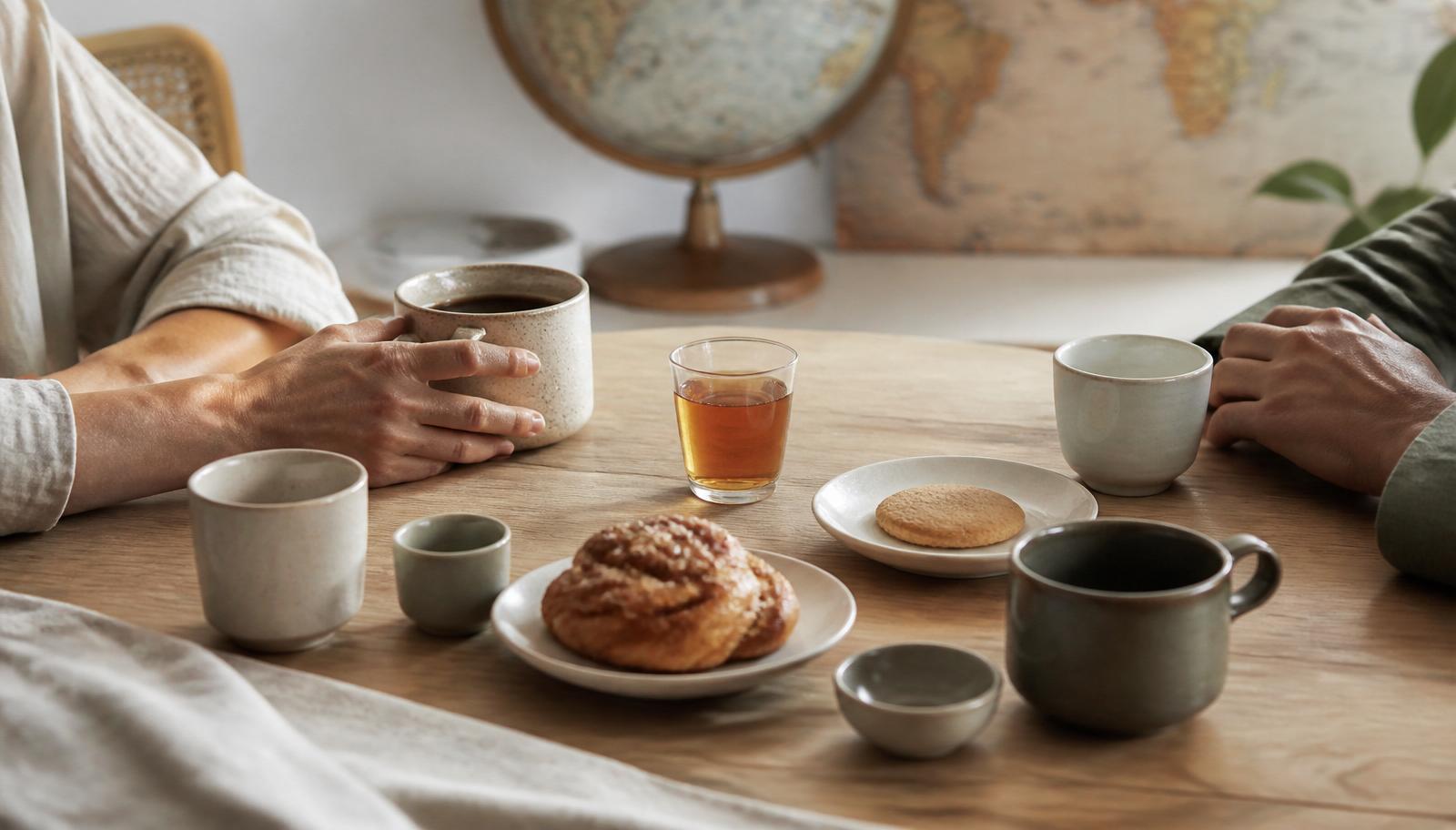
Accessibility matters. Practicing fika does not require expensive coffee, Scandinavian furniture, imported pastries, a beautifully styled home, Swedish ancestry, or a specific income level. The value is in intentional time and attention. A mug and ten quiet minutes with another person can be fika. So can a shared thermos on a bench.
When Fika Becomes a Trend
As traditions travel, they can also be simplified. Fika is not immune. Common simplifications include:
- Reducing fika to coffee products or premium drink SKUs.
- Presenting fika mostly as an aesthetic — throws, mugs, moody photos.
- Marketing fika as a productivity or optimization hack.
- Claiming specific health benefits without evidence.
- Suggesting that expensive goods are necessary for authentic fika.
- Using the word without any reference to its Swedish origins.
None of this means businesses, cafés, or books that engage with fika are automatically at fault. Cafés selling Swedish pastries are part of how fika travels; books explaining fika are part of how people learn about it. What matters is cultural accuracy, transparency, and respect for the source.
In that spirit, it is worth being direct about Fika Pause itself. Fika Pause did not create fika. Fika Pause is an independent modern educational and daily-practice platform that draws inspiration from the Swedish tradition and seeks to help people learn about its origins and practice values of intentional connection, conversation, reflection, hospitality, and belonging in everyday life. The tradition is older than us. Our role is to point back toward it while offering a contemporary practice inspired by it.
What Fika Can Learn From the World
Cultural exchange should not be one-directional. As fika is practiced internationally, people can also learn from the many other traditions of hospitality, ritual, and conversation that already exist around the world.
Depending on where you live and who you sit with, that might mean paying more attention to:
- Extended hospitality that treats guests as central rather than as an interruption.
- Intergenerational storytelling that puts elders and children at the same table.
- Ceremonial attention that treats preparation itself as part of the meaning.
- Care for guests that anticipates rather than merely responds.
- The practice of lingering after meals, without a next task waiting.
- Neighborhood and community gathering that does not require an occasion.
- Communal food preparation as shared time, not as a chore.
- Respect for elders and the pace they set in a conversation.
- Making room for silence rather than filling every gap with talk.
- Shared rituals that everyone knows and no one has to organize.
The point is not to build a taxonomy of what each culture “does best.” Cultures are not tidy categories, and assigning single virtues to whole peoples flattens them. The point is that humility and curiosity travel well in both directions.
“The most respectful form of cultural exchange begins with curiosity, not ownership.”
A Global Fika Does Not Need to Look the Same Everywhere
Fika can remain Swedish in origin while inspiring people elsewhere. The goal is not to standardize fika globally, and it is not to make every culture practice the same ritual. A world that only knew one way to gather over food and drink would be a poorer world.
The opportunity is different, and quieter. It is to learn from a tradition that reminds people to make time for one another, and to translate that reminder into local materials, languages, and habits — with Swedish roots acknowledged, and with local traditions equally honored. Fika in a Minneapolis living room, fika in a Tokyo office, fika at a table in São Paulo, and fika in a Swedish kitchen do not need to look identical to be connected by the same intention.
How to Practice Fika Respectfully Wherever You Live
- Learn the origins. Read a short piece on Swedish fika. Even ten minutes of context changes how the word sits in your mouth. Our History of Fika in Sweden is a place to start.
- Keep it simple. A drink, a person or two, ten to fifteen minutes. You do not need a themed cart or an aesthetic overhaul.
- Protect time. Put fika in your day the way you would put a real appointment. Small ritual, real time.
- Give people your attention. Phones out of reach. Notifications off. Faces up.
- Share something. A biscuit, a slice of bread, a piece of fruit. The object is small; the gesture is the point.
- Respect local traditions. Notice the ways your family, culture, and community already gather. Let fika sit alongside them rather than replace them.
- Repeat the practice. Once a day, once a week, once with a specific person on a specific afternoon. Repetition is what turns a nice idea into a rhythm.
For a fuller daily framework, read How to Practice Fika Every Day. When you are ready to invite one or two people, our practical guide to hosting a fika walks through invitations, setting, food, and conversation without overcomplicating any of it.
For more on what fika is and how it differs from other pauses, see What Is Fika?, The Meaning of Fika, and Fika vs. Coffee Break.
Frequently Asked Questions
- Is fika practiced outside Sweden?
- Yes, though unevenly. Swedish diaspora communities, Scandinavian cultural organizations, cafés, workplaces, and interested individuals around the world have adopted or adapted fika. It is not a formal global movement and it is not practiced identically everywhere, but interest is real and growing.
- Can anyone practice fika?
- Yes. Fika is a cultural tradition, not a closed ritual. Anyone can learn about it, practice it, and share it — respectfully. That means acknowledging its Swedish origins, using the word accurately, and valuing the practice rather than treating it as a trend or aesthetic.
- Is it cultural appropriation to practice fika if you are not Swedish?
- There is no universal verdict, and thoughtful people disagree. What generally distinguishes respectful practice from appropriation is context, attribution, accuracy, and intent. Learning where fika comes from, using the word correctly, not claiming to have invented or improved the tradition, and not exploiting it commercially without acknowledgement all move a practice toward respect.
- Is fika popular in the United States?
- There is documented interest through Swedish-American cultural institutions, Scandinavian cafés and bakeries, cookbooks, media coverage, and some workplaces with Swedish ties. That is not the same as fika being mainstream across the country. It is a growing niche interest with real communities behind it, not a household word.
- Is fika the same as afternoon tea?
- No. British afternoon tea has its own distinct history, foods, service style, and social meaning. Both traditions involve a pause, a drink, and often something to eat, but the settings, foods, expectations, and cultural contexts differ. It is more accurate to describe them as related but different.
- Is fika the same as sobremesa?
- No. Sobremesa is a Spanish and Latin American tradition of lingering conversation after a shared meal. It is not defined by coffee or a scheduled pause; it flows from the meal itself. Both traditions value slow conversation, but their timing, form, and cultural context are different.
- Does fika always include Swedish food?
- No. Cinnamon buns, cardamom buns, and simple cookies are common in Sweden, but food is not required and does not have to be Swedish. A locally baked biscuit, a piece of fruit, or nothing at all can all fit within fika. What matters most is the pause and the attention, not the menu.
- Can fika include tea instead of coffee?
- Yes. Coffee is culturally central in Sweden, but fika is defined by the pause, not the beverage. Tea, hot chocolate, water, or another drink can all be part of fika. Adapting the drink to what people in a given place actually enjoy is a natural part of the tradition traveling.
- Can people practice fika virtually?
- People can borrow from fika's emphasis on intentional conversation to shape video or phone calls, especially for friends and family who live far apart. Whether every virtual coffee call counts as authentic Swedish fika is a separate question. Called by its proper name and used with intent, virtual fika can be meaningful; used casually as a rebrand of any online meeting, it stretches the term.
- How can businesses use the idea of fika respectfully?
- By acknowledging that fika is a Swedish cultural tradition, using the word accurately, not overclaiming health or productivity benefits, and centering the practice on genuine connection rather than product sales or aesthetics. Businesses inspired by fika can be honest about the source and clear about how their offering relates to — or diverges from — the tradition.
- Does Fika Pause own or represent the Swedish tradition of fika?
- No. Fika is a Swedish cultural tradition with a history that long predates Fika Pause. Fika Pause is an independent educational and daily-practice platform inspired by fika and focused on helping people create more intentional opportunities for human connection.
- How can I start practicing fika where I live?
- Read a little about where fika comes from. Choose a drink you actually like. Invite someone to share ten or fifteen unhurried minutes. Put your phone away. Ask a real question and listen. Do it again next week. Over time, you will find your own steady shape for the practice.
Sources & Further Reading
Organization
The Swedish Institute — sweden.se
Official Swedish cultural overview describing fika as a daily practice of pausing together.
Organization
About Sweden — The Swedish Institute
Svenska institutet
Swedish public agency promoting interest in Sweden abroad; a primary source for Swedish cultural context.
Organization
American Swedish Institute, Minneapolis
Swedish-American cultural institution offering programs on Swedish heritage, including fika.
Organization
Embassy of Sweden in Washington
Government Offices of Sweden
Official Swedish diplomatic presence in the United States; a primary source on Swedish cultural outreach.
Book
Fika: The Art of the Swedish Coffee Break
Anna Brones & Johanna Kindvall (Ten Speed Press, 2015)
Widely cited English-language introduction to fika as a Swedish tradition and everyday practice.
Organization
Ethiopian Coffee Ceremony — cultural overview
Smithsonian National Museum of African Art
Museum resource describing the Ethiopian coffee ceremony as a distinctive social ritual.
Organization
Turkish coffee culture and tradition — Intangible Cultural Heritage
UNESCO
UNESCO inscription describing Turkish coffee as a symbol of hospitality, friendship, and conversation.
Organization
Arabic coffee, a symbol of generosity — Intangible Cultural Heritage
UNESCO
UNESCO inscription documenting the hospitality traditions surrounding Arabic coffee.
Organization
Washoku, traditional dietary cultures of the Japanese — Intangible Cultural Heritage
UNESCO
UNESCO inscription providing context for Japanese food and hospitality traditions.
Research
Office of the U.S. Surgeon General (2023)
Frames loneliness and social isolation as a public-health concern and highlights the value of everyday social connection.
On Fika Pause
On Fika Pause
On Fika Pause
On Fika Pause
On Fika Pause
On Fika Pause
On Fika Pause
Continue Your Fika Journey
Learning about fika is only the beginning. The real transformation happens when you practice it. Explore daily reflections, conversation prompts, kindness challenges, and meaningful connection activities inside Fika Pause.
Keep going
Continue Learning
Recommended Series
You May Also Like
Understanding Fika
The History of Fika in Sweden: Origins of a Beloved Tradition
Discover the history of fika in Sweden, from the arrival of coffee in the 1600s through royal bans and industrial life to the modern daily pause for connection and calm.
Understanding Fika
What Is Fika? The Swedish Tradition That Can Improve Your Relationships
Discover the meaning of fika, the Swedish tradition of slowing down to connect over coffee, conversation, and community—and how to practice it every day.
Understanding Fika
Common Misconceptions About Fika: What Fika Is — and What It Isn’t
Learn the most common misconceptions about fika and discover why this Swedish tradition is about connection, presence, and intentional time together.
Newest Guides
Families
Small Family Rituals: Making Room for Everyday Connection
Meaningful shared routines don't need to be elaborate, expensive, or picture-perfect. How to notice, shape, and keep small family rituals flexible — including fika with grandparents.
Families
Beyond “How Was Your Day?”: Conversation Starters for Family Fika
Specific, playful, and choice-based questions that give children and adults an easier place to begin — without interrogating anyone or asking for personal disclosure.
Families
The Family Fika: A Simple Ritual for Slowing Down Together
A family fika is a few minutes when people stop what they are doing and make room for conversation, listening, or simply being together. What it can look like, and why it doesn't need to be elaborate.
Popular Guides
Understanding Fika
What Is Fika? The Swedish Tradition That Can Improve Your Relationships
Discover the meaning of fika, the Swedish tradition of slowing down to connect over coffee, conversation, and community—and how to practice it every day.
Understanding Fika
The Meaning of Fika: More Than Coffee, More Than a Break
Discover the true meaning of fika and why this Swedish tradition is about slowing down, building relationships, and creating meaningful moments together.
Understanding Fika
How to Practice Fika Every Day: A Simple Guide
Learn how to practice fika every day with simple ideas for home, work, school, and community. Discover how small daily pauses create stronger relationships.