Understanding Fika
BeginnerFika Etiquette and Traditions: How to Show Up Well for a Swedish Pause
A gentle, evidence-informed guide to fika etiquette and traditions — how to accept an invitation, host respectfully, share the table, and honor the Swedish practice.
- Reading time
- 16 min
- Words
- ~4,100
- Sections
- 24
- Published
- July 13, 2026
- Updated
- July 13, 2026
Learning Goals
After reading this article you will:
- Participate respectfully across home, workplace, café, and community settings.
- Accept or decline a fika invitation graciously, and know what to bring.
- Follow customary serving, eating, and phone norms without stiffness.
- Recognize traditions like fredagsfika and kanelbullens dag and know when they apply.
- Distinguish documented Swedish customs from personal preference and marketing myths.
Key Takeaways
- Fika etiquette is about presence, welcome, and shared attention — not formality.
- Say yes when you can, and decline warmly when you cannot; both are polite.
- Bring something small, offer to help, and sit down when invited.
- Coffee and a small baked good are traditional; adaptations are welcome when named honestly.
- Fredagsfika (Friday fika) and workplace fika are common Swedish rhythms, not universal rules.
- Phones down and eyes up is the single most important modern etiquette practice.
- Hosts prepare enough to be present, then let the gathering breathe.
- Respect the tradition by naming it accurately and centering people over aesthetics.
Series
Understanding Fika1 of 10 · ~150 min total
- What Is Fika? The Swedish Tradition That Can Improve Your Relationships
- The Meaning of Fika: More Than Coffee, More Than a Break
- The History of Fika in Sweden: Origins of a Beloved Tradition
- How to Practice Fika Every Day: A Simple Guide
- Why Fika Matters Today: Slowing Down and Connecting in a Busy World
- Common Misconceptions About Fika: What Fika Is — and What It Isn’t
- Fika vs. Coffee Break: What Makes Swedish Fika Different?
- Fika Around the World: How a Swedish Tradition Is Inspiring Connection Everywhere
- How to Host a Fika: A Simple Guide to Bringing People Together
- Fika Etiquette and Traditions: How to Show Up Well for a Swedish Pause
Introduction
When people first learn about fika, they often ask a very reasonable question: are there rules? Do you have to bring something? Is it rude to take the last bun? Do you drink coffee even if you do not like coffee? Do you check your phone? Do you talk about work? Do you stay for a certain amount of time?
The honest answer is that Swedish fika is more custom than rulebook. It is a shared social practice shaped by centuries of everyday life at home, at work, and in cafés. There are gentle expectations rather than strict laws, and most of the etiquette is about one thing: showing up for the people you are with. This guide walks through what those small expectations are, where they come from, and how to honor them wherever you live.
If you are new to the tradition itself, start with What Is Fika? and The Meaning of Fika. If you would like to host, see How to Host a Fika.
What Fika Etiquette Really Means
Etiquette is often misunderstood as formality — the correct fork, the correct greeting, the correct silence. Fika etiquette is almost the opposite. It is a soft set of habits that make the pause feel welcoming: arriving when you said you would, being kind, listening, letting other people speak, keeping phones away, and treating the drink and the food as supports for time together rather than the main event.
The Swedish Institute describes fika as an everyday social pause — usually with coffee and something small to eat — that is embedded in home life, workplaces, and public culture. The etiquette that surrounds it exists to keep that pause honest. When a fika becomes a performance, a status symbol, or a working meeting in disguise, the etiquette has gone quiet.
“Fika etiquette is less about doing things correctly and more about being present kindly.”
Invitation Etiquette: Saying Yes, No, and Maybe
A fika invitation is small on purpose. It usually does not require formal RSVPs, dressing up, or elaborate plans. Because the invitation is low-stakes, the etiquette of accepting or declining it is straightforward:
- Reply in a reasonable amount of time — same day when possible.
- Confirm the day, time, and place clearly.
- Say what you can bring, if appropriate, or ask if anything is needed.
- Mention any dietary needs the host may want to know.
- Let the host know if you can only stay a shorter time.
If you cannot come, decline warmly. A short, honest reply — “Thank you for thinking of me; I cannot this Saturday, but could we do the following weekend?” — is polite and easy to receive.
Arrival: The First Two Minutes
Punctuality is quietly important in Sweden. Arriving within about five to ten minutes of the agreed time is standard courtesy. If you are running late, send a short message. If you are extremely early, wait outside; hosts are often finishing small preparations.
When you arrive:
- Greet the host by name.
- Remove shoes if you are entering a Swedish home — it is customary in most Swedish households.
- Greet the other guests warmly.
- Hand any small gift to the host without making a production of it.
- Ask where to sit if it is not obvious.
These small gestures are not tests. They are simply the shape of a comfortable welcome — the kind that keeps the pause unhurried from the very first minute. They are also etiquette doing its real work, which is hospitality: lowering the small costs of being a guest so that no one has to guess how to behave.
What to Bring (and Whether You Should)
You are almost never required to bring anything. Bringing something small is a gentle gesture, especially the first time you visit someone’s home. Appropriate small offerings include:
- a few pastries or buns from a good bakery
- a bag of nice coffee or a small box of tea
- fruit
- a homemade cookie or slice of cake
- a small bunch of seasonal flowers or greenery
Skip anything elaborate, expensive, or difficult for the host to store. If you have a dietary need, bringing something you can eat is thoughtful, not rude. If you are unsure, it is completely fine to ask, “Would you like me to bring anything?”
At the Table: Small Rituals That Matter
Fika at a table has a rhythm that is more felt than announced:
- Wait until the host indicates the food and drinks are ready.
- Take a modest first serving; you can always come back for more.
- Pass shared plates and pots so no one has to reach across the table.
- Use a napkin, even a paper one, for buns and crumbs.
- Compliment the food or drink — a short, honest word is enough.
- Sit long enough for conversation, not just for eating.
In many Swedish homes, hosts do not begin eating before their guests. Guests, in turn, wait for the host’s cue to start. These are small, human courtesies rather than formal rules.
Coffee, Refills, and Påtår
Coffee is culturally central to Swedish fika. Historically, Sweden has been one of the highest per-capita coffee-consuming countries in the world, and coffee is present in most traditional fika settings.
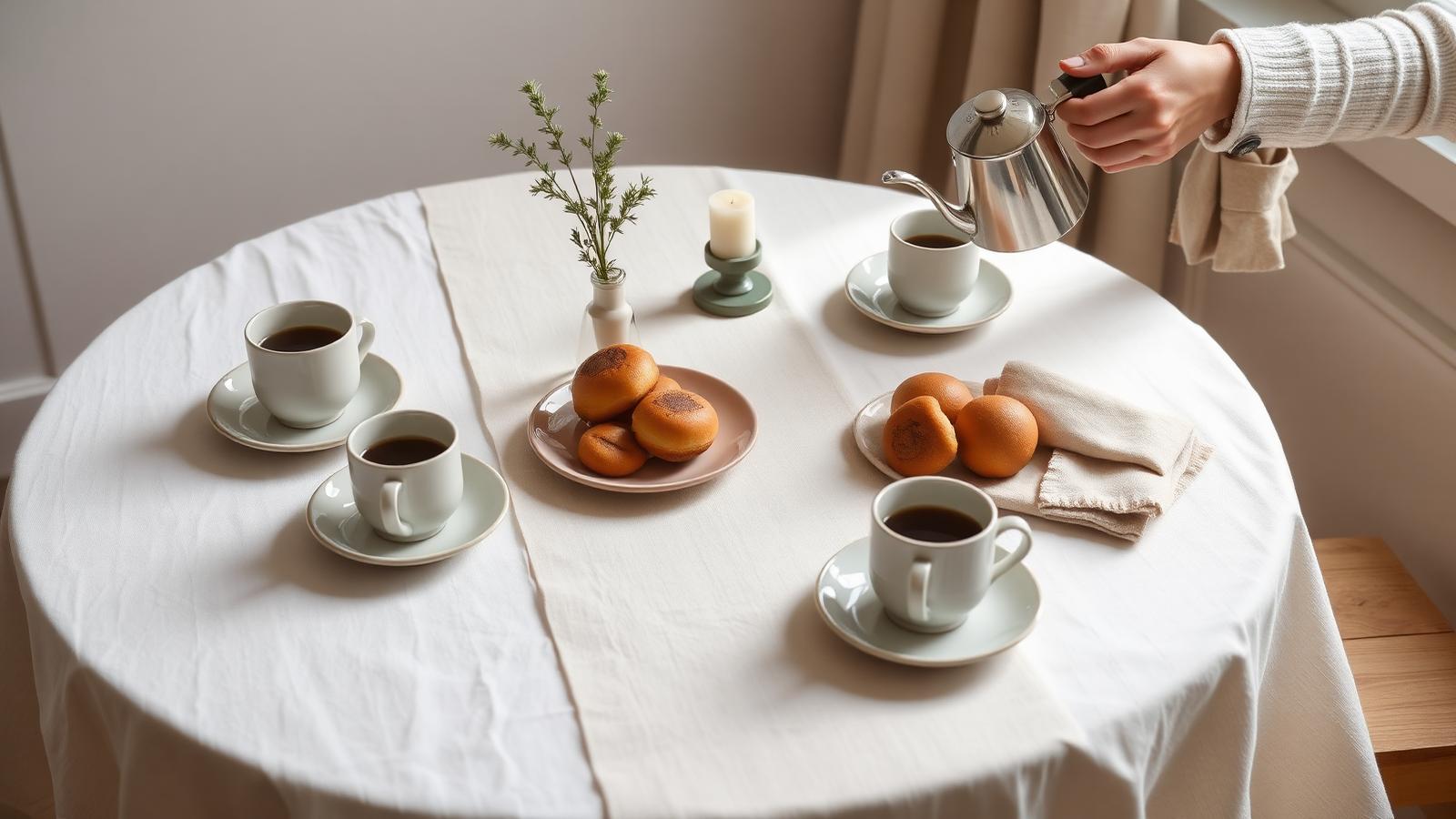
Påtår is a distinctive Swedish word for the second cup of coffee at fika. The concept matters: it signals that the fika is not being rushed. A host who offers påtår is inviting the pause to continue. A guest who accepts påtår is saying, gently, yes, I am happy to stay a little longer.
If you do not drink coffee, that is entirely fine. Choose tea, hot chocolate, water, or milk. A good host has a non-coffee option; a good guest does not treat it as second-best. Fika is protected by the pause, not by the exact beverage.
Kanelbullar, Cardamom, and the Seven Kinds of Cookies
Cinnamon buns (kanelbullar) and cardamom buns (kardemummabullar) are the baked goods most strongly associated with Swedish fika. Cinnamon buns even have their own national day in Sweden: Kanelbullens dag on October 4. On that day, bakeries, workplaces, schools, and homes commonly serve extra cinnamon buns as a small cultural celebration.
The older phrase sju sorters kakor — “seven kinds of cookies” — comes from a historical high standard for home coffee entertaining. It is not required for a modern fika, and treating it as a requirement can turn a warm pause into a stressful performance. Save it for a special occasion if you love baking; otherwise, one or two simple options is enough. How that distinction plays out in ordinary household life is covered in fika at home.
For more on which foods are traditionally Swedish and which are practical adaptations elsewhere, see Fika Around the World.
From the makers of Fika Spice™
From the bakery spices to the coffee cup
Cinnamon and cardamom are familiar flavors around a Swedish fika table. Fika Spice™ brings those flavors together with seven other real spices in one blend made to sprinkle into coffee.
Meet Original Fika Spice™Conversation Etiquette
Conversation at fika is intentionally unhurried. It rarely follows an agenda. Common conversational courtesies include:
- let everyone at the table have a turn to speak
- ask follow-up questions rather than switching topics quickly
- listen without preparing your rebuttal
- keep politics, religion, and heavy debate to a level everyone is comfortable with
- avoid gossip about people who are not present
- notice when someone is quiet and invite them in gently
- do not correct people harshly, even when you know more
Silence is not a problem. A little pause between topics is completely normal in Swedish conversation and does not need to be filled quickly.
“A good conversation at fika is not a performance of intelligence. It is a shared quiet that leaves everyone feeling more human.”
Phones, Screens, and Modern Attention
The single most important modern update to fika etiquette involves phones. Phones do not appear in traditional Swedish fika manuals because phones are new; the etiquette exists anyway. It is derived from the whole point of fika: shared attention.
Practical, gentle guidance:
- keep phones face down or out of sight
- silence notifications
- do not scroll while others are talking
- do not photograph the table or guests unless you have asked
- if you are on call for family or work, explain briefly at the start
- step away from the table to take an urgent call, and rejoin quickly
The U.S. Surgeon General’s 2023 advisory on loneliness identifies attention and presence in ordinary interactions as an important, undervalued driver of connection. Phone etiquette during fika is not old-fashioned. It is one of the small ways the tradition protects what it is for.
Fredagsfika: The Friday Tradition
Fredagsfika — Friday fika — is a widely recognized Swedish tradition of a slightly more celebratory pause on Friday to mark the transition from the working week to the weekend. In many Swedish workplaces, fredagsfika is a small ritual: someone brings buns, a cake, or another treat, and colleagues gather in the kitchen or breakroom for a few minutes together.
Fredagsfika is neither mandatory nor uniform. Some teams take turns providing something to share; others simply gather with whatever is available. Families and friends outside work also mark Friday with a slightly longer or sweeter fika at home. The etiquette is the same as for any fika, with a small tilt toward warmth, generosity, and the gentle mood of a week ending.
If you are practicing fika outside Sweden, adopting a weekly fika — Friday afternoon, Saturday morning, Sunday evening, whatever fits your life — is a respectful way to honor the rhythm of the tradition without pretending to import a specific workplace custom exactly as it exists in Sweden.
Workplace Fika Etiquette in Sweden and Beyond
Fika is deeply embedded in Swedish working life. Many workplaces have one or two short fika breaks written informally into the day. Etiquette in that setting tends to focus on inclusion and equality:
- everyone is welcome, from newest employee to most senior leader
- seniority is not treated as more important than the pause
- hosts (or the team member bringing something) do not perform
- coworkers are not required to disclose personal information
- work is discussed casually, but the fika is not a working meeting
- fika is not used to punish or reward attendance
Translated to workplaces outside Sweden, the same principles apply: keep it voluntary, inclusive, and short enough to sustain — the practical design work of making such a pause repeatable week after week is covered in Workplace Rituals That Last. Include remote or hybrid colleagues in some format when possible. A workplace fika is not a substitute for fair pay, workload, or management — see Common Misconceptions About Fika for more on this.
Family Fika and Children
Fika is a normal, low-key family practice in Sweden. Children are included, often with their own version of the drink and food. Etiquette in a family fika is gentle:
- let children help welcome guests
- let children help serve, when age-appropriate
- invite children to speak, but do not force disclosure
- allow age-appropriate movement
- keep the food simple and safe for the children present
- do not use fika as a bribe or a punishment
A relaxed family fika where children are welcome to speak and be quiet, eat and pause, stay and go, is one of the most meaningful ways the tradition is passed on.
Outdoor, Travel, and Café Etiquette
Fika does not need to happen indoors. A picnic blanket, a park bench, a hike, a workplace garden, or a summer porch all work well. Etiquette outdoors adds a few practical items:
- bring a small trash bag and leave the space cleaner than you found it
- respect quiet zones and neighboring groups
- choose accessible spots when someone in the group has mobility needs
- have water available in warm weather
- pack food that will not spoil in the sun
At a café, Swedish fika etiquette overlaps with normal café courtesy: order clearly, tip or round up if that is local practice, keep noise reasonable, do not spread across a table meant for four when there are two of you, and thank staff. Cafés are a public version of fika. Their staff are part of what makes the pause possible.
Host Etiquette: Prepare Enough to Be Present
The most important rule of hosting a fika is to prepare enough that you can sit down.
- Have a place ready for people to sit.
- Have drinks and simple food set out where guests can reach them.
- Reduce distractions: turn down music, silence phones, put screens away.
- Greet each guest as they arrive.
- Make introductions with a small bridge people can walk across.
- Notice who is quiet and gently include them.
- Offer a second cup — påtår — when it feels natural.
- Do not spend the whole gathering in the kitchen.
For a step-by-step guide, see How to Host a Fika.
Guest Etiquette: How to Be a Good Fika Guest
A good fika guest does small things well:
- Arrive close to the agreed time.
- Bring something small if it feels appropriate.
- Greet everyone at the table.
- Take a modest first serving.
- Participate in conversation rather than only listening or only talking.
- Offer to help clear a small thing at the end.
- Thank the host warmly.
- Reach back out afterward — a short message the next day is generous.
The best guests do not require constant hosting. They contribute to the pause, notice others, and leave the host feeling that the gathering was worth having.
How to Decline Gracefully
Declining is a normal part of hospitality. A polite decline includes three small parts: thanks, honesty, and — when you would like to see the person again — a next step.
Examples: “Thank you for inviting me. Saturday is not possible for me, but I would love to another weekend if you are free.” Or, “I appreciate you thinking of me. I need a quiet weekend this time; can we plan something in a couple of weeks?”
You do not owe anyone a long explanation. A short, warm reply protects the friendship and the invitation.
How to Leave a Fika Well
Leaving is a small art. A rushed exit at the peak of a good conversation can feel abrupt; an extremely long farewell can feel exhausting. A comfortable middle:
- Notice a natural break in the conversation.
- Thank the host by name.
- Offer a small help — clearing a cup or plate — if it fits.
- Say goodbye to the other guests, briefly.
- Leave without pulling everyone away from the table.
A short follow-up message the next day — “Thank you for yesterday. I really enjoyed the afternoon.” — is one of the most underrated small acts of hospitality.
Cultural Respect: What Fika Is Not
Etiquette also includes how you speak about the practice. Fika is a Swedish tradition. It was not invented by any single company, brand, or app — including Fika Pause. Respectful practice includes:
- using the word accurately and not turning it into a synonym for “any coffee break”
- acknowledging the Swedish origin when relevant
- not claiming to have improved or reinvented it
- avoiding stereotypes of Sweden or Scandinavia
- naming which foods are traditional and which are your practical local choices
- giving credit to Swedish institutions and writers when quoting them
Practicing fika does not require Swedish ancestry, Swedish products, or Swedish design. It requires the same thing everyone else brings: time, attention, and a small measure of care for the people you are with.
Etiquette Myths to Let Go Of
Some ideas about fika etiquette circulate widely but are not necessary or accurate:
- “You must always serve seven kinds of cookies.” Not for a normal fika.
- “You must drink coffee.” Coffee is central, but not mandatory. Tea and other beverages are welcome.
- “You must speak Swedish.” No. Fika does not require any particular language.
- “Fika must last a specific number of minutes.” There is no official duration.
- “You have to bake everything from scratch.” Homemade baking is meaningful but not required.
- “Fika is a business tool.” It can complement working life, but it is not a productivity hack. See Why Fika Matters Today and Common Misconceptions About Fika.
A One-Page Fika Etiquette Checklist
A short checklist to keep in mind before your next fika — as guest or as host. Nothing on this list requires perfection; each item is a small kindness.
As a guest:
- Reply promptly.
- Arrive close to the agreed time.
- Greet the host and other guests.
- Offer to bring something small.
- Sit when invited.
- Keep the phone away.
- Take a modest first serving.
- Ask, listen, and answer.
- Include quieter guests.
- Thank the host and follow up the next day.
As a host:
- Send a clear, low-pressure invitation.
- Prepare enough to be present.
- Set out drinks and simple food.
- Reduce distractions.
- Greet each guest by name.
- Offer påtår when it feels natural.
- Notice everyone in the conversation.
- Do not perform.
- Thank people for coming.
- Consider a next date before people leave.
How Fika Pause Supports the Practice
Fika Pause is a small companion for the practice of pausing well with people. It does not replace fika, and it did not invent fika. It offers reflection prompts, conversation starters, and gentle daily nudges that make it easier to keep the etiquette of presence, listening, and welcome alive between gatherings.
To keep exploring the tradition, see The History of Fika in Sweden, Fika vs. Coffee Break, and How to Practice Fika Every Day.
Knowledge Check
Frequently Asked Questions
- What is fika etiquette?
- Fika etiquette is the set of small, mostly unspoken customs that make a Swedish pause feel welcoming — showing up on time, greeting people warmly, keeping phones away, taking part in conversation, offering to help, and respecting the shared time. It is more about attention than formality.
- Do I have to bring something to fika?
- No. Most hosts do not expect a gift. Bringing something small — a pastry, a piece of fruit, or a small bag of coffee — is a kind gesture, especially for a first visit or a longer gathering. Ask the host if you are unsure.
- What is fredagsfika?
- Fredagsfika is a common Swedish workplace and family tradition of a slightly longer, more celebratory Friday fika — often with something extra, like a cake or a special pastry — to mark the end of the working week.
- Is it rude to check my phone during fika?
- In most Swedish settings, checking phones during fika is considered inattentive. The whole point of the pause is to be present with the people you are with. Leave the phone face down, in a pocket, or in another room unless there is a real reason to keep it out.
- How long does a fika usually last?
- Everyday and workplace fikas often last fifteen to thirty minutes. A weekend fika at home or a café may stretch to an hour or more. There is no official duration; the honest range depends on setting, group size, and what people feel like.
- What is påtår?
- Påtår is the Swedish word for the second cup of coffee at fika — a refill. Offering påtår is a small hospitable gesture. Accepting påtår signals that you are enjoying yourself and are not in a hurry to leave.
- Do I have to drink coffee at fika?
- No. Tea, hot chocolate, water, milk, or another beverage is welcome. Coffee is culturally central to Swedish fika, but choosing another drink is not a breach of etiquette.
- What are 'the seven kinds of cookies' (sju sorters kakor)?
- Sju sorters kakor refers to an older Swedish tradition — often associated with formal home coffee gatherings — of serving seven varieties of small baked goods. It is not required for a normal fika. It is a historical high standard, not an everyday expectation.
- Is it polite to leave the last bun on the plate?
- Swedish custom often includes some polite hesitation around taking the very last piece from a shared plate. Hosts can gently offer it aloud so guests know it is welcome to be taken. This is more of a soft convention than a strict rule.
- How do I politely decline a fika invitation?
- Say thank you, explain that you cannot make it this time, and — if you would like to see the person — suggest another day. A gracious decline includes warmth and honesty, not a long explanation.
- Is fika etiquette different at work?
- Somewhat. Workplace fika is often shorter, more egalitarian, and involves coworkers from many roles. Etiquette focuses on inclusion, kindness across the hierarchy, respecting scheduling, and not turning fika into a meeting.
- Can children participate in fika?
- Yes. Fika is a family practice in many Swedish homes. Children should be included in the welcome, offered simple food and drink, and given room to speak. Adults should not pressure children into performing or answering personal questions.
- Do I need to be Swedish to follow fika etiquette?
- No. Anyone can practice fika respectfully. The most important etiquette rule is to use the word accurately, acknowledge its Swedish roots, and center the practice on people rather than aesthetics.
- What should I not do at fika?
- Do not rush people, dominate the conversation, ignore quieter guests, keep your phone active, treat the pause as a working meeting, or perform hospitality for social media instead of showing up for the people at the table.
- How do I end a fika politely?
- Thank the host, help clear a small thing if it feels natural, and say goodbye by name to those you have spoken with. If the group is enjoying itself, you can leave quietly without pulling everyone into a long farewell.
Sources & Further Reading
Organization
The Swedish Institute — sweden.se
Official Swedish cultural overview describing fika as an everyday social pause centered on coffee and something small to eat.
Organization
About Sweden — The Swedish Institute
Svenska institutet
Swedish public agency promoting understanding of Sweden abroad; a primary source for Swedish cultural context.
Organization
American Swedish Institute, Minneapolis
Swedish-American cultural institution offering public programs on Swedish heritage and hospitality.
Organization
Institute for Language and Folklore (Isof)
Institutet för språk och folkminnen
Swedish government institute for language and folklore; a primary source on everyday Swedish cultural practices.
Book
Fika: The Art of the Swedish Coffee Break
Anna Brones & Johanna Kindvall (Ten Speed Press, 2015)
Widely cited English-language introduction to fika as a Swedish tradition and everyday practice.
Research
Office of the U.S. Surgeon General (2023)
Frames small, repeated in-person interactions as a foundation for connection and community wellbeing.
On Fika Pause
On Fika Pause
On Fika Pause
On Fika Pause
On Fika Pause
On Fika Pause
On Fika Pause
On Fika Pause
On Fika Pause
Continue Your Fika Journey
Learning about fika is only the beginning. The real transformation happens when you practice it. Explore daily reflections, conversation prompts, kindness challenges, and meaningful connection activities inside Fika Pause.
Keep going
Continue Learning
Recommended Series
You May Also Like
Understanding Fika
How to Host a Fika: A Simple Guide to Bringing People Together
Learn how to host a simple, meaningful fika with practical ideas for invitations, food, conversation, setting, and making guests feel welcome.
Understanding Fika
How to Practice Fika Every Day: A Simple Guide
Learn how to practice fika every day with simple ideas for home, work, school, and community. Discover how small daily pauses create stronger relationships.
Understanding Fika
What Is Fika? The Swedish Tradition That Can Improve Your Relationships
Discover the meaning of fika, the Swedish tradition of slowing down to connect over coffee, conversation, and community—and how to practice it every day.
Newest Guides
Families
Small Family Rituals: Making Room for Everyday Connection
Meaningful shared routines don't need to be elaborate, expensive, or picture-perfect. How to notice, shape, and keep small family rituals flexible — including fika with grandparents.
Families
Beyond “How Was Your Day?”: Conversation Starters for Family Fika
Specific, playful, and choice-based questions that give children and adults an easier place to begin — without interrogating anyone or asking for personal disclosure.
Families
The Family Fika: A Simple Ritual for Slowing Down Together
A family fika is a few minutes when people stop what they are doing and make room for conversation, listening, or simply being together. What it can look like, and why it doesn't need to be elaborate.
Popular Guides
Understanding Fika
What Is Fika? The Swedish Tradition That Can Improve Your Relationships
Discover the meaning of fika, the Swedish tradition of slowing down to connect over coffee, conversation, and community—and how to practice it every day.
Understanding Fika
The Meaning of Fika: More Than Coffee, More Than a Break
Discover the true meaning of fika and why this Swedish tradition is about slowing down, building relationships, and creating meaningful moments together.
Understanding Fika
How to Practice Fika Every Day: A Simple Guide
Learn how to practice fika every day with simple ideas for home, work, school, and community. Discover how small daily pauses create stronger relationships.