Understanding Fika
BeginnerThe History of Fika in Sweden: Origins of a Beloved Tradition
Discover the history of fika in Sweden, from the arrival of coffee in the 1600s through royal bans and industrial life to the modern daily pause for connection and calm.
- Reading time
- 15 min
- Words
- ~3,900
- Sections
- 11
- Published
- July 5, 2026
- Updated
- July 5, 2026
Learning Goals
After reading this article you will:
- Trace how coffee arrived in Sweden and became a national beverage.
- Understand the linguistic origin of the word fika.
- Learn how Sweden's coffee bans shaped a stubborn coffee culture.
- See how fika grew from a home ritual into a workplace and civic institution.
- Recognize what the history of fika still teaches us about daily life today.
Key Takeaways
- Coffee reached Sweden in the late 1600s and became a genuinely popular drink in the 1700s.
- The word fika is generally traced to a Swedish back-slang reversal of the syllables in kaffi (an older form of 'coffee'), attested in writing by the early 20th century.
- Swedish authorities imposed several coffee prohibitions and restrictions from the mid-18th through the early 19th centuries — and none of them held.
- Industrialization turned fika into a shared workplace ritual, protected by unions and factory floors alike.
- Fika endured because it answered a human need — for pause, presence, and each other — that no century has outgrown.
Series
Understanding Fika1 of 10 · ~150 min total
- What Is Fika? The Swedish Tradition That Can Improve Your Relationships
- The Meaning of Fika: More Than Coffee, More Than a Break
- The History of Fika in Sweden: Origins of a Beloved Tradition
- How to Practice Fika Every Day: A Simple Guide
- Why Fika Matters Today: Slowing Down and Connecting in a Busy World
- Common Misconceptions About Fika: What Fika Is — and What It Isn’t
- Fika vs. Coffee Break: What Makes Swedish Fika Different?
- Fika Around the World: How a Swedish Tradition Is Inspiring Connection Everywhere
- How to Host a Fika: A Simple Guide to Bringing People Together
- Fika Etiquette and Traditions: How to Show Up Well for a Swedish Pause
Introduction
Coffee arrived in Sweden in the late 1600s as a foreign curiosity, was treated for the next century and a half as a genuine threat to public order, and eventually became so thoroughly Swedish that the country now drinks more of it per person than almost anywhere else on earth. In between those two facts sits the whole history of fika: a story of smuggled beans, royal bans, back-slang, and a stubborn national habit of pausing together that no decree ever managed to stop.
That arc — arrival, suspicion, and eventual embrace — is not a footnote to the tradition. It is the tradition's origin story, and it explains why fika became something closer to a social contract than a beverage choice. Tracing it helps explain why a fifteen-minute coffee pause in a small northern country became one of the world's most quietly influential ideas about how to live well.
This is a companion piece to What Is Fika? and The Meaning of Fika. Where those pieces describe what fika is and what it means, this one traces where it came from.
Coffee Arrives in Sweden
Coffee entered Europe from the Ottoman world in the 1600s. It reached Venice, then Vienna, London, Paris, and Amsterdam, before working its way north. By the late 17th century it had reached Sweden — a small, mostly rural kingdom on the far edge of Europe with long winters, a curious court, and, as it turned out, an unusually receptive palate.
The most colorful thread in the Swedish coffee origin story runs through King Karl XII (1682–1718), the warrior-king who spent years in exile in the Ottoman Empire after a disastrous military campaign. When he finally returned to Sweden in 1715, he brought a taste for Turkish-style coffee with him. Coffee at court was fashionable and expensive; it was also, quickly, admired. Historians disagree about how much Karl XII personally shaped Swedish coffee habits, but by the 1720s Stockholm had its first coffee houses, and by mid-century coffee was moving out of the aristocratic salon and into the merchant class.
“A bean from the equator, carried home from a warrior-king's exile, meeting a country with very long winters. Coffee was almost destined to stay.”
In the 1700s coffee was still a luxury import — costly, taxed, and imperfectly understood. Doctors argued about whether it was medicinal or dangerous. Clergy worried about the political conversations happening in coffeehouses. The state, always short of revenue, eyed coffee as either a source of tax income or, when the mood turned, as a decadent foreign vice to be stamped out. Both instincts would shape what came next.
The Origins of the Word Fika
The word fika is younger than the drink. It is first attested in written Swedish around the early 20th century — roughly 1910 by most reference works — and its origin is one of the more charming footnotes in the history of the Swedish language.
The standard explanation — the one linguists cite most often — is that fika is a back-slang, or reversed-syllable, form of an older Swedish word for coffee: kaffi. In a playful street slang known as backslang or bakvänt språk, syllables of ordinary words were swapped around. Under that rule, kaffi becomes fika. The slang stuck. Over decades it stopped sounding slangy at all, and by the early-to-mid 20th century fika was the ordinary Swedish name for the whole ritual — the coffee, the cake, the pause, and the company.
A few things are worth noting. First, the reversal happened before the word kaffe (the modern Swedish spelling) fully replaced kaffi, which is why the sounds line up. Second, fika is grammatically flexible in a way English coffee words aren't. It functions as both noun and verb: you can have a fika, and you can fika. That grammatical flexibility is one reason the word travels so easily into English.
There are, as with any etymology, a few competing theories at the margins — some researchers have proposed dialect influences or alternative slang chains — but the back-slang explanation is by far the most widely accepted, and it is the one the Institute for Language and Folklore (Isof) and most Swedish dictionaries cite.
Coffee Bans and Sweden's Unique Coffee History
Between the mid-1700s and the early 1800s, Sweden restricted or outright banned coffee multiple times — popular histories most often count five or six episodes across roughly 1756–1822. This is not a detail people expect. It is, however, one of the most important threads in the whole history of fika, because it helps explain why Swedish coffee culture became so unusually stubborn.
The first ban, in 1756, was framed as a response to "misuse and excesses" of coffee and tea and was tied to broader fiscal and mercantilist worries about luxury imports. Coffee had by then reached ordinary households; taking it away turned out to be politically difficult and practically impossible. Further restrictions followed later in the century and into the early 1800s in similar patterns: the state would issue a decree, revenue officers would raid a few homes, coffee-drinking would move to back rooms and rural kitchens, and eventually the restriction would quietly lapse.
The most famous episode belongs to King Gustav III (1746–1792), who was reportedly convinced coffee was harmful. Sweden's best-known coffee legend claims that Gustav ordered an experiment on twin brothers under sentence of death, commuting their sentences on condition that one drink coffee daily for the rest of his life and the other drink tea, with doctors assigned to monitor them.
The story goes that the experiment did not go as planned: the assigned doctors died first, then Gustav III himself was assassinated in 1792, and the tea-drinking twin outlived the coffee-drinker only by a small margin — or, in some retellings, the coffee drinker outlived them all. Historians treat this "twins experiment" as a widely repeated anecdote rather than firmly documented history; specific details often cited in popular accounts (exact daily doses, precise ages at death) are not well supported by primary sources. It is best remembered as a piece of Swedish coffee folklore that captures how embattled — and ultimately unsuccessful — the anti-coffee position was.
“The king was sure coffee would kill you. Sweden kept drinking anyway.”
The restrictions failed for a reason that goes beyond a single anecdote. By the late 1700s coffee had already become part of everyday domestic life in Sweden — brewed in homes, shared with visitors, tied to hospitality. You cannot easily legislate a drink out of a country whose grandmothers already serve it to guests. When the last of the bans lapsed in the 1820s, coffee returned openly, and it never left. Sweden is today consistently ranked among the countries with the highest per-person coffee consumption in the world.
The bans mattered because they turned coffee into something worth defending. A drink you have hidden in your kitchen for decades is no longer just a beverage. It is a small act of continuity, family life, and quiet independence. That posture — coffee as ours, coffee as home — is one of the things that eventually made fika more than a coffee break.
How Fika Became Part of Daily Life
Through the 19th century, coffee moved deeper into ordinary Swedish life. Rural farms brewed it in the morning and again in the afternoon. Towns opened konditorier — pastry shops that served coffee alongside the small sweet breads and buns that would become inseparable from fika. The kanelbulle, the cinnamon bun that non-Swedes now associate with fika, took its modern form in the 20th century; Sweden even has a National Cinnamon Bun Day, Kanelbullens dag on October 4, established in 1999 by Hembakningsrådet (the Swedish Home Baking Council).
Two 19th-century social currents pushed coffee toward becoming a ritualized shared pause rather than just a drink. The first was the rise of the middle-class home, with its parlors, guest coffee sets, and etiquette around receiving visitors. Hospitality became associated with a pot of coffee and something small to eat. The sjukaffe — the "seven-cake coffee," a traditional coffee-table spread of exactly seven types of biscuit or bun — dates from this period. Even today, older Swedes remember the etiquette.
The second current was industrialization. From the late 19th century onward, Swedes moved into mills, factories, and offices. Long, unbroken shifts were common. Workers, and eventually the unions that organized them, argued that a short paid coffee pause was both humane and productive. Over decades, the workplace coffee break became a normal part of the working day in Sweden and much of the Nordic world, and in some sectors it was reinforced by collective agreements — though fika is not codified in Swedish labour law. This is, in a real sense, when fika stopped being a purely home ritual and became a national one.
Fika in Swedish Homes
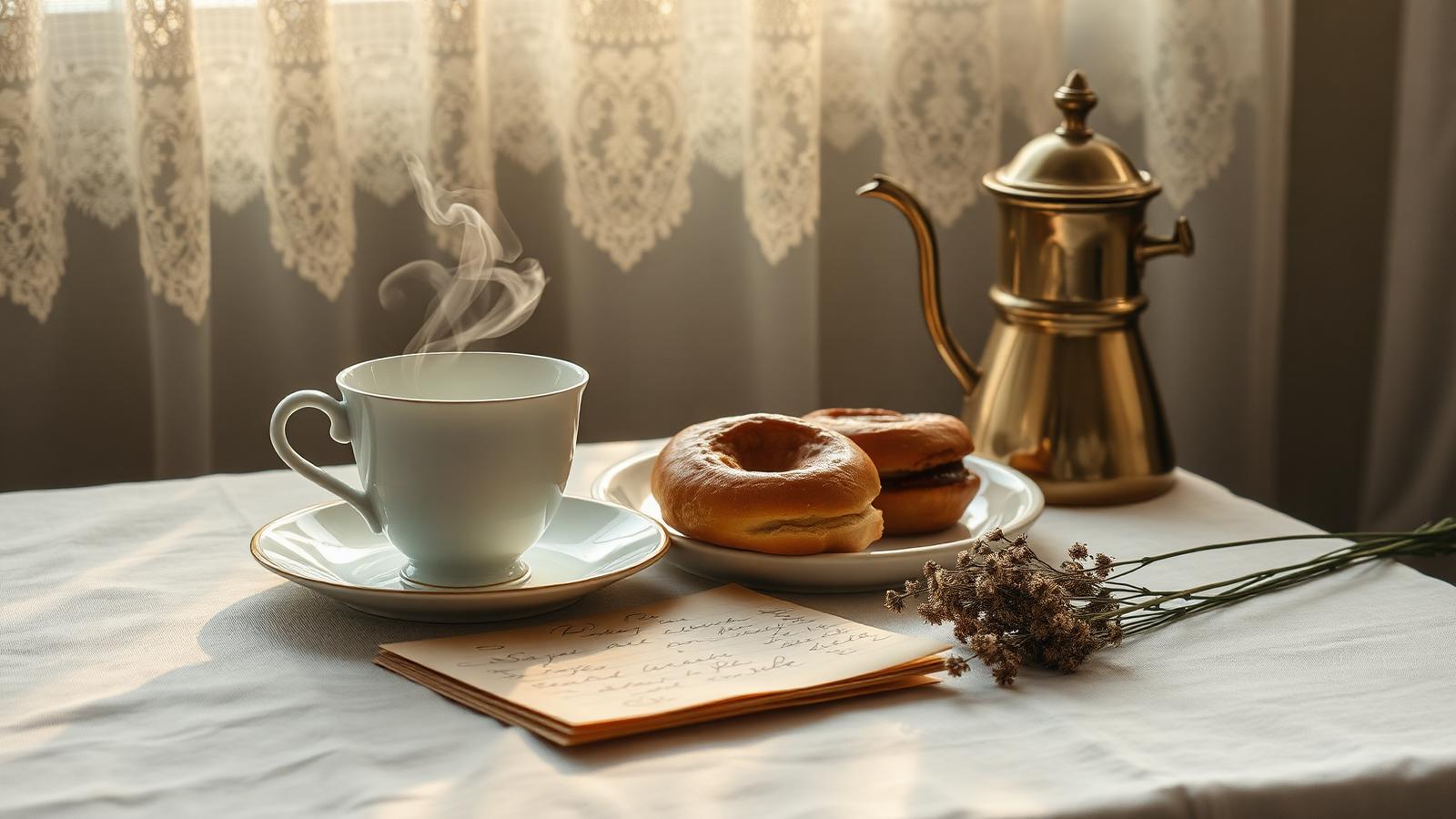
The home has always been the place where fika learned its manners. Long before it was a workplace institution or a tourist word, it was what happened between morning chores and lunch, or between the afternoon's work and the evening meal. A pot went on. Something small was set out. Someone sat down.
Home fika tended to follow soft rules rather than strict ones. The coffee was strong. The food was modest — a biscuit, a slice of bread, a bun, or, on a good day, the seven-cake spread. Neighbors dropping by would be pulled into a fika whether they had planned to stay or not. Grandparents especially were guardians of the ritual; a child's memory of a Swedish grandmother is very often a memory of her kitchen table and her coffee cup.
The word hemmafika — home fika — carries a quiet weight. It signals that the pause is not being taken at a café or an office kitchen, but at a specific well-known table, in a specific well-known light, with specific well-known people. It is the version most Swedes secretly rate highest.
Fika in Swedish Workplaces
In Swedish working life, fika is not a perk. It is closer to a fixture. In most offices there is a morning fika and an afternoon fika — often at roughly the same times each day. People stop what they are doing, walk to the kitchen or a shared room, pour coffee, and sit together for ten to twenty minutes. The CEO is expected to join. The intern is expected to join. The topic is rarely work.
This is more than habit. It is culturally load-bearing. Swedish workplaces are comparatively flat, informal, and consensus-driven, and fika is one of the small practices that makes that flatness real. You cannot easily maintain a rigid hierarchy with someone you drink coffee with twice a day. You also cannot easily hide from colleagues, or from yourself, in a company that expects you to sit down and be a person for fifteen minutes on schedule.
“In Sweden, if you want to know how a team is really doing, you don't call a meeting. You go to fika.”
International businesses that open offices in Sweden almost always encounter this. Some of them adapt to it, and — quietly — most of them come to appreciate it. It turns out that a short daily human pause is not only pleasant; it is also a very effective way to keep a team's tensions from calcifying, its ideas from siloing, and its people from burning out.
This history is one reason that, when workplaces elsewhere want to build cultures of belonging and psychological safety, they so often reach — sometimes without knowing it — for a Swedish idea. Fika is portable. It has crossed oceans not because it is exotic but because it works.
Why Fika Endured Through Generations
A great deal of what once organized daily life has faded. Formal calling hours, the seven-cake coffee, the daily newspaper on the kitchen table — these are memories now. Fika is not. In a country where almost everything else about daily life has been reshaped by industrialization, digitization, and globalization, the coffee pause stubbornly remains.
Why?
- It is small enough to fit anywhere. A kettle, a mug, fifteen minutes. Any life that has those things can have a fika.
- It is cheap enough to survive hard times. Wars, recessions, plagues, rationing — fika has passed through all of them. When there was no coffee, Swedes made ersatzkaffe from chicory or roasted grain, and kept the ritual anyway.
- It is unfussy enough to escape purity culture. There is no correct brew, no correct pastry, no correct opening line. That informality has kept it from becoming precious.
- It is social enough to matter. The tradition rewards being together. In a country with long dark winters, that is not decorative — it is protective.
- It is human enough to translate. The need to pause with someone is not Swedish. The Swedish contribution is a beautifully-shaped container for that need.
Traditions survive when they do work for the people who keep them. Fika keeps working — for children after school, for tired parents in the morning, for colleagues at 10 a.m., for grandparents who have finally sat down. Every generation adapts the details. Everyone recognizes the shape.
What the History of Fika Can Teach Us Today
Reading the history of fika, a few threads worth carrying into ordinary life stand out — wherever in the world you happen to live.
- Small rituals outlast big ambitions. No Swedish reformer set out to invent fika. It grew, slowly, out of what people already did. The most durable habits in any life tend to be the ones assembled from parts you already have.
- Defended pauses matter. Sweden's coffee bans failed because ordinary people, quietly, refused to give up their small daily pause. That instinct — to guard the pause, even when the outside world is against it — is worth keeping.
- Hospitality doesn't need to be elaborate. The seven-cake coffee was a special-occasion spread, but the everyday fika was a biscuit and a warm cup. Being a good host is, most of the time, a matter of sitting down and paying attention.
- Human workplaces perform better. Sweden did not invent the coffee break to make workers more productive. It made them more productive anyway. Kindness and calm turn out to be surprisingly useful economic inputs.
- Culture is what we repeat. Fika is not written into Swedish law anymore. It doesn't need to be. It is written into what people do at 10 a.m. and 3 p.m., every day, largely without thinking. Any culture — a family, a team, a neighborhood — is built the same way.
You do not need to be Swedish, or even a coffee drinker, to inherit this. You need a kettle, fifteen minutes, and a willingness to protect them. The rest is centuries of quiet practice, offered freely.
From the makers of Fika Spice™
A modern addition to the coffee ritual
Fika Spice™ grew from our own family's coffee ritual: bringing nine real spices together in one blend made to sprinkle into coffee. It's our Wisconsin-made addition to the fika table — not a traditional part of Swedish fika.
Discover Fika Spice™Continue Your Fika Journey
Fika's history is a reminder that a good daily ritual doesn't have to be invented — it can be inherited. When you're ready to keep exploring, these guides go deeper:
- What Is Fika? — a short, clear introduction to the tradition.
- The Meaning of Fika — the values and etymology behind the word.
- How to Practice Fika Every Day — a practical guide for home, work, school, and community.
- How to Practice Fika Every Day — the daily practice this site is built around.
- Why Human Connection Matters — the wider case for small, repeated acts of connection.
And if you'd like a small daily companion for the practice — try Fika Pause. It's designed to make the habit almost effortless to keep.
Frequently Asked Questions
- When did coffee first arrive in Sweden?
- Coffee is first documented in Sweden in the late 1600s, brought back by diplomats and traders with ties to the Ottoman Empire. King Karl XII, who had spent years in Turkey during his military campaigns, is often credited with helping popularize the drink at the Swedish court in the early 1700s.
- Where does the word 'fika' come from?
- Fika is generally traced to a Swedish back-slang form of kaffi, an older word for coffee: the syllables were reversed so kaffi became fika. It is first attested in writing around the early 20th century (about 1910), and Sweden's Institute for Language and Folklore (Isof) cites this back-slang origin.
- Did Sweden really ban coffee?
- Yes. Between the mid-1700s and the early 1800s, Sweden imposed several restrictions and outright bans on coffee — commonly counted as five or six episodes across roughly 1756–1822 — for mixed fiscal and moral reasons. King Gustav III was famously hostile to coffee, and a widely repeated story says he ordered a coffee-versus-tea experiment on two condemned prisoners; historians treat the details of that story as anecdotal rather than firmly documented. The restrictions repeatedly failed in practice, and by the mid-1800s coffee had become a fixture of daily life.
- When did fika become a workplace ritual?
- The workplace fika grew alongside Sweden's industrialization in the late 19th and early 20th centuries. As more people moved into factories, offices, and shops, short shared coffee pauses became a normal part of the working day. In some workplaces they were reinforced by union practice or workplace agreements, though fika itself is a cultural custom rather than a right written into Swedish labour law.
- Is fika unique to Sweden?
- Coffee breaks exist in many cultures, but fika's specific combination of daily rhythm, shared pause, informal hospitality, and social equality is distinctly Swedish. Similar traditions exist elsewhere in the Nordics, but the word fika and its cultural weight belong to Sweden.
- Why has fika survived when so many other traditions have faded?
- Fika endured because it is small, unpretentious, and useful. It doesn't require special equipment, a religious calendar, or a lot of time. It fits into any life that has a kettle and fifteen minutes, and it answers a need — for pause and for each other — that hasn't gone away.
Sources & Further Reading
Organization
Sweden.se — Fika: a Swedish tradition
The Swedish Institute
Official cultural explainer on the role of fika in Swedish life.
Organization
Isof — Frågelådan: fika (etymology)
Institutet för språk och folkminnen (Institute for Language and Folklore)
Sweden's official language and folklore institute on the back-slang origin of 'fika' from 'kaffi', attested from about 1910.
Organization
Nordiska museet — collections and articles on Swedish coffee culture
The Nordic Museum, Stockholm
Museum collections and essays on the social history of coffee, hospitality, and everyday life in Sweden.
Organization
Kaffeförbud på 1700-talet — teacher's guide
Stockholmskällan / City of Stockholm
Swedish-language educational resource summarising the 18th-century coffee restrictions and their fiscal and political context.
Book
Fika: The Art of the Swedish Coffee Break
Anna Brones & Johanna Kindvall
A widely cited introduction to fika as both tradition and everyday practice.
Book
Coffee: A Global History
Jonathan Morris — Reaktion Books (2019)
Scholarly overview of coffee's spread through Europe, including Sweden's unusual role.
Article
Gustav III's kaffeexperiment (Wikipedia, Swedish)
Wikipedia (Swedish-language article)
Overview of the widely-repeated Gustav III twins story, describing its authenticity as highly uncertain.
On Fika Pause
On Fika Pause
Continue Your Fika Journey
Learning about fika is only the beginning. The real transformation happens when you practice it. Explore daily reflections, conversation prompts, kindness challenges, and meaningful connection activities inside Fika Pause.
Keep going
Continue Learning
Recommended Series
You May Also Like
Understanding Fika
What Is Fika? The Swedish Tradition That Can Improve Your Relationships
Discover the meaning of fika, the Swedish tradition of slowing down to connect over coffee, conversation, and community—and how to practice it every day.
Understanding Fika
The Meaning of Fika: More Than Coffee, More Than a Break
Discover the true meaning of fika and why this Swedish tradition is about slowing down, building relationships, and creating meaningful moments together.
Understanding Fika
How to Practice Fika Every Day: A Simple Guide
Learn how to practice fika every day with simple ideas for home, work, school, and community. Discover how small daily pauses create stronger relationships.
Newest Guides
Families
Small Family Rituals: Making Room for Everyday Connection
Meaningful shared routines don't need to be elaborate, expensive, or picture-perfect. How to notice, shape, and keep small family rituals flexible — including fika with grandparents.
Families
Beyond “How Was Your Day?”: Conversation Starters for Family Fika
Specific, playful, and choice-based questions that give children and adults an easier place to begin — without interrogating anyone or asking for personal disclosure.
Families
The Family Fika: A Simple Ritual for Slowing Down Together
A family fika is a few minutes when people stop what they are doing and make room for conversation, listening, or simply being together. What it can look like, and why it doesn't need to be elaborate.
Popular Guides
Understanding Fika
What Is Fika? The Swedish Tradition That Can Improve Your Relationships
Discover the meaning of fika, the Swedish tradition of slowing down to connect over coffee, conversation, and community—and how to practice it every day.
Understanding Fika
The Meaning of Fika: More Than Coffee, More Than a Break
Discover the true meaning of fika and why this Swedish tradition is about slowing down, building relationships, and creating meaningful moments together.
Understanding Fika
How to Practice Fika Every Day: A Simple Guide
Learn how to practice fika every day with simple ideas for home, work, school, and community. Discover how small daily pauses create stronger relationships.