Families
BeginnerSmall Family Rituals: Making Room for Everyday Connection
Meaningful shared routines don't need to be elaborate, expensive, or picture-perfect. How to notice, shape, and keep small family rituals flexible — including fika with grandparents.
- Reading time
- 4 min
- Words
- ~890
- Sections
- 6
- Published
- September 27, 2026
- Updated
- September 27, 2026
Key Takeaways
- A family ritual doesn't need to be impressive; ordinary moments can be enough.
- Small rituals give families a repeatable moment and a reason to pause.
- Participation stays flexible, and rituals can change as children grow.
- Missing a day or a week is not failure. This is not a habit streak.
Series
Families1 of 3 · ~13 min total
- The Family Fika: A Simple Ritual for Slowing Down Together
- Beyond “How Was Your Day?”: Conversation Starters for Family Fika
- Small Family Rituals: Making Room for Everyday Connection
Ordinary Can Be Enough
When people picture family rituals, they sometimes imagine something grand: elaborate holiday traditions, weekend outings, a beautifully set table. Those have their place. But many of the shared routines that end up mattering in a household are much smaller than that, and much easier to keep.
A small family ritual is simply something a family does together, more or less regularly, that offers a reason to pause. It doesn't need to be expensive or photographable. It doesn't need a name. Over time it can become familiar — a moment people know is coming, and can join if they want to.
What Small Rituals Look Like
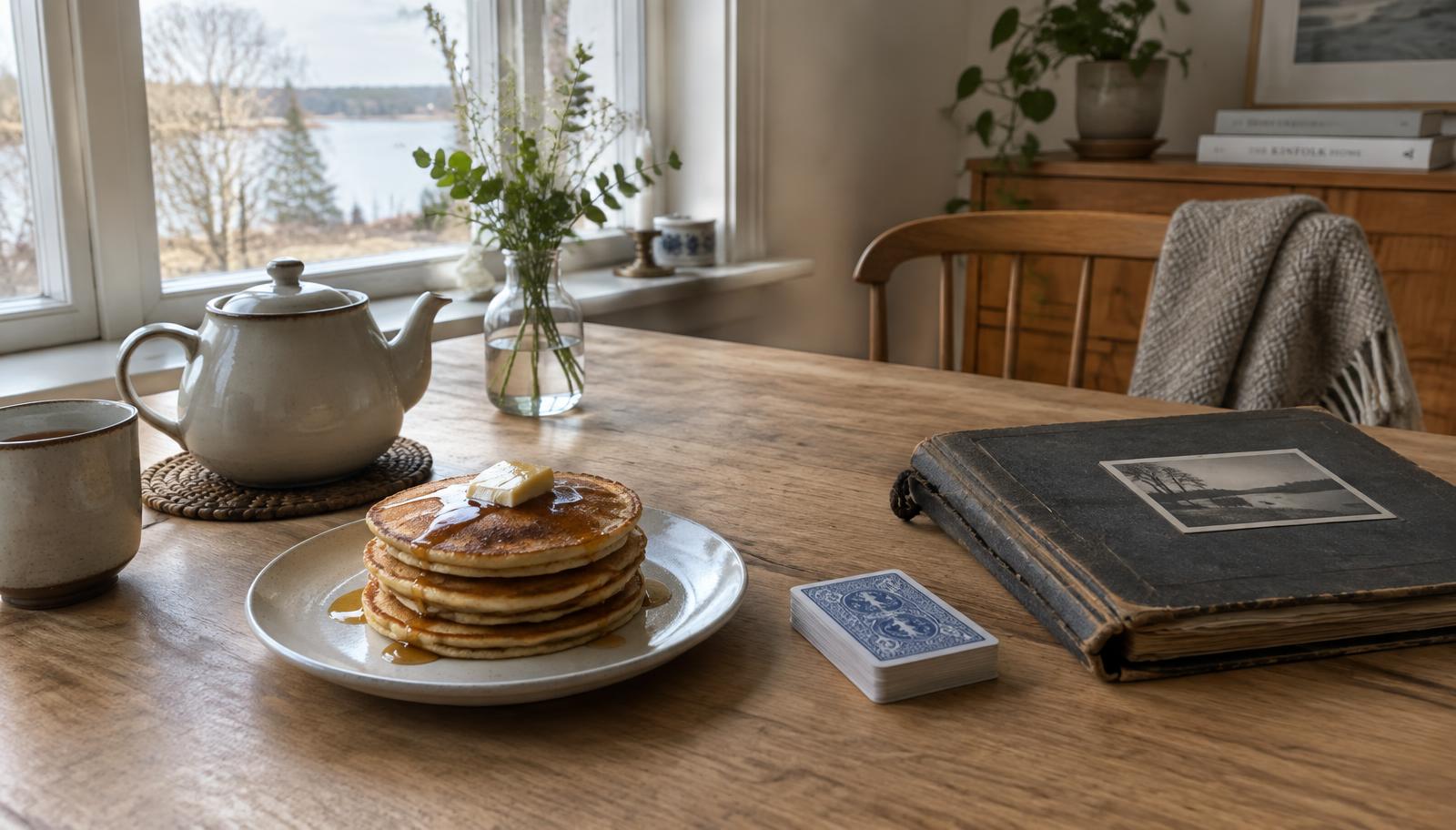
Look closely at almost any household and you'll find a few already. Saturday pancakes. Friday cocoa. An after-school snack at the kitchen counter. Sitting on the porch in the evening. Walking the dog. Making pizza together. A stop at the bakery on the way home. Sunday breakfast.
Others involve people outside the house: tea with a grandparent, or calling Grandma or Grandpa on the same evening each week. Some are almost invisible — listening to music together in the car, a short walk after dinner, sitting together for a few minutes after practice, sharing fruit at the counter, or a quiet few minutes before everyone heads off in separate directions.
None of these is impressive, and that's rather the point. The ritual doesn't need to be impressive. Ordinary can be enough. What gives it meaning is that it gives a family a repeatable moment — a small, predictable opportunity to be in the same place. A family fika is one version of this, but by no means the only one.
How to Create a Small Family Ritual
You don't need a plan to start. But if it's helpful, a few gentle principles tend to keep rituals easy rather than effortful.
1. Choose an ordinary moment.
Attach the ritual to something that already happens — coming home, a weekend morning, the end of dinner. It is easier to add a little intention to an existing moment than to invent a new one.
2. Keep it simple.
The simpler it is, the more likely it is to last. A snack and five minutes will usually outlive an elaborate production.
3. Make participation flexible.
Some people will join fully, some partly, some not at all on a given day. Someone might read nearby, help in the kitchen, or come for the snack and leave. That flexibility is part of what keeps a ritual welcome rather than required.
4. Let children help shape it.
Children often have good ideas about what would feel fun — which snack, which song, which route for the walk. When they help shape it, the ritual belongs a little more to everyone.
5. Repeat it when it works.
There's no need to commit to a schedule. If something felt good, try it again. Repetition is what lets a moment become familiar.
6. Allow it to change as children grow.
The after-school cocoa of a seven-year-old may become a late-evening snack with a teenager, or stop altogether. Rituals that change with a family tend to fit better than rituals that are held fixed.
Fika With Grandparents
Fika-inspired pauses can work especially naturally across generations. A grandparent's kitchen table, a pot of tea, and something small to eat can provide a setting where children and older adults spend unhurried time together without needing a reason.
The activities can be very simple: sharing a snack, baking something, looking through photographs, playing cards, sitting outside, taking a short walk, telling a funny story, or working on a small project together. Doing something side by side often makes conversation easier than sitting face to face — and makes quiet feel comfortable.
There's no need to encourage children to ask grandparents for their life story or personal history, or to talk about feelings. If stories come up naturally, lovely. If the afternoon is mostly cards and cookies, that's lovely too. Grandparents, like everyone else, can share as much or as little as they choose.
“Connection is an invitation, never an obligation.”
When the Ritual Doesn't Happen
Some weeks the pancakes won't get made. The walk will be rained out, practice will run late, someone will be sick, or everyone will simply be too tired. Missing a day or a week is not failure.
This is not a habit streak, and there's nothing to keep count of. Families change. Schedules change. Children grow. A ritual that fit well one year may not fit the next, and letting it go — or letting it become something else — is part of how rituals work.
A useful ritual serves the people taking part. If it starts to feel like another obligation, another thing to feel guilty about, it is fine to loosen it, pause it, or choose something different. And if you'd like a few low-pressure ways to open conversation during these moments, see conversation starters for family fika.
Start With Something Your Family Already Does
You probably don't need to invent anything. Start with something your family already does.
Over the next few days, notice one existing moment — a snack, a car ride, a meal, a walk — that could simply be treated with a little more intention. Maybe that means sitting down instead of standing, putting a phone aside, or lingering a minute longer. Nothing more is required.
Continue Your Fika Journey
Learning about fika is only the beginning. The real transformation happens when you practice it. Explore daily reflections, conversation prompts, kindness challenges, and meaningful connection activities inside Fika Pause.
Keep going
Continue Learning
Recommended Series
You May Also Like
Families
The Family Fika: A Simple Ritual for Slowing Down Together
A family fika is a few minutes when people stop what they are doing and make room for conversation, listening, or simply being together. What it can look like, and why it doesn't need to be elaborate.
Families
Beyond “How Was Your Day?”: Conversation Starters for Family Fika
Specific, playful, and choice-based questions that give children and adults an easier place to begin — without interrogating anyone or asking for personal disclosure.
Human Connection
Shared Rituals: Why Simple Traditions Create Stronger Relationships
Shared rituals are repeated experiences that create opportunities for connection, trust, belonging, and shared meaning. An evidence-informed guide to why simple, everyday traditions strengthen families, friendships, workplaces, and communities — and how to begin one of your own.
Newest Guides
Families
Beyond “How Was Your Day?”: Conversation Starters for Family Fika
Specific, playful, and choice-based questions that give children and adults an easier place to begin — without interrogating anyone or asking for personal disclosure.
Families
The Family Fika: A Simple Ritual for Slowing Down Together
A family fika is a few minutes when people stop what they are doing and make room for conversation, listening, or simply being together. What it can look like, and why it doesn't need to be elaborate.
Popular Guides
Understanding Fika
What Is Fika? The Swedish Tradition That Can Improve Your Relationships
Discover the meaning of fika, the Swedish tradition of slowing down to connect over coffee, conversation, and community—and how to practice it every day.
Understanding Fika
The Meaning of Fika: More Than Coffee, More Than a Break
Discover the true meaning of fika and why this Swedish tradition is about slowing down, building relationships, and creating meaningful moments together.
Understanding Fika
How to Practice Fika Every Day: A Simple Guide
Learn how to practice fika every day with simple ideas for home, work, school, and community. Discover how small daily pauses create stronger relationships.