Human Connection
IntermediateShared Rituals: Why Simple Traditions Create Stronger Relationships
Shared rituals are repeated experiences that create opportunities for connection, trust, belonging, and shared meaning. An evidence-informed guide to why simple, everyday traditions strengthen families, friendships, workplaces, and communities — and how to begin one of your own.
- Reading time
- 20 min
- Words
- ~4,900
- Sections
- 17
- Published
- July 27, 2026
- Updated
- July 27, 2026
Learning Goals
After reading this article you will:
- Define what a shared ritual actually is, in plain language.
- Distinguish rituals from routines, habits, and obligations.
- Understand why repetition and shared meaning strengthen relationships.
- See how rituals build trust, belonging, identity, and memory over time.
- Recognize meaningful rituals already present in your everyday life.
- Design one small, sustainable ritual of your own this week.
Key Takeaways
- The difference between a routine and a ritual is intention — the same act, held with meaning, not complexity or expense.
- New traditions can begin at any age; repetition, not inheritance, is what turns a moment into a ritual.
- Shared rituals are repeated experiences that create predictable opportunities for connection.
- Rituals do not need to be religious, formal, or elaborate to shape a relationship.
- Families, friendships, workplaces, and communities all become more resilient through simple shared traditions.
- Small weekly or daily rituals often become the memories people carry across a lifetime.
- Fika is one lived example of a recurring relationship ritual, not the only one.
Series
Human Connection1 of 10 · ~203 min total
- Why Human Connection Matters: The Science, Meaning, and Everyday Practice of Belonging
- The Difference Between Being Around People and Feeling Connected
- The Science of Meaningful Conversations: How Great Conversations Build Trust, Belonging, and Lasting Relationships
- Belonging: Why Every Person Needs to Feel They Matter
- How Trust Is Built: Why Small Moments Matter More Than Big Gestures
- The Power of Listening: Why Feeling Heard Changes Everything
- Hospitality: How Simple Acts of Welcome Change Relationships and Communities
- Shared Rituals: Why Simple Traditions Create Stronger Relationships
- Creating Spaces Where People Feel Welcome: Designing Everyday Environments for Human Connection
- The Ripple Effect of Human Connection: How Small Acts Change Families, Communities, and Lives
Introduction
Ask people to describe the moments that hold their most important relationships together, and they rarely name the extraordinary ones. They name the ordinary ones done many times. The Sunday phone call. The walk after dinner. The Friday pizza. The birthday breakfast that has quietly happened for twenty years. The coffee at the same café, with the same friend, on roughly the same morning of the week.
These small repeated moments have a name. They are shared rituals. And they may be the most underrated force in human relationships.
A shared ritual is a repeated experience two or more people undertake together with some sense of meaning. Its value does not come from complexity. It comes from consistency, participation, and the quiet understanding that this moment matters. Over time, that repetition builds trust, belonging, identity, stability, and memory in a way that grand gestures rarely can.
This article is an evidence-informed guide to why simple traditions strengthen relationships — and how to begin one that will actually last. We will draw on the Harvard Study of Adult Development, the U.S. Surgeon General's 2023 advisory on loneliness, Robin Dunbar's research on social eating, Barbara Fiese's decades-long work on family rituals, the sociological writing of Ray Oldenburg and Robert Putnam, and anthropological scholarship on ritual as a near-universal human practice. Along the way we will look at a small Swedish ritual called fika as one lived example — not because it is unique, but because it is a good one.
What Is a Shared Ritual?
A shared ritual is a repeated experience, done together, with meaning attached to the repetition itself. Three ingredients matter: it is shared (at least one other person is part of it), it is repeated (once is an event; many times is a ritual), and it carries some shared meaning (the participants recognize it as this thing we do).
By that definition, rituals are everywhere — often more places than we notice. A family that eats dinner together on Sundays has a ritual. Two friends who walk on Saturday mornings have a ritual. A workplace that pauses at 3 p.m. for coffee has a ritual. A couple that reads in bed for twenty minutes before sleep has a ritual. None of these are ceremonial. All of them are, quietly, ritual.
Anthropologists have long noted that ritual is a near-universal human practice. In Ritual and Religion in the Making of Humanity, Roy Rappaport described ritual as one of humanity's oldest technologies for creating shared meaning and social cohesion. That framing is useful because it takes ritual out of the purely religious register and lets us see it clearly in kitchens, offices, park benches, and cafés.
For our purposes, a ritual does not need to be sacred. It only needs to be shared, repeated, and recognized.
Rituals vs. Routines
Rituals and routines look identical from the outside. They are both repeated. The difference is inside the people doing them.
A routine is repetition for the sake of function. Brushing your teeth, commuting to work, loading the dishwasher. Routines are useful precisely because they do not require attention; that is what makes them efficient. A ritual, by contrast, is repetition for the sake of meaning. The same act — coffee at 3 p.m. — is a routine when done alone in a hurry between tasks, and a ritual when done with a colleague, on purpose, week after week.
The line between them is not the act. It is the intention.
This distinction matters because it means rituals are surprisingly available. You probably already have several routines that, with only a small shift in attention, could become rituals. A dinner eaten in parallel becomes a ritual when you agree to eat it facing each other. A drive to school becomes a ritual when you use the ten minutes to actually talk. Turning a routine into a ritual usually costs no time at all; it costs only the decision that this moment counts.
Related distinctions worth naming
- Habit vs. ritual. A habit is largely individual and often automatic. A ritual is shared and held with meaning. Habits change your behavior; rituals change your relationships.
- Celebration vs. ritual. A celebration is usually one-off and marks something. A ritual is repeated and shapes something. Both matter; they do different work.
- Tradition vs. obligation. A tradition is something you get to do. An obligation is something you have to do. Healthy rituals sit on the tradition side; when they slide into obligation they usually need to be redesigned or released.
- Repetition vs. monotony. Repetition, held with attention, feels like meaning. Repetition, held without attention, feels like monotony. The act is identical; the inner posture is not.
- Consistency vs. rigidity. Consistency is showing up most of the time. Rigidity is punishing anyone who misses. Rituals thrive on the first; they die of the second.
Why Humans Create Rituals
Human beings appear to be wired for repetition with meaning. Nearly every culture in recorded history has developed rituals around meals, greetings, seasons, births, deaths, work, and worship. Anthropologists argue this is not incidental. Rituals allow small groups to coordinate attention, communicate belonging, stabilize relationships across time, and make sense of the ordinary and the enormous alike.
At the psychological level, rituals do at least four useful things at once. They lower the cost of connection by removing the need to plan each time. They provide a container that holds emotion, whether that emotion is joy, grief, or simple companionship. They mark time in a way that raw calendars do not. And they build a shared story: a set of moments that participants recognize as ours.
Vohs and colleagues (2013) demonstrated experimentally that even short, arbitrary rituals meaningfully change how people experience shared moments — increasing attention, enjoyment, and perceived value. If that is true of invented rituals in a laboratory, it is even more true of the rituals people build, knowingly or not, over years of shared life.
“We are built for repetition with meaning. A shared ritual is simply a promise the calendar keeps for us.”
How Rituals Strengthen Relationships
Relationships are built by frequency, not by intensity. The most durable friendships and family bonds are almost never built on grand annual events. They are built on many small returns.
This is a quietly liberating finding. It means the average person, without unusual resources or free time, can build stronger relationships by choosing a very small thing and repeating it. A ten-minute weekly call. A shared walk. A monthly meal. A morning coffee. The magic is not in the moment; it is in the pattern.
A ritual also removes what might be the single largest tax on adult relationships: the cost of arrangement. Without a ritual, every meeting requires a new decision — when, where, whether. Each decision is friction, and friction quietly kills friendships. A ritual holds the answer in advance. It turns connection from something you have to organize into something that simply happens, again.
How Rituals Build Trust
Trust grows through small, reliable moments. That is exactly what a ritual provides: a scheduled series of small reliable moments. When a friend shows up at your door on Saturday mornings for a walk for the twenty-third week in a row, the walk itself is almost beside the point. What is being communicated is presence, over time.
The reverse also holds. When rituals quietly disappear — the weekly call that becomes monthly, then occasional, then nothing — trust tends to erode even if no one has done anything wrong. Not because the care is gone, but because its expression has stopped repeating.
This is one reason therapists who work with couples and families often ask about rituals early. It is a surprisingly reliable indicator of relational health. Not whether people love each other on paper, but whether they still return to shared moments together, again and again.
How Rituals Create Belonging
Baumeister and Leary (1995) framed belonging as a fundamental human need. Rituals are one of the most efficient ways human groups meet it. Each recurrence quietly answers the unspoken question every participant carries: Am I still part of this?
This is why children remember Sunday breakfasts twenty years later, and why adults describe standing weekly dinners with a friend as one of the most stabilizing forces in their life. It is not the food. It is the implicit message repeated every week: you are still one of us.
For a deeper treatment of this psychological need, see our companion article on why belonging matters. For our purposes here, it is enough to notice that when a group stops practicing its shared rituals, belonging almost always weakens, even if no one has left.
Family Rituals
Family rituals may be the best-studied kind. Barbara Fiese and colleagues, in a 2002 review synthesizing 50 years of research, found that consistent family rituals are associated with stronger family identity, better emotional adjustment in children and adolescents, healthier adolescent behavior, and higher relationship satisfaction in adults. The specific ritual varies wildly across families; what shows up again and again is that it is there, and that it happens.
Fiese and her colleagues carefully distinguish routines (instrumental, done for function) from rituals (symbolic, done for meaning). A weekly family dinner where everyone eats and leaves is a routine. A weekly family dinner where the same people gather, and where its absence would be felt, is a ritual. Their research suggests the ritual version does far more work than the routine version.
Family rituals can be very small. A special phrase at bedtime. Pancakes on Saturday. A song sung on the way to school. A candle lit at dinner on Fridays. What makes them count is not their scale but their recognizability — the fact that a child in that family could describe them, years later, as things we did.
“The rituals a child remembers were almost never the ones the family thought were important. They were the ones that repeated.”
Friendship Rituals
Adult friendships live or die by rituals more than most people realize. In childhood and adolescence, friendships are supported by shared institutions — schools, neighborhoods, teams — that provide almost automatic frequency. In adulthood, those scaffolds disappear. If nothing replaces them, even beloved friendships quietly attenuate.
A shared ritual is one of the most effective replacements. A standing monthly dinner. A weekly walk. A long-running book club, running group, or coffee date that both parties treat as protected time. The specific form matters far less than the fact that the calendar holds it.
This is why, when friends drift, the remedy is often not a dramatic reconciliation but the humbler act of proposing a small recurring thing. Would you want to have coffee every second Wednesday? Would you like to walk on Sunday mornings? Would you mind if I called every other Friday? The rituals people say yes to this year become the friendships that survive the next decade.
Community Rituals
Communities are held together by rituals too — often ones so ordinary they are invisible. The Tuesday morning market. The neighborhood coffee shop where regulars greet each other. The library storytime. The Friday evening pickup game. The block party that has happened every August for years.
Ray Oldenburg's The Great Good Place made the case that these recurring informal gatherings — often anchored in what he called "third places" — are foundational infrastructure for civic life. How welcoming those physical spaces feel shapes whether a ritual can take root there at all; see creating spaces where people feel welcome for more on that. Robert Putnam's Bowling Alone documented what happens when such places erode: declining trust, thinner friendships, more loneliness. The pattern travels across countries and decades.
The encouraging inverse is also true. Communities that deliberately build or protect simple recurring rituals — shared meals, weekly gatherings, neighborhood introductions, seasonal celebrations — tend to rebuild trust and belonging faster than expected. Community, in the end, is what happens when a place keeps repeating itself with the same people in it.
Shared Meals and Connection
Of all the rituals humans have invented, the shared meal may be the most durable. Nearly every culture has independently discovered that if you want people to become closer, you put them at the same table with food between them.
Robin Dunbar's 2017 study of social eating found that people who eat with others regularly report larger support networks, closer friendships, and greater life satisfaction than those who eat alone — regardless of what is served. Something about the shared act itself — the slower pace, the equal height at the table, the small courtesies of passing and pouring — moves relationships forward in a way conversation alone does not.
Notice that the meal does not have to be dinner, and it does not have to be elaborate. Toast counts. Coffee counts. A bowl of soup counts. What matters is the pause, the table (real or improvised), and the fact that two or more people chose to occupy it together, again.
Celebrations and Milestones
Some rituals mark the calendar rather than the week. Birthdays, anniversaries, holidays, seasonal gatherings, moments of transition. These milestone rituals are important, but it is worth naming what they do — and what they cannot.
Milestone rituals concentrate meaning into a single moment. They help groups mark change, acknowledge one another, and produce shared memory. But they cannot, on their own, carry a relationship through the rest of the year. That work is done by the smaller weekly and daily rituals in between.
The healthiest relational lives tend to have both — a rhythm of small everyday rituals that carry the year, plus a smaller set of milestone rituals that mark it. When only the milestones are present, the relationship often feels performative but distant. When only the everyday rituals are present, it can feel close but unmarked. The pair together does the fullest work.
Creating New Traditions
Many people assume traditions have to be inherited to count. They do not. A tradition is any ritual that has repeated long enough that it feels like ours. Every tradition in the world was, once, brand new.
Starting a ritual is almost always simpler than people expect. It usually looks like this: choose one small moment already available in your life (a meal, a walk, a call, a coffee). Invite one specific person. Agree, gently, to repeat it. Do it three times before you decide whether it works. Most rituals feel a little awkward at the beginning and meaningful only in retrospect.
Two design principles keep new rituals alive. Keep them simple — anything elaborate is fragile, and fragile rituals do not survive difficult seasons. Keep them flexible — a ritual that punishes missed weeks becomes an obligation and quietly dies. The rituals that last are the ones people are glad to return to, not required to attend. The workplace version of that same design problem — a shared pause that is still happening after a busy quarter — is worked through in workplace rituals that last.
How Fika Is a Relationship Ritual
Fika is one lived example of a recurring relationship ritual. It is not the only one, and it is not magical. It is offered here because it happens to illustrate almost everything this article has been describing.
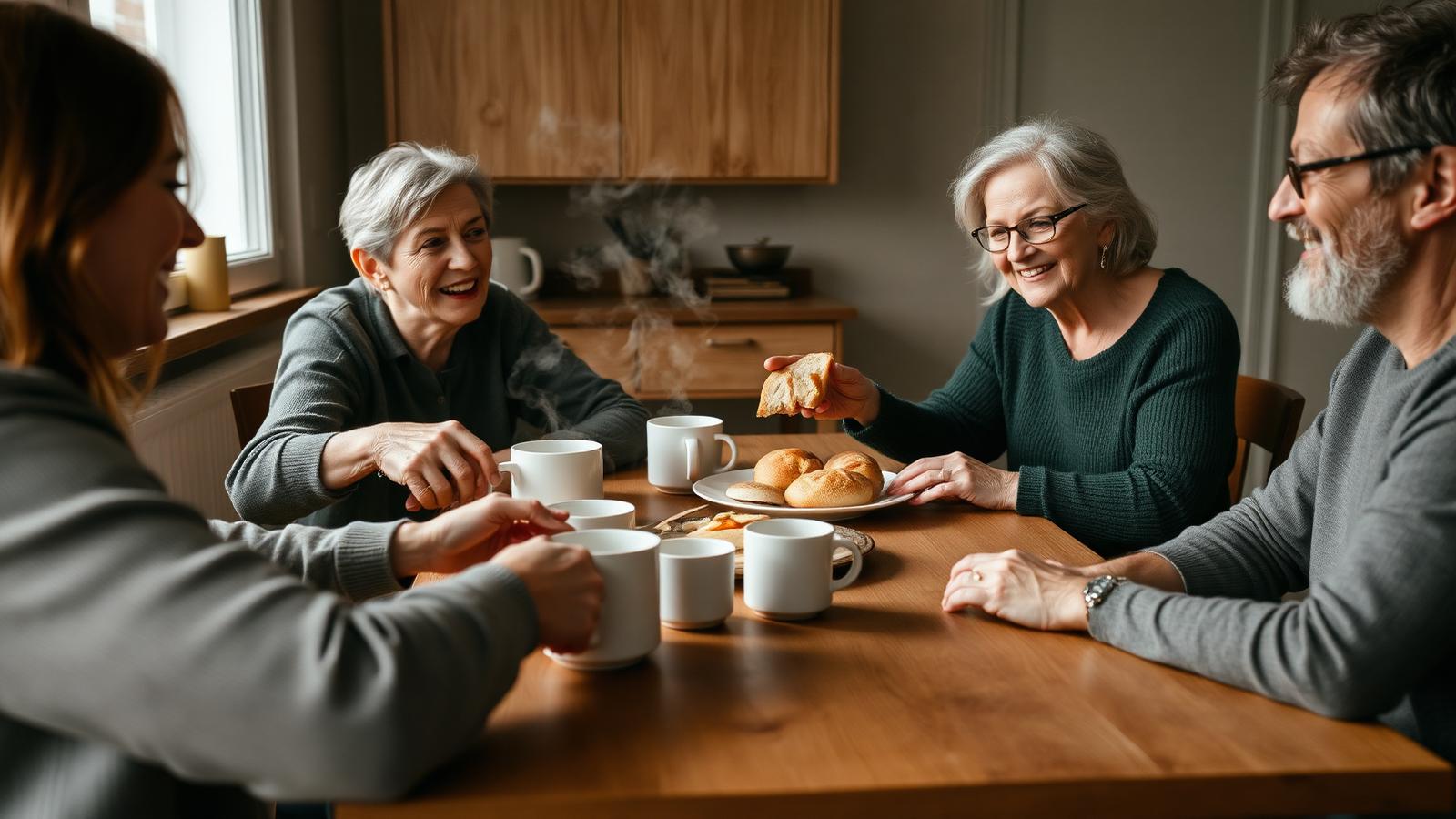
At its simplest, fika is a short shared pause — coffee or tea, often with something small to eat, taken in the company of others. It is repeated: at workplaces, most days; in homes, often weekly; in friendships, as a standing arrangement. It carries shared meaning without any ceremony: everyone understands that this is not just a break, it is fika. And it is astonishingly low-friction. A tired parent, an introverted friend, or a busy colleague can sustain it in a way more elaborate hosting rarely allows.
If you want to see what a durable relationship ritual looks like in one culture's daily life, read our guides on how to practice fika every day and the history of fika in Sweden. For a wider view of how everyday welcome sustains relationships, see hospitality and human connection.
We are careful not to overclaim. Every culture has its own recurring relationship rituals — the Italian passeggiata, the Middle Eastern coffee ritual, the American Sunday supper, the Japanese ochakai, and many more. Fika is one honest example, not a superior model.
Beginning Today
You do not need a new schedule or a new personality to build meaningful shared rituals. You need only two decisions: choose the moment, and repeat it.
Today, take a quiet inventory. Which moments in your week are already happening with other people — meals, walks, commutes, calls, coffees — that you could hold with a little more intention? Which relative, friend, or colleague would say yes if you proposed a small standing thing? Which routine already in your life is one attention shift away from becoming a ritual?
Here is the distinction that actually matters: an event happens once and is over. A ritual is one thing that repeats. So rather than planning a single dinner, a single outing, a single grand gesture, pick a moment already available to you and schedule its repeat — same person, same rough time, next week, on the calendar, before you have decided whether the first one was perfect. The relationship is built by the second and third time you show up, not the first.
Knowledge Check
Frequently Asked Questions
The FAQ below appears in the article's structured data and answers the questions readers most often ask about shared rituals, traditions, and everyday relationship practices.
Frequently Asked Questions
- What is a shared ritual?
- A shared ritual is a repeated experience that two or more people undertake together with some sense of meaning — a Sunday walk, a Friday dinner, a nightly check-in, a weekly coffee. Its power comes from consistency, participation, and the shared understanding that this moment matters, not from complexity or expense.
- What is the difference between a ritual and a routine?
- A routine is something you repeat because it needs doing (brushing teeth, commuting). A ritual is something you repeat because it means something. The same act — coffee at 3 p.m. — can be a routine when done alone in a hurry and a ritual when done with a friend, on purpose, week after week. Intention is the difference.
- Why do traditions matter?
- Traditions matter because relationships are built by repetition, not by intensity. A tradition offers a reliable moment when people can expect to be present with one another. Over time, those repeated moments accumulate into trust, belonging, memory, and a shared sense of identity that daily life alone rarely produces.
- Do rituals have to be religious?
- No. Anthropologists use 'ritual' to describe any repeated symbolic act, religious or not. A weekly family dinner, a Friday team lunch, a nightly bedtime story, a monthly walk with a friend — all are secular rituals. Religion is one important container for ritual; it is not the only one.
- How do rituals strengthen relationships?
- Rituals strengthen relationships by creating predictable opportunities for attention. You do not have to schedule connection each time; the ritual holds a space open. That predictability reduces friction, lowers the cost of showing up, and lets small moments of care accumulate into a stable relational pattern.
- Can friendships have rituals?
- Yes — and adult friendships often depend on them. Without a shared ritual (a weekly walk, a standing coffee, a monthly dinner), adult friendships tend to drift, not because people stop caring but because life keeps interrupting. A simple ritual quietly protects the friendship from that drift.
- How do family rituals affect children?
- Decades of research summarized by Barbara Fiese and colleagues (2002) associate consistent family rituals with stronger family identity, better emotional wellbeing in children and teens, and higher relationship satisfaction in adults. The specific ritual matters less than its consistency and the sense that it belongs to this family.
- What is the difference between a habit and a ritual?
- A habit is largely individual and often automatic. A ritual is shared and held with meaning. Habits change your behavior; rituals change your relationships. A person can have a coffee habit alone; two people share a coffee ritual together.
- Can I start a new tradition later in life?
- Yes. Rituals are made by repetition, not by inheritance. A tradition you start with your partner, friend, or child this month can become a decades-long fixture if you keep showing up for it. Many of the rituals people cherish most began casually and simply were not abandoned.
- What if my family or culture does not have strong rituals?
- That is more common than it sounds, and it is not a personal failure. Rituals can be inherited, adapted, or invented. What matters is that a small shared moment becomes recognizable — that people can say, 'this is what we do.' You can begin one this week.
- How is a ritual different from an obligation?
- An obligation is something you have to do; a ritual is something you get to do. When a tradition becomes purely obligatory, it often loses its meaning. Healthy rituals are held loosely enough that people can miss one without guilt, and returned to gladly rather than resentfully.
- Do rituals really need to be simple?
- Yes, if they are meant to last. Elaborate traditions tend to be brittle: one hard year and they collapse. Simple rituals — a Sunday call, a walk after dinner, a shared cup of something warm — survive stress, illness, distance, and busyness in a way complicated ones do not.
- How does fika function as a shared ritual?
- Fika is a recurring Swedish pause for coffee (or tea) and often something small to eat, taken in the company of others. It is one clear example of a low-friction relationship ritual: cheap, repeatable, unhurried, and inclusive. Its power comes from doing it often, not doing it well.
- What if we miss a week — is the ritual broken?
- No. A ritual is broken by giving up on it, not by missing one occurrence. A weekly call skipped during a busy season is easily resumed. Treat missed rituals gently — the point is the long pattern, not perfect attendance.
- How do workplaces benefit from shared rituals?
- Shared workplace rituals — a Monday check-in, a Friday close-out, protected coffee breaks, small welcomes for newcomers — improve psychological safety, team identity, and the felt sense that a workplace is humane. They are inexpensive interventions with outsized effects on trust.
- How do I begin?
- Choose one moment already available to you (a meal, a walk, a coffee, a phone call), invite one specific person, and agree to repeat it. Do it three times before deciding whether it works. Most rituals feel awkward at first and meaningful only in retrospect.
Sources & Further Reading
Research
Breaking Bread: The Functions of Social Eating
Robin I. M. Dunbar (Adaptive Human Behavior and Physiology, 2017)
Empirical evidence that eating socially — even simple, unplanned meals — is strongly associated with greater life satisfaction, closer friendships, and larger support networks.
Organization
The Harvard Study of Adult Development
Harvard Medical School
Long-running study consistently showing that the quality of close, responsive relationships — often maintained through small recurring practices — is central to lifelong wellbeing.
Research
Office of the U.S. Surgeon General (2023)
Public-health advisory naming ordinary community rituals as part of the infrastructure of social connection.
Research
The Need to Belong: Desire for Interpersonal Attachments as a Fundamental Human Motivation
Roy F. Baumeister & Mark R. Leary (Psychological Bulletin, 1995)
Foundational paper establishing belonging as a fundamental human need that recurring rituals quietly meet.
Research
The Meaning of Family Rituals: A Review and a Model of Family Symbolic Interaction
Barbara H. Fiese et al. (Journal of Family Psychology, 2002)
Comprehensive review of 50 years of research on family rituals and routines, showing consistent links to child wellbeing, family identity, and relationship satisfaction.
Book
The Great Good Place
Ray Oldenburg (Marlowe & Company, 1989; updated 1999)
Foundational work on 'third places' — the cafés, pubs, and gathering spots where recurring informal rituals sustain community life.
Book
Bowling Alone: The Collapse and Revival of American Community
Robert D. Putnam (Simon & Schuster, 2000; updated 2020)
Landmark analysis of declining social capital and the role of recurring shared traditions in rebuilding it.
Organization
American Psychological Association — Family Rituals & Relationships
American Psychological Association (APA)
Overview of psychological research on family and relational rituals.
Research
Kathleen D. Vohs, Yajin Wang, Francesca Gino & Michael I. Norton (Psychological Science, 2013)
Experimental evidence that even brief rituals meaningfully change how people experience shared moments — deepening attention and enjoyment.
Research
How Anthropologists Think About Ritual
Roy A. Rappaport, Ritual and Religion in the Making of Humanity (Cambridge University Press, 1999)
Anthropological framing of ritual as a near-universal human strategy for creating shared meaning and social cohesion.
On Fika Pause
On Fika Pause
On Fika Pause
On Fika Pause
On Fika Pause
On Fika Pause
On Fika Pause
On Fika Pause
Continue Your Fika Journey
Learning about fika is only the beginning. The real transformation happens when you practice it. Explore daily reflections, conversation prompts, kindness challenges, and meaningful connection activities inside Fika Pause.
Keep going
Continue Learning
Recommended Series
You May Also Like
Human Connection
Hospitality: How Simple Acts of Welcome Change Relationships and Communities
Hospitality is the practice of helping people feel welcomed, respected, comfortable, and included. An evidence-informed guide to what hospitality actually is, how it differs from entertaining, and the small everyday acts of welcome that quietly build trust, belonging, and community.
Human Connection
How Trust Is Built: Why Small Moments Matter More Than Big Gestures
Trust develops through repeated experiences of honesty, reliability, consistency, empathy, accountability, and follow-through. An evidence-informed guide to how trust actually grows in families, friendships, communities, and workplaces — and why the small everyday actions carry more weight than the dramatic ones.
Human Connection
The Power of Listening: Why Feeling Heard Changes Everything
Listening is one of the most powerful human connection skills. An evidence-informed guide to what real listening looks like, why our brains need to feel heard, why most people listen poorly, and the small daily habits that make anyone a better listener at home, at work, and in community.
Newest Guides
Families
Small Family Rituals: Making Room for Everyday Connection
Meaningful shared routines don't need to be elaborate, expensive, or picture-perfect. How to notice, shape, and keep small family rituals flexible — including fika with grandparents.
Families
Beyond “How Was Your Day?”: Conversation Starters for Family Fika
Specific, playful, and choice-based questions that give children and adults an easier place to begin — without interrogating anyone or asking for personal disclosure.
Families
The Family Fika: A Simple Ritual for Slowing Down Together
A family fika is a few minutes when people stop what they are doing and make room for conversation, listening, or simply being together. What it can look like, and why it doesn't need to be elaborate.
Popular Guides
Understanding Fika
What Is Fika? The Swedish Tradition That Can Improve Your Relationships
Discover the meaning of fika, the Swedish tradition of slowing down to connect over coffee, conversation, and community—and how to practice it every day.
Understanding Fika
The Meaning of Fika: More Than Coffee, More Than a Break
Discover the true meaning of fika and why this Swedish tradition is about slowing down, building relationships, and creating meaningful moments together.
Understanding Fika
How to Practice Fika Every Day: A Simple Guide
Learn how to practice fika every day with simple ideas for home, work, school, and community. Discover how small daily pauses create stronger relationships.