Understanding Fika
BeginnerThe Meaning of Fika: More Than Coffee, More Than a Break
Discover the true meaning of fika and why this Swedish tradition is about slowing down, building relationships, and creating meaningful moments together.
- Reading time
- 14 min
- Words
- ~3,400
- Sections
- 9
- Published
- July 3, 2026
- Updated
- July 3, 2026
Learning Goals
After reading this article you will:
- Trace the etymology of fika from early-20th-century Swedish back-slang to modern usage.
- Name the five values fika carries: presence, equality, hospitality, lagom, and belonging.
- Explain why fika resists translation and what that reveals about the tradition.
- Practice fika in a way that honors its meaning, not only its shape.
Key Takeaways
- Fika is both a noun and a verb — a pause, and the act of taking one, almost always shared.
- It doesn't translate cleanly into English because it names a value, not just a moment.
- The meaning of fika lives in its values: presence, equality, hospitality, moderation, belonging.
- Coffee and pastry are the stage set; the point is protected time with another person.
- The meaning of fika travels — you can practice it anywhere, with anyone, in fifteen minutes.
Series
Understanding Fika1 of 10 · ~150 min total
- What Is Fika? The Swedish Tradition That Can Improve Your Relationships
- The Meaning of Fika: More Than Coffee, More Than a Break
- The History of Fika in Sweden: Origins of a Beloved Tradition
- How to Practice Fika Every Day: A Simple Guide
- Why Fika Matters Today: Slowing Down and Connecting in a Busy World
- Common Misconceptions About Fika: What Fika Is — and What It Isn’t
- Fika vs. Coffee Break: What Makes Swedish Fika Different?
- Fika Around the World: How a Swedish Tradition Is Inspiring Connection Everywhere
- How to Host a Fika: A Simple Guide to Bringing People Together
- Fika Etiquette and Traditions: How to Show Up Well for a Swedish Pause
Introduction
Ask a Swede what fika means and you'll rarely get a tidy definition. You'll get a small smile, a pause, and then a story — about a grandmother's kitchen, a Tuesday at the office, a first date, a walk that ended at a bakery. The word slips easily into English sentences but refuses to sit still inside them. It looks, at first, like a coffee break. It is, on closer inspection, something quite different.
Fika (pronounced FEE-kah) is one of the most quietly influential words in Swedish daily life. It shapes how meetings are scheduled, how families mark the afternoon, how strangers become friends, and how a country famous for long, dark winters keeps a warm light burning through them. To understand fika, it helps to stop translating it and start listening to what it carries.
This guide is a slow walk into the meaning of fika — its etymology, the values it protects, and what the ritual actually signals when Swedes use the word. If you're looking for the shorter definition and a first practical shape, What Is Fika? is the better starting place. This piece assumes you already know what a fika looks like and asks what it means.
What Does Fika Really Mean?
At its most literal, fika is a Swedish word for a pause, usually taken with coffee or tea and something small to eat, usually in the company of another person. It is both a noun and a verb. You have a fika. You fika with a friend. You suggest fika the way an American might suggest grabbing a coffee, but with more weight — an invitation to sit, not to grab.
Etymologically, fika is a piece of Swedish back-slang first attested in writing around the early 20th century. It was built by reversing the syllables of kaffi, an older form of the Swedish word for coffee — an inside joke of a word that gradually became national vocabulary. That playful origin says something about the tradition: fika did not descend from an official ritual. It emerged from ordinary life, at kitchen tables and factory benches, and slowly earned its place in the language.
Over time, the word drifted away from its literal referent. Today, fika does not really mean coffee. It names the whole social event: the pause, the warmth, the company, the agreement that for the next fifteen minutes, no one has anywhere more important to be. Coffee is often present. It is no longer the point.
“En dag utan fika är ingen riktig dag. — A day without fika is not a real day.”
If you listen carefully to how the word is used, you'll notice a pattern. Swedes don't say "let's have a fika" the way one might say "let's grab a coffee." They say it more like an invitation to be present with each other for a small, agreed-upon moment. That subtle shift — from a beverage to a shared pause — is the whole of the meaning.
Why Fika Doesn't Translate Into English
Translators have tried. "Coffee break." "Coffee and cake." "A moment for coffee." None of them are wrong; all of them are thin. The trouble is that English has no single word for the specific thing fika names: a small, protected, shared pause that is treated as a cultural good in itself.
English tends to describe breaks in terms of what they interrupt (work, tasks, productivity) or what they contain (coffee, snacks, a cigarette). Fika does neither. It describes the pause as an event of its own — not a subtraction from the day but a small addition to it. That framing is what gets lost when the word gets rendered as "coffee break."
Words that resist translation often do so because they carry a value the target language hasn't named. Danish hygge, Japanese ikigai, Portuguese saudade, German Gemütlichkeit — all of them describe things English speakers experience but haven't bothered to name. Fika belongs to that family. It is not untranslatable because it is exotic. It is untranslatable because English never made room for a word that treats a shared pause as a small, dignified thing.
More Than Coffee, More Than a Break
The clearest way to understand fika is to understand what it is not.
Fika is not the paper cup you carry back to your desk. It is not the caffeine you drink while replying to Slack. It is not the ten minutes between meetings when you scroll your phone in the office kitchen. Those are things English already has words for. Fika is something else.
Fika, at minimum, involves:
- Stopping. The work is set down. Not paused with one eye on the inbox — actually set down.
- Sitting. A fika taken standing at the counter, coat still on, is barely a fika. Sitting says: I am here for a moment, on purpose.
- Company. Fika is almost always shared. You can fika alone with a book, and Swedes do, but the default assumption is that fika is a small social event.
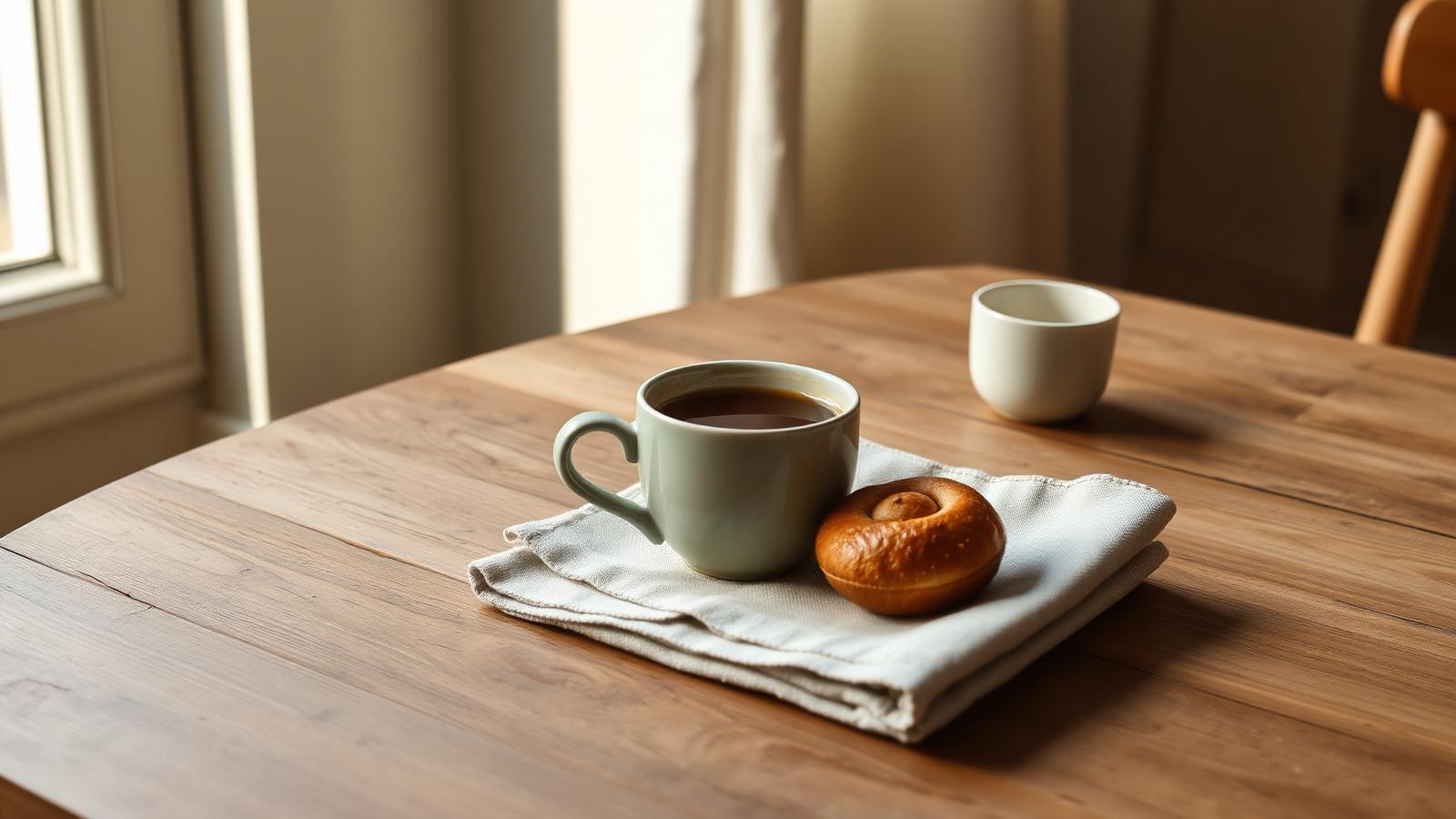
- A warm thing. Coffee, tea, cocoa, hot water with lemon. Warmth in the hands is part of the ritual — a signal to the body that the pace has changed.
- Attention. Phones face down. Laptops closed. Whoever is in front of you gets the next fifteen minutes.
None of these are dramatic. That is the point. Fika is not built out of grand gestures. It is built out of small, repeated agreements: that this moment matters, that this person is worth stopping for, that fifteen minutes of undivided attention is a real thing you can give someone.
The pastry — the iconic kanelbulle, the cardamom bun, the small square of dark chocolate — is a signal, not a requirement. It says: this is not fuel. This is a small treat, chosen on purpose, to mark that the pause is happening.
“The point of a fika is the pause, not the coffee. Everything else is stage set.”
The Values Behind Fika
The deeper you look at fika, the less it looks like a coffee break and the more it looks like a small, portable expression of Swedish values. Five of them show up almost every time:
1. Presence
Fika insists on being where you are. The phone goes down. The screen closes. For fifteen minutes, the person across the table is more important than any message that might arrive. In a culture that increasingly rewards split attention, this is a quietly radical stance.
2. Equality (jämlikhet)
In Swedish workplaces, everyone fikas together. The CEO, the intern, the visiting electrician, the new hire — same table, same coffee, same fifteen minutes. Fika flattens hierarchy without announcing that it's doing so. It is not team-building; it is simply the way the day is shaped.
3. Hospitality
To offer someone fika is to offer them your time. In rural Sweden, hosts historically served coffee with sju sorters kakor — seven kinds of cookies — as a mark of respect for a guest. The number was aspirational; the gesture was real. Fika is how Swedish hospitality happens on ordinary days.
4. Lagom (moderation)
Fika is enough, not too much. One cup, not three. A bun, not a buffet. Fifteen minutes, not an hour. The tradition carries the Swedish idea of lagom — "just right, neither too much nor too little" — into daily practice. A fika that turns into a two-hour meal is no longer a fika. Restraint is part of the design.
5. Belonging
Fika is one of the small daily inputs by which people become part of a place. Ring the bell, sit at the table, share the pause — and, over time, you belong to the group that sits at that table. It is the mechanism, at kitchen scale, by which a workplace becomes a community and a household becomes a family. For a broader look at how belonging is built from small, repeated acts, see Why Human Connection Matters More Than Ever.
Why the Meaning of Fika Still Matters Today
We live in a culture that has quietly stopped protecting its pauses. Meals happen at keyboards. Coffee arrives in disposable cups on the way to the next thing. Breaks, when they happen, are places we check messages rather than places we rest. The word "break" itself has come to mean, mostly, a shorter form of work.
Into that culture, fika lands with a small, clarifying force. It insists that a pause is not a gap between the real parts of the day. It is a real part of the day. It insists that the person across the table is not a distraction from your work but one of the reasons your work has any meaning. It insists that fifteen minutes of undivided attention is a gift you can afford to give and receive.
The evidence for why this matters keeps accumulating. Julianne Holt-Lunstad's meta-analyses have shown that strong social relationships are associated with roughly a 50% increase in the odds of longevity — an effect comparable to quitting smoking. The Harvard Study of Adult Development, one of the longest studies of human life ever conducted, has consistently found that the single strongest predictor of long-term wellbeing is the quality of a person's close relationships. Matthias Mehl's ambient-audio studies have found that people who report higher wellbeing spend more of their day in substantive conversation and less in purely superficial exchanges. Michael Norton and colleagues have shown that small, repeated rituals reduce anxiety and increase enjoyment of ordinary experiences.
None of that research is about fika, specifically. What it describes is the underlying architecture fika happens to embody: brief, regular, shared, low-stakes contact, inside a named ritual, with your attention actually in the room. That is one of the most reliable inputs to long-term wellbeing that we know of — and fika is one of the most portable ways to arrange it.
The meaning of fika, then, is not a nostalgic Scandinavian throwback. It is a small, practiced answer to a very modern problem: how to remain human in a day that would prefer you didn't stop.
“Fika is a small, practiced answer to a very modern problem: how to remain human in a day that would prefer you didn't stop.”
Notice the Values, Not Just the Moment
The real test of understanding fika isn't whether you can define it — it's whether you can spot the values underneath it as they happen. When a colleague waves you over instead of finishing an email, that's equality showing up. When a friend clears an hour on a hard week just to sit with you, that's presence and hospitality, not scheduling. Watching for these moments, rather than only performing the ritual, is how the meaning stays alive.
A few small, honest ways to practice noticing:
- Name the pause. Say it out loud, even to yourself: "I'm going to fika now." Naming turns a break into a ritual, and rituals are far more resistant to interruption.
- Pick a time that already exists. Mid-morning. Mid-afternoon. After school. Before dinner. Fika works best when it sits on top of a moment your day already has.
- Choose warmth. Coffee is traditional. Tea, cocoa, or hot water with lemon are all fair. Warmth in the hands is part of the practice.
- Invite one person. A colleague. A partner. A neighbor. A child. The invitation is often more important than the beverage.
- Watch for who slows down for you. Notice which people already treat your time as worth protecting — that instinct is fika's values in action, with or without the word.
- Stop when it's over. Fifteen unhurried minutes is enough. You do not have to earn the pause, and you do not have to extend it into a meal.
For a more detailed walk-through, see How to Practice Fika Every Day. For the history behind the ritual, see The History of Fika in Sweden. And if you're curious about how Fika Pause turns the tradition into a small daily practice you can actually sustain, see How to Practice Fika Every Day
Bring the ritual to your cup
Fika Spice™ is The Spice for Coffee™—a Scandinavian-inspired blend of nine real spices. The Fika Discovery Set™ includes one full-size bottle each of Original Fika Spice™ and Maple Sugar Fika Spice™.
Explore the Fika Discovery Set™Frequently Asked Questions
- What is the meaning of fika in Swedish?
- Fika means a shared, unhurried pause — usually with a warm drink and something small to eat, almost always in the company of another person. It is both a noun (a fika) and a verb (to fika). More deeply, it names a value: that connection, presence, and rest are worth stopping for.
- What does fika literally translate to?
- There is no clean English translation. The word is Swedish slang — attested in writing by around 1910 — built by swapping the syllables of kaffi, an older form of the Swedish word for coffee. But the meaning has drifted far beyond 'coffee' — fika now names the whole social ritual, not just the drink.
- Is fika just a coffee break?
- No — the coffee break is fuel; fika is a pause with intention. For the full side-by-side comparison of purpose, structure, and workplace context, see Fika vs. Coffee Break.
- Why is fika so important to Swedes?
- Because it protects something Swedish culture prizes: the small, egalitarian, unhurried moment. Fika is a daily reminder that people, relationships, and presence come before productivity — and that a workday that never pauses is not a well-lived workday.
- What values does fika represent?
- Presence, equality, hospitality, moderation (lagom), and belonging. Fika treats everyone at the table as equal, keeps things simple rather than showy, welcomes whoever is there, and gives the moment your full attention.
- Can non-Swedes practice fika?
- Yes. Fika needs a kettle, another person, and fifteen minutes you're willing to protect. The tradition was born in Sweden, but its meaning — pausing on purpose to be with someone — belongs to anyone who wants to practice it.
- How is the meaning of fika different from hygge?
- Hygge (Danish) describes a cozy atmosphere — candles, warmth, close company. Fika (Swedish) is the specific act of pausing together around a warm drink. Hygge is a quality of a room or a moment; fika is a small daily ritual.
Sources & Further Reading
Book
Fika: The Art of the Swedish Coffee Break
Anna Brones & Johanna Kindvall
A warm cultural and culinary introduction to fika, widely credited with popularizing the word outside Sweden.
Organization
Isof — Frågelådan: fika (etymology of the word)
Institutet för språk och folkminnen (Institute for Language and Folklore)
Sweden's official language and folklore institute on the back-slang origin of 'fika' from 'kaffi', attested from about 1910.
Organization
Sweden.se — Fika: a Swedish tradition
The Swedish Institute
Official cultural explainer from the Swedish Institute on how fika functions in daily life.
Research
Social Relationships and Mortality Risk: A Meta-analytic Review
Holt-Lunstad et al., PLOS Medicine (2010)
Meta-analysis linking strong social relationships to roughly a 50% increase in the odds of longevity.
Research
Eavesdropping on Happiness: Well-being is Related to Having Less Small Talk and More Substantive Conversations
Mehl, Vazire, Holleran, Clark, Psychological Science (2010)
Ambient-recording study linking substantive conversation to higher self-reported wellbeing.
Research
Rituals Enhance Consumption
Vohs, Wang, Gino, Norton, Psychological Science (2013)
Experimental evidence that small, repeated rituals increase enjoyment and meaning in ordinary experiences.
Organization
The Harvard Study of Adult Development
Robert Waldinger, Harvard Medical School
One of the longest studies of human life; consistently finds relationship quality predicts long-term wellbeing.
On Fika Pause
Continue Your Fika Journey
Learning about fika is only the beginning. The real transformation happens when you practice it. Explore daily reflections, conversation prompts, kindness challenges, and meaningful connection activities inside Fika Pause.
Keep going
Continue Learning
Recommended Series
You May Also Like
Understanding Fika
What Is Fika? The Swedish Tradition That Can Improve Your Relationships
Discover the meaning of fika, the Swedish tradition of slowing down to connect over coffee, conversation, and community—and how to practice it every day.
Understanding Fika
How to practice fika
Five simple steps to bring the Swedish tradition of fika into ordinary life — at home, at work, or alone.
Understanding Fika
Common Misconceptions About Fika: What Fika Is — and What It Isn’t
Learn the most common misconceptions about fika and discover why this Swedish tradition is about connection, presence, and intentional time together.
Newest Guides
Families
Small Family Rituals: Making Room for Everyday Connection
Meaningful shared routines don't need to be elaborate, expensive, or picture-perfect. How to notice, shape, and keep small family rituals flexible — including fika with grandparents.
Families
Beyond “How Was Your Day?”: Conversation Starters for Family Fika
Specific, playful, and choice-based questions that give children and adults an easier place to begin — without interrogating anyone or asking for personal disclosure.
Families
The Family Fika: A Simple Ritual for Slowing Down Together
A family fika is a few minutes when people stop what they are doing and make room for conversation, listening, or simply being together. What it can look like, and why it doesn't need to be elaborate.
Popular Guides
Understanding Fika
What Is Fika? The Swedish Tradition That Can Improve Your Relationships
Discover the meaning of fika, the Swedish tradition of slowing down to connect over coffee, conversation, and community—and how to practice it every day.
Understanding Fika
How to Practice Fika Every Day: A Simple Guide
Learn how to practice fika every day with simple ideas for home, work, school, and community. Discover how small daily pauses create stronger relationships.