Workplace
BeginnerWorkplace Rituals That Last: Building a Shared Pause Into the Working Week
Why most workplace rituals quietly die within a month, and what the surviving ones have in common — predictable, simple, optional, shared, repeatable. A practical guide to designing a shared pause that outlives a busy quarter.
- Reading time
- 17 min
- Words
- ~4,200
- Sections
- 23
- Published
- August 20, 2026
- Updated
- August 20, 2026
Learning Goals
After reading this article you will:
- Explain why most workplace rituals fail within weeks, and why the reason is design rather than enthusiasm.
- Recognise what actually counts as a workplace ritual — including the small unnamed ones already happening.
- Use the Fika Pause predictable–simple–optional–shared–repeatable framework to design or repair a ritual.
- Choose a shared pause that fits the real constraints of your week rather than an ideal one.
- Start a ritual without authority, budget, or a calendar invitation to the whole company.
- Keep a ritual alive through the first month and through a genuinely busy quarter.
- Adapt a ritual for remote, hybrid, and shift-based teams without turning it into another meeting.
- Notice when a ritual has become obligation, theatre, or decoration — and end it well.
Key Takeaways
- A workplace ritual lasts because it is easy to repeat, not because it is impressive. Effort per occurrence is the single best predictor of survival.
- Predictable, simple, optional, shared, repeatable is a Fika Pause editorial framework — a design checklist drawn from practice, not a validated model.
- Predictability removes the daily decision. A ritual that has to be proposed each time is not a ritual; it is a recurring negotiation.
- Optionality is not weakness. The moment attendance is compulsory, a pause becomes a meeting, and people start managing it rather than enjoying it.
- Ownership by one enthusiastic person is a failure mode. If the ritual disappears when that person is on leave, it was never shared.
- The shared pause — coffee, tea, ten minutes, no agenda — is the strongest default because it has almost no moving parts.
- Most rituals do not collapse dramatically; they decay by being skipped once during a busy week and never resumed. The recovery, not the streak, is what matters.
- A ritual makes informal contact easier. It cannot repair overload, distrust, unfair management, or a team that has no time at all.
Series
Workplace Connection1 of 9 · ~155 min total
- Why Connection at Work Matters: Belonging, Trust, and the Ordinary Moments Between Colleagues
- Belonging and Trust at Work: What Makes a Team Feel Safe to Be Yourself In
- How to Actually Talk to Your Coworkers: Everyday Conversation at Work
- Making People Feel Welcome at Work: Onboarding, First Weeks, and Everyday Hospitality
- Workplace Rituals That Last: Building a Shared Pause Into the Working Week
- Connection on Remote and Hybrid Teams: When Proximity Isn't Doing the Work
- Honest Conversations at Work: Feedback, Disagreement, and Repair
- Psychological Safety at Work: What It Is, What It Isn't, and How It's Built
- Building a Workplace Where People Want to Be: Putting Connection Into Practice
The Ritual That Nobody Cancelled
In most workplaces there is one small thing that keeps happening. It is rarely the thing anyone would name if asked about culture. It is the two people who always make tea at half past three. The Thursday walk that three colleagues take around the block. The habit on one team of spending the first four minutes of a call talking about nothing in particular before anybody opens the document. Nobody organises these. Nobody has ever put them on a slide. They survive quarters that killed the offsite, the innovation hour, and the fortnightly social.
Meanwhile, the deliberate attempts usually go the other way. Somebody proposes a monthly team lunch. It happens twice, beautifully. The third one is moved because of a deadline, the fourth is quietly not scheduled, and six weeks later nobody mentions it again. It was not disliked. People enjoyed it. It simply required a person to organise it, and that person eventually had a week where organising it was the eleventh most important thing they had to do.
“A workplace ritual does not last because it is impressive. It lasts because it is easy to repeat.”
This article is about that difference. Not about which rituals are meaningful — meaning is the easy part, and almost anything repeated becomes meaningful eventually — but about which ones are structurally capable of surviving an ordinary bad month. It is a design problem rather than a motivation problem, and the design principles are unglamorous. The rituals that last tend to be smaller, plainer, and less organised than the ones that die.
The rest of this series has made the case for connection at work and worked through the relationships involved: why any of it matters, belonging and trust between colleagues, everyday conversation with coworkers, and making people feel welcome. All of that depends on people being in each other's company often enough for anything to happen. A ritual is the least dramatic way to arrange that.
Why Most Workplace Rituals Die
It is worth being precise about the cause of death, because the usual diagnoses are wrong.
The first wrong diagnosis is that people did not care. In practice, the people who stopped attending are usually the same people who liked it. What changed was not their opinion but their week.
The second wrong diagnosis is that the ritual was not good enough — that with a better format, a nicer venue, a better facilitator, or an actual budget it would have survived. Almost the opposite is true. Every one of those improvements adds a dependency, and each dependency is a way for the ritual to fail. A monthly lunch depends on a booking, a budget line, and a calendar consensus among eight people. A shared coffee at three depends on a kettle.
The real cause is nearly always cumulative friction. Ask what has to be true for the ritual to happen one more time. If the answer includes a decision, a person, an approval, a room, or a message to the group, then the ritual has to be re-created weekly, and it will only be re-created for as long as somebody has spare energy. Spare energy is the first thing a busy quarter takes.
There is a useful distinction in the organizational literature between rites and ceremonials — the notable, staged, occasional events an organization performs — and the ordinary repeated practices that make up daily working life. Both are real. Only the second kind is cheap enough to happen fifty times a year, and it is the frequency, not the significance of any single occasion, that changes how a team feels to be part of.
What Counts as a Workplace Ritual
A workplace ritual, for the purposes of this article, is a small practice that a group repeats in roughly the same form at roughly the same time, whose purpose is not the production of anything.
Three boundaries follow from that.
It is not a meeting. Meetings exist to produce a decision, a plan, or shared information. When a pause acquires an agenda, a note-taker, or an expectation that something will come out of it, it has become a meeting with refreshments and will be treated as one.
It is not an event. The summer party, the quarterly offsite, and the leaving drinks are all worth having and none of them are rituals in this sense. They happen too rarely to become expected, and each one has to be organised from scratch.
It does not have to be named. Some of the most durable workplace rituals have never been given a title, and naming them can actually shorten their lives by making them official. The Thursday walk works partly because nobody has ever called it The Thursday Walk.
The broader question of what rituals do for people — why humans across every culture repeat small shared acts, and what those acts carry — belongs to Shared Rituals and Human Connection. This article assumes that case and takes on the narrower engineering problem: given that repeated shared practices matter, how do you build one at work that is still alive in November.
Durability Is the Whole Design Problem
Here is the shift in thinking that makes the rest of this practical. Stop asking whether a proposed ritual would be nice. Assume it would. Ask instead: what is the effort required for the fortieth occurrence?
Almost every workplace ritual is designed for its first occurrence. The first one is easy to make good, because someone is excited and has cleared time for it. The fortieth is the one that matters, and it will happen on a day when nobody has cleared any time at all, two people are off sick, and there is a deadline on Friday. A ritual that requires anything of that day will not survive it.
Work on organizational routines makes a related point in more formal language: a routine is not really the written rule but the accumulation of its actual performances, sustained by the people carrying it out. The description of a ritual is not the ritual. The fortieth performance is.
“Design for the fortieth time it happens, not the first. The first one always goes well.”
Research on habits points the same direction from the individual side. Behaviours repeated in a stable context come to be prompted by the context itself rather than by a fresh decision each time — the kitchen at three o'clock does the remembering, so nobody has to. That work is about individuals, not teams, and it is an analogy here rather than evidence about groups. But the design implication survives the translation: anything that requires a fresh decision every week will eventually not get one.
Predictable · Simple · Optional · Shared · Repeatable
The five properties below are a Fika Pause editorial framework — a design checklist assembled from practice and from what the rituals that survive appear to have in common. It is not a validated model, and no research reported here tests these five properties as a set. Treat it as a way of noticing where a ritual is likely to break.
Read it as a diagnostic. When a ritual dies, it almost always failed on one of these five, and it is usually possible to say which.
Predictable: It Happens Whether or Not Anyone Organises It
Predictability means the ritual has a fixed slot that nobody has to defend. Three o'clock on Wednesdays. The last fifteen minutes of Friday. Every morning when the shift changes over. The slot is doing enormous work: it removes the decision, it removes the invitation, and it lets people plan around it without thinking about it.
The test for predictability is whether the ritual happens when its most enthusiastic participant is on holiday. If it does not, what you have is a recurring negotiation with a friendly face on it.
Predictability is also what makes a ritual joinable. A newcomer cannot join something that happens when someone decides to propose it, because they will never be in the room when the proposal is made. They can join something that is simply known to happen at three.
A caution: predictable does not mean immovable. Rituals that survive tend to have a fixed default and a relaxed attitude to exceptions. If the room is busy, people stand somewhere else. If half the team is in a workshop, the two who are free still go. Rigidity looks like strength and is actually another dependency.
Simple: If It Needs Preparation, It Will Not Survive
The strongest single predictor of survival is how little has to happen beforehand. Every piece of preparation is a chance to fail, and preparation compounds: a ritual that needs a booking also needs someone to remember to book, someone to notice when the booking clashes, and someone to tell everyone about the change.
A practical rule: if the ritual cannot happen with five minutes' notice using only what is already in the building, it is too complicated.
This is where good intentions do the most damage. Someone suggests adding pastries, so now somebody buys pastries. Someone suggests a rotating host, so now there is a rota, and rotas need maintenance. Someone suggests a theme each week, so now the ritual has homework. Each addition is individually charming and collectively fatal.
The practitioner literature on designed workplace rituals tends in the opposite direction — towards deliberately constructed practices with distinct steps and symbolic props. Those can work, particularly for marking transitions like a project ending or a person leaving. For the ordinary weekly kind, the argument here is for radically fewer moving parts: the version with nothing in it is the version still running next year.
Optional: Attendance That Is Compulsory Stops Being a Pause
A pause that people must attend is not a pause. It occupies the same category in a person's mind as a status meeting, and it will be evaluated the same way — as a claim on time that must be justified.
Optionality has to be real, which means more than saying the word. It is undermined by attendance being noticed, by the manager commenting on who came, by a group photograph, by anything that turns presence into a signal. If skipping it has a social cost, it is not optional; it is compulsory with extra steps.
Real optionality also protects the people for whom the ritual is genuinely hard: the colleague who leaves at three for school pickup, the part-timer who is not in on Wednesdays, the person for whom a loud kitchen is exhausting, the person who is fasting, the person who simply does not want to and should not have to produce a reason. A ritual that quietly excludes those people while calling itself inclusive is worse than no ritual.
There is a counterintuitive consequence. Optional rituals often have better attendance over time than mandatory ones, because everyone present chose to be there and nobody is performing enjoyment. The relationship between attendance and pressure is covered further in Making People Feel Welcome at Work, which deals with the same tension when someone is new.
Shared: Nobody Owns It, Everyone Can Start It
Ownership feels like responsibility and functions like a single point of failure. If the ritual is Anna's coffee thing, then it happens as often as Anna has the energy for it, it stops when Anna is on leave, and it ends when Anna changes team. It also subtly becomes hers to be thanked for, which makes it a gift rather than a shared practice, and gifts are awkward to inherit.
Shared means two things. First, anyone can initiate it — the ritual belongs to the slot, not to a person, so whoever is nearest the kettle at three starts it. Second, nobody has to be thanked for it, because nobody organised it.
The practical move is deliberate redundancy from the beginning. Say out loud, early, that this is not yours: "I'm doing this at three, don't wait for me if I'm in a meeting." Then genuinely do not show up one week, and see whether it happens anyway. Nothing tells you more about a ritual's health.
“If the ritual disappears while you are on holiday, it was never a shared ritual. It was your hospitality, and hospitality does not scale.”
Repeatable: The Same Small Thing, Many Times
Repeatability is what the other four properties are for. What makes a ritual worth anything is not any single occurrence but the accumulation — the fact that you have stood in the same kitchen with the same four people forty times, and that somewhere in those forty times you learned that one of them is renovating a boat and another one hates the new process as much as you do.
Research on how coworker relationships develop points repeatedly to proximity, shared situations, and repeated contact as ordinary contributors to relationships broadening beyond the task. A ritual does not manufacture closeness. It supplies repetition, and repetition is the raw material closeness is made from.
This is why the small version beats the ambitious one so consistently. Ten minutes, forty times, is six and a half hours of unstructured contact with colleagues. A quarterly team lunch is four occasions a year, each one slightly performed, each one requiring organisation, and none of them producing the ordinary familiarity that the kitchen produces by accident.
Choosing a Ritual Worth Repeating
Most teams do not need to invent anything. The best candidate is usually something already happening informally, which can be made slightly more predictable without being made official.
Reliable candidates, roughly in order of durability:
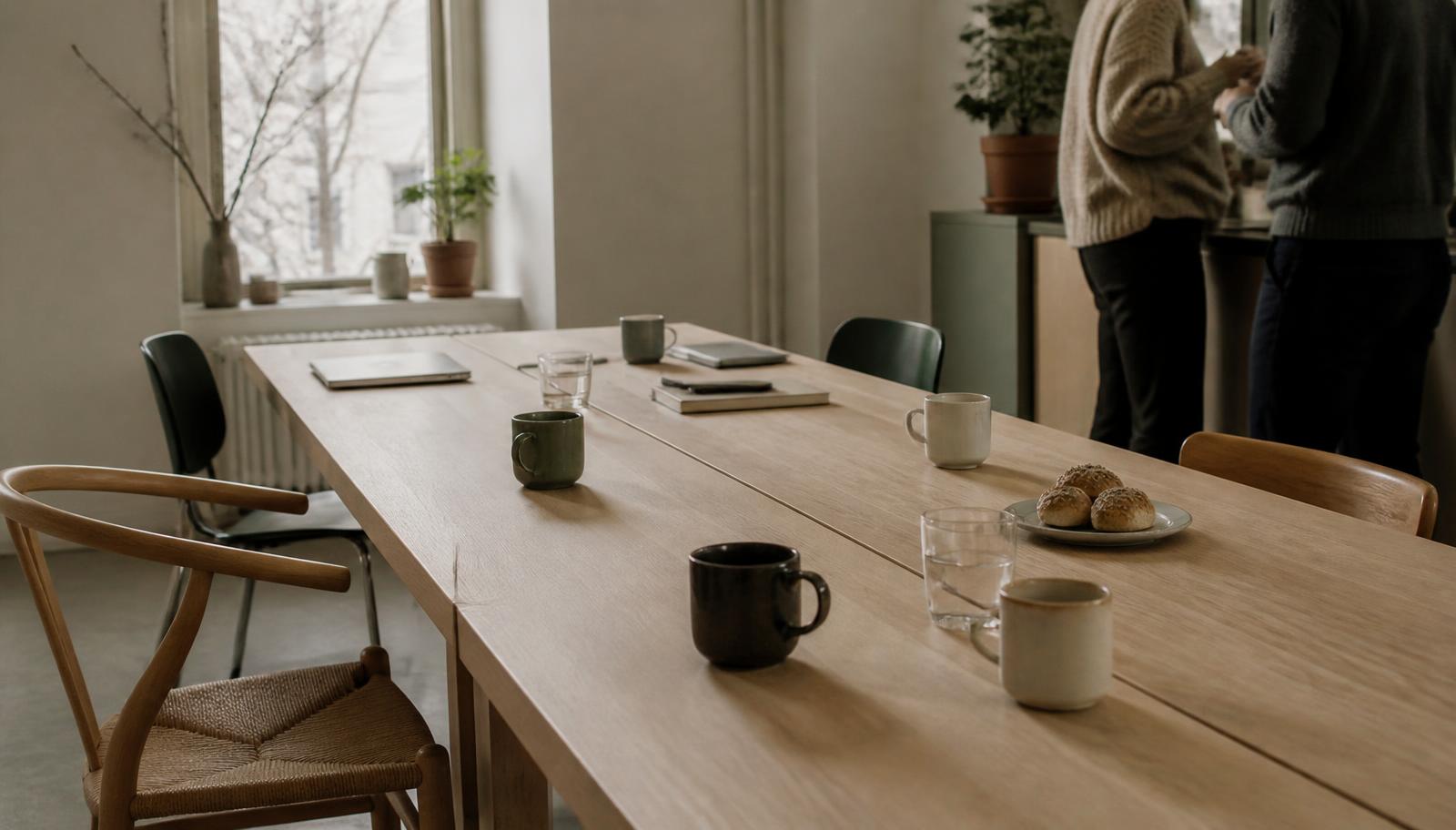
The shared pause. Coffee or tea, a fixed time, ten to fifteen minutes, no agenda. Almost no dependencies. Works in person, works badly over video unless kept very short.
The walk. A short loop outside at a fixed time. Free, healthy, and naturally limits itself. Weather-dependent, which is a real dependency, so it needs an indoor default.
The first five minutes. Not a separate ritual but a protected space at the start of an existing recurring call where nothing work-related is discussed. Zero additional time in the calendar, which makes it unusually survivable — though it dies instantly if anybody starts calling it a check-in exercise.
The shift handover pause. For teams that do not share an office day, the overlap between shifts is the only reliably shared moment there is. Ten minutes of it, kept deliberately non-operational, does more than any scheduled social.
The weekly bake or bring. Popular, warm, and structurally fragile, because it depends on somebody's labour and often somebody's money. It can work as an occasional layer on top of a durable ritual. It should never be the ritual itself.
Weak candidates share a family resemblance: they need a budget, an organiser, a booking, a format, or a facilitator. Anything requiring a slide is not a ritual.
The Shared Pause as the Default Choice
If you take one recommendation from this article, take the plainest one: a short shared pause at a fixed time, with nothing in it.
It scores well on all five properties almost by accident. It is predictable because it is attached to a clock rather than a plan. It is simple because the equipment is a kettle. It is optional because it is too small to be a formal occasion. It is shared because nobody can plausibly own the act of making coffee. It is repeatable because it costs nothing, in money or preparation, to do again tomorrow.
This is roughly what the Swedish workplace pause looks like in practice. The Swedish Institute's own description of fika treats it as an ordinary social practice observed at home, at work, and in cafés — a legitimate reason to set aside a moment, rather than a wellbeing initiative or a perk. Its usefulness at work comes precisely from being unremarkable. The comparison between this and a conventional coffee break, including what actually differs, is handled in Fika vs. Coffee Break, and the etiquette of it — who pours, how long it lasts, what is impolite — is covered in Fika Etiquette and Traditions.
Two claims that should not be made for it: that it improves performance, and that it fixes culture. Neither is supportable, and both are the kind of promise that gets a ritual mandated and then killed. The honest claim is smaller and still worth having. A shared pause makes informal contact more likely, more often, with less effort than any alternative.
How to Start One Without Authority
You do not need permission to take a break at a consistent time and be visibly available while you do it. That is the whole mechanism.
Start by doing it, not by proposing it. A proposal invites discussion, scheduling, and objections about workload. Doing it invites people to join. "I'm making coffee at three if anyone wants one" is a fundamentally different act from "shall we start a weekly team coffee?"
Pick the time first and the people second. Timing chosen to suit everyone suits nobody and takes three weeks to agree. Choose a plausible slot, accept that some people can never make it, and let the ritual belong to whoever is free.
Do it twice before mentioning it again. Two occurrences establish that this is a thing that happens rather than a thing that was suggested. Almost all the persuasion is done by repetition.
Invite sideways, not downwards. A general announcement to a channel produces polite silence. Saying it aloud to whoever is nearby, or mentioning it in passing to one person, produces attendance. This is the same dynamic described in How to Talk to Coworkers: the low-stakes, in-passing register is what makes an approach easy to accept and easy to decline.
Resist improving it. The first time someone enjoys it, there will be a suggestion to formalise it — put it in the calendar, add it to onboarding, get it a budget. Every one of those suggestions is well meant and most of them will shorten its life.
Surviving the First Month
The first four weeks have a characteristic shape, and knowing it prevents most premature abandonments.
Week one: nobody comes. Or one person does, briefly, and it is slightly awkward. This is normal and not informative. Go again.
Week two: someone asks what it is. The answer should be underwhelming. "Just coffee at three." Any grander answer creates an expectation the ritual cannot meet.
Week three: the first real conversation. Usually with one or two people, and usually about something unrelated to work. This is the ritual actually functioning.
Week four: it gets skipped. Something urgent lands. This is the decisive moment and it always arrives sooner than expected. The ritual is not decided by the streak; it is decided by whether week five happens.
The habit-formation literature is quietly reassuring here. In a field study of everyday habit formation, the time taken varied enormously between individuals, and missing a single occasion did not derail the process. Extrapolating from individuals to teams is loose, but the practical lesson holds: consistency over time matters, unbroken perfection does not.
Surviving a Busy Quarter
Busy periods do not kill rituals by making them impossible. They kill rituals by making them feel indefensible. Standing in a kitchen for ten minutes while a launch is behind schedule feels like something you should be able to justify, and most people would rather skip it than have to.
The two moves that work are both about shrinking rather than pausing.
Reduce the size, keep the slot. Five minutes instead of fifteen. Two people instead of six. Standing instead of sitting. The slot is the thing being protected, because the slot is what everyone's memory is attached to.
Never announce a suspension. "Let's pause this until things calm down" is how rituals end. It sounds responsible and it removes the default, and once the default is gone someone has to restart it — which requires exactly the organising energy that a busy quarter has consumed. Things also rarely calm down on schedule.
One genuine exception: if the team is in a period of real crisis — layoffs, a serious incident, a bereavement — a cheerful pause can feel grotesque. In those cases the honest thing is usually not to cancel it but to let it become quieter and smaller for a while. A shared pause during a hard period is often more valuable than during an easy one, provided nobody is required to be upbeat in it.
Rituals Across Distance and Shifts
Everything above assumes people are occasionally in the same place. Many teams are not, and the honest position is that distance makes this genuinely harder rather than merely different.
Three adaptations hold up reasonably well.
Attach it to something already recurring. The most durable remote ritual is usually the unhurried few minutes at the start of a call that already exists. It requires no new invitation and no new slot, which removes most failure modes at once.
Keep it shorter than feels right. Unstructured time over video is more effortful than in a kitchen; silence is heavier and exits are more conspicuous. Fifteen minutes in person is ten minutes on a call.
Do not compensate with format. Icebreakers, quizzes, and themed calls are the standard remote answer and they fail for the reasons already described: they need a facilitator, they need preparation, and they ask people to perform. A short optional call with nothing in it outlives all of them.
For shift-based and frontline teams, the overlap at handover is usually the only genuinely shared moment in the week, and it is worth protecting ten non-operational minutes of it more than it is worth inventing anything new. The wider problem of connection across distance and asynchrony is its own subject, taken up in Connection on Remote and Hybrid Teams.
Failure Modes: Mandatory Fun and Slow Decay
Two things go wrong, and they look nothing like each other.
Mandatory fun is the loud failure. A ritual is noticed by someone senior, approved of, and then promoted: it goes in the calendar for everyone, appears in the team charter, gets mentioned to candidates, and acquires a photograph. Attendance becomes visible, and visible attendance is compulsory attendance. What was a pause becomes a performance of a pause, and the people who liked it most are usually the first to stop coming.
The defence is to keep it slightly beneath institutional notice. Not secret — just not promoted. If a manager wants to help, the most useful thing they can do is attend occasionally, not mention who else did, and never put it on a slide.
Slow decay is the quiet failure and much more common. Nobody decides anything. It happens weekly, then most weeks, then when someone remembers, then it is a thing the team used to do. Decay is hard to notice from inside because no single week looks like the end.
The defence is a low-effort check: once a quarter, ask whether it happened last week. Not a review, not a retrospective — one question. If the answer is no twice running, either restart it deliberately or end it deliberately. Both are better than the drift.
When to Let a Ritual End
Not every ritual should be saved, and keeping one alive past its usefulness produces exactly the hollow corporate ceremony that makes people cynical about all of this.
Reasonable reasons to end one:
The team it was built for no longer exists. The time no longer suits anybody, and moving it properly would mean inventing a new ritual anyway. It has become obligation — people are attending to be seen. It has become theatre — it exists to demonstrate culture to outsiders. Or it has simply become dull, and everyone can feel it.
End it in plain language and without ceremony. "We haven't done Wednesday coffee in two months — shall we stop calling it a thing?" Naming the ending frees the slot and, more importantly, frees people from the low-grade guilt of a lapsed commitment. Teams that end rituals cleanly start new ones more readily.
What a Ritual Cannot Do
A weekly pause makes informal contact easier. That is the whole claim, and it is worth defending against inflation.
It cannot manufacture trust, which is built through what people do when something is at stake, as Belonging and Trust at Work sets out. It cannot create psychological safety, which is a team-level condition about the consequences of speaking up, not a function of how friendly the breaks are — that is the subject of Psychological Safety at Work. It cannot compensate for chronic overload; where there is genuinely no slack, a ritual is one more thing people are failing to do. And it cannot substitute for fair management. Where a workplace is unwell, offering a coffee break as a remedy is not neutral — it implies the problem was social when it was structural.
Held to its actual size, though, it is one of the few interventions available to someone with no authority, no budget, and no mandate. That is a rare combination, and it is why this article is in the series.
The Practice: The Four-Week Pause
Where to Go Next
This article deliberately kept its claims small and handed the larger ones elsewhere. Why any of this deserves time at work is argued by the series cornerstone, Why Connection at Work Matters. What rituals do for people in general — the anthropology rather than the logistics — is the subject of Shared Rituals and Human Connection. If you want the personal version of the same practice rather than the team version, How to Practice Fika Every Day covers it, and How to Host a Fika is the practical guide to hosting one occasion well.
The series continues with Honest Conversations at Work on feedback, disagreement, and repair where consequences are real, and closes with Building a More Human Workplace, the capstone that puts all nine pieces in order. The series page lists them in reading order.
Knowledge Check
Frequently Asked Questions
The questions below are the ones most often asked about starting and sustaining workplace rituals. Where the full answer belongs to another guide — shared rituals in general, fika etiquette, remote teams, or psychological safety — the answer here stays short and points to the article that owns it.
Frequently Asked Questions
- What is a workplace ritual?
- A small practice a group repeats in roughly the same way at roughly the same time — a Friday coffee, a Monday walk, the ten minutes at the start of a shift when nobody talks about work. It is different from an event, which happens once, and different from a meeting, which exists to produce something. A ritual's only job is to be repeated.
- Why do most workplace rituals fail?
- Almost always because they are too much work to repeat. They need someone to organise them, a booked room, a budget, an agenda, or a burst of enthusiasm. The first busy week removes the effort, and nothing brings it back. Rituals rarely die of dislike; they die of friction.
- How do you start a ritual at work if you are not a manager?
- Do the smallest version yourself, at the same time, twice, and mention it out loud rather than scheduling it. "I'm making coffee at three if anyone wants one" is a start. Repeat it the following week whether or not anyone came. Most durable rituals begin as one person's ordinary habit that other people are welcome to join.
- How long does it take for a workplace ritual to stick?
- There is no honest number, and research on individual habit formation found wide variation between people rather than a single threshold. A practical rule from experience: four consistent repetitions is enough for people to start expecting it, and it is expectation — not enthusiasm — that keeps it alive.
- Should attendance at a workplace ritual be mandatory?
- No. Required attendance converts a pause into a meeting, and people manage meetings rather than enjoy them. Optionality also protects the people for whom the ritual is genuinely difficult — carers, part-timers, people with sensory or social limits — without making them explain themselves.
- How often should a shared pause happen?
- Often enough to be expected, rarely enough to be easy. Daily works when it is genuinely short and requires nothing. Weekly is the safest starting point for most teams. Monthly is usually too infrequent to become a ritual at all — each occurrence has to be organised again, which is exactly the failure mode to avoid.
- What is the difference between a workplace ritual and a team-building event?
- Frequency and effort. A team-building event is exceptional, planned, often paid for, and asks people to behave unusually. A ritual is ordinary, unplanned each time, free, and asks people to behave normally. Events are remembered; rituals accumulate. Only one of them survives a bad quarter.
- Can a workplace ritual work on a remote team?
- Yes, but only if it stays short, optional, and camera-relaxed, and if it is not scheduled like a meeting with an agenda. The difficulty on distributed teams is not the ritual itself but the missing informal contact around it. Connection on remote and hybrid teams is a distinct problem and gets its own article later in this series.
- What should you do when the ritual gets skipped?
- Resume it. That is the whole answer, and it is harder than it sounds because the skip usually feels like evidence that it failed. It is not. In the individual habit literature, a missed occasion did not prevent the behaviour from continuing to strengthen. What ends a ritual is not the skip but the absence of the next one.
- Who should own a workplace ritual?
- Ideally nobody. If it depends on one enthusiastic person, it disappears the week they are on leave and it quietly becomes their event rather than the team's. The test is simple: could two other people start it in your absence without asking permission?
- Does a workplace ritual need a budget?
- No, and needing one is a warning sign. Anything that requires an approval, an order, or a receipt has a dependency that will eventually fail. Coffee people were going to make anyway, a walk around the block, or ten minutes in a kitchen costs nothing and therefore cannot be cut.
- How do you keep a ritual alive during a busy quarter?
- Shrink it rather than cancel it. Ten minutes becomes five; the whole team becomes whoever is free; the kitchen becomes two people standing by a window. A reduced ritual survives a busy period; a suspended one usually does not come back, because resuming requires the organising energy that made it fragile in the first place.
- How is workplace fika different from a normal coffee break?
- Mainly in intent: a coffee break is refuelling and can be solitary; a fika is a shared pause where the point is the pause and the company. The full comparison, including what Swedish workplaces actually do, belongs to Fika vs. Coffee Break.
- When should you end a workplace ritual?
- When it has become obligation, performance, or decoration — when people attend to be seen, when it is used to demonstrate culture to outsiders, or when the team it was built for no longer exists. Ending it plainly is better than letting it decay, and it leaves room for something the current team would actually repeat.
- Can a ritual fix a disconnected team?
- No. A ritual makes informal contact easier and more frequent, which is a real but modest thing. It cannot repair overload, unfair management, distrust, or a workload that leaves genuinely no slack. Where a workplace is unwell, a weekly coffee is not a treatment and should not be offered as one.
Sources & Further Reading
Research
Rituals in Organizations: A Review and Expansion of Current Theory
Gazi Islam & Michael J. Zyphur (Group & Organization Management, 2009)
Conceptual review of how rituals have been theorised in organizational life, including their role in marking transitions and expressing group membership. Used here to support the general claim that repeated symbolic practices are a recognised feature of organizations, not to claim any specific outcome for a coffee break.
Research
Studying Organizational Cultures Through Rites and Ceremonials
Harrison M. Trice & Janice M. Beyer (Academy of Management Review, 1984)
Foundational paper distinguishing rites, ceremonials, and rituals as observable cultural forms in organizations. Referenced for the distinction between an occasional ceremony and an ordinary repeated practice — a distinction this article leans on heavily.
Research
Reconceptualizing Organizational Routines as a Source of Flexibility and Change
Martha S. Feldman & Brian T. Pentland (Administrative Science Quarterly, 2003)
Theoretical account separating the abstract idea of a routine from its actual performances, and arguing that routines are sustained and altered by the people enacting them. Used for the claim that a ritual survives through repeated performance rather than through the rule that describes it.
Research
How Are Habits Formed: Modelling Habit Formation in the Real World
Phillippa Lally, Cornelia H. M. van Jaarsveld, Henry W. W. Potts & Jane Wardle (European Journal of Social Psychology, 2010)
Field study of everyday habit formation in which automaticity increased with repetition, with wide variation between individuals and no evidence that a single missed occasion prevented the habit from forming. Applied here at the level of an individual behaviour, as an analogy for group practice rather than as evidence about groups.
Research
A New Look at Habits and the Habit–Goal Interface
Wendy Wood & David T. Neal (Psychological Review, 2007)
Theoretical review describing how repeated behaviour in stable contexts becomes cued by the context itself rather than by deliberate intention. Used to support the design argument that a fixed time and place carries a ritual further than motivation does.
Research
From Coworkers to Friends: The Development of Peer Friendships in the Workplace
Patricia M. Sias & Daniel J. Cahill (Western Journal of Communication, 1998)
Interview-based study describing proximity, shared work, and repeated contact as common contributors to how coworker relationships broaden. Cited for the modest point that repetition is what a ritual actually supplies.
Research
Kathleen D. Vohs, Yajin Wang, Francesca Gino & Michael I. Norton (Psychological Science, 2013)
Experimental studies in which performing a short ritualised sequence before eating or drinking changed how the experience was evaluated. Included as evidence that small ritualised behaviours are studied seriously; the effects reported are about individual experience in laboratory settings and are not transferred to workplace outcomes here.
Article
Kursat Ozenc & Margaret Hagan (Wiley, 2019)
Practitioner book cataloguing designed workplace rituals. Used as a reference point for the design view of rituals — that they can be deliberately shaped — while this article argues for far fewer moving parts than most designed rituals carry.
Article
Swedish Institute (sweden.se)
Official Swedish Institute description of fika as a social practice observed at home, at work, and in cafés. Used for the cultural claim that the workplace pause in Sweden is ordinary rather than exceptional.
Continue Your Fika Journey
Learning about fika is only the beginning. The real transformation happens when you practice it. Explore daily reflections, conversation prompts, kindness challenges, and meaningful connection activities inside Fika Pause.
Keep going
Continue Learning
You May Also Like
Workplace
Making People Feel Welcome at Work: Onboarding, First Weeks, and Everyday Hospitality
How new employees and colleagues actually come to feel welcome — not through one good first day, but through introductions with context, explained norms, a second invitation, and ordinary inclusion that continues after the novelty fades.
Workplace
Why Connection at Work Matters: Belonging, Trust, and the Ordinary Moments Between Colleagues
Why work often feels transactional even when you are surrounded by people, what connection at work is actually made of, and what an individual can realistically influence without authority.
Human Connection
Shared Rituals: Why Simple Traditions Create Stronger Relationships
Shared rituals are repeated experiences that create opportunities for connection, trust, belonging, and shared meaning. An evidence-informed guide to why simple, everyday traditions strengthen families, friendships, workplaces, and communities — and how to begin one of your own.
Newest Guides
Families
Small Family Rituals: Making Room for Everyday Connection
Meaningful shared routines don't need to be elaborate, expensive, or picture-perfect. How to notice, shape, and keep small family rituals flexible — including fika with grandparents.
Families
Beyond “How Was Your Day?”: Conversation Starters for Family Fika
Specific, playful, and choice-based questions that give children and adults an easier place to begin — without interrogating anyone or asking for personal disclosure.
Families
The Family Fika: A Simple Ritual for Slowing Down Together
A family fika is a few minutes when people stop what they are doing and make room for conversation, listening, or simply being together. What it can look like, and why it doesn't need to be elaborate.
Popular Guides
Understanding Fika
What Is Fika? The Swedish Tradition That Can Improve Your Relationships
Discover the meaning of fika, the Swedish tradition of slowing down to connect over coffee, conversation, and community—and how to practice it every day.
Understanding Fika
The Meaning of Fika: More Than Coffee, More Than a Break
Discover the true meaning of fika and why this Swedish tradition is about slowing down, building relationships, and creating meaningful moments together.
Understanding Fika
How to Practice Fika Every Day: A Simple Guide
Learn how to practice fika every day with simple ideas for home, work, school, and community. Discover how small daily pauses create stronger relationships.